A trade, not a straightforward gift
Older people are widely expected to be more cautious than younger ones — slower to take a risk, quicker to sound a warning. This isn't just a stereotype. Risk tolerance genuinely tends to decline with age, for reasons that are partly hormonal and partly something much simpler: decades spent watching what risk actually costs.
One explanation for why this pattern might exist at all, specifically in humans, is known as the grandmother hypothesis. It suggests that people past their own reproductive years contribute to a group's survival not by having more children themselves, but through guidance, resource-sharing, and support for the young — help calibrated by decades of experience about what's actually risky and what only looks that way. It's one proposed reason humans, along with orcas, have such an unusually long life after their reproductive years have ended.
There's a related distinction from cognitive science worth knowing here too. Researchers separate what's called crystallised intelligence — accumulated knowledge, pattern recognition, good judgement — from fluid intelligence, which is more about raw processing speed and solving completely new problems. Crystallised intelligence tends to hold up well with age, sometimes even improving. Fluid intelligence tends to decline. Put simply: older people are often slower with something genuinely new, but faster and more reliable at spotting when something "new" is actually an old pattern wearing a different outfit.
That's the wisdom side of the ledger, and it's real. But it isn't the whole picture.
The cost that comes with the same trait
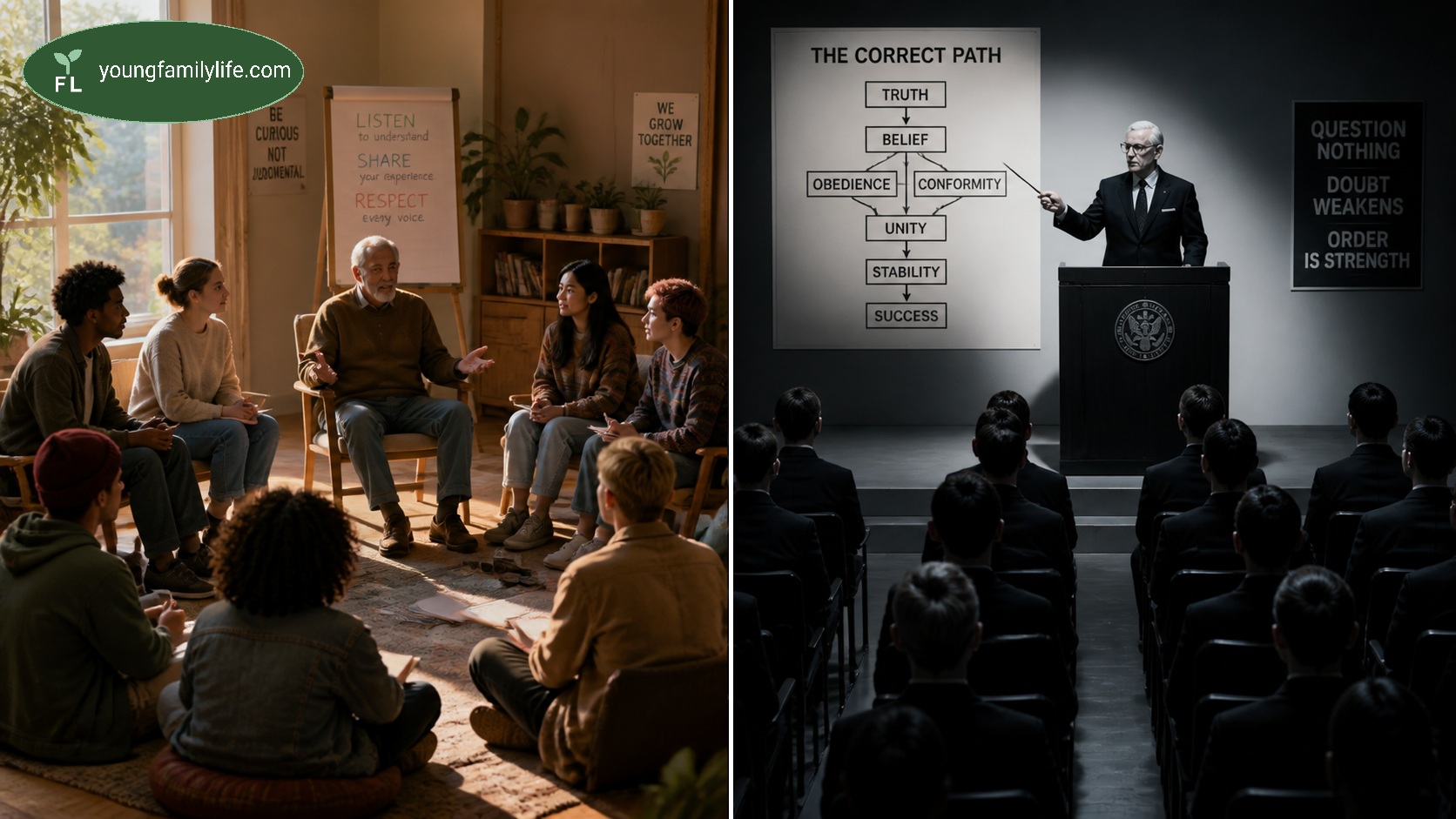
The exact same thing that builds wisdom can also calcify into something far less useful. A lifetime of experience creates a genuinely valuable pattern-library — but a pattern-library can turn into a fixed lens, filtering out anything new rather than genuinely evaluating it. Confidence built from a long track record of having been right can slowly harden into certainty that's stopped checking itself.
This is the honest, less comfortable half of "elder wisdom." Age doesn't only sharpen judgement. Left unchecked, it can just as easily entrench it — turning what was once careful, earned caution into something closer to reflexive resistance to anything unfamiliar.
Why it doesn't happen the same way to everyone
Here's the part that's easy to miss: ageing doesn't push every person toward the same outcome. Some people become genuinely wiser with age. Others become more rigid. Both are real, common patterns — and which one shows up in a given person has less to do with how many years have passed, and more to do with something that was already true about them decades earlier.
There's a well-established pattern, observed across many social species — ants, fish, birds, and humans among them — where a population reliably splits into roughly two groups: a smaller portion, often estimated around 20%, who explore, take risks, and break from established patterns, and a much larger portion who maintain and follow them. This split seems to function as a kind of built-in balance for a group as a whole, and it runs completely independently of age.
That means two separate things are happening to a person as they get older: an age effect, pulling everyone toward more caution, and a type effect — whether someone was naturally a risk-taker or a rule-follower — that doesn't disappear just because time has passed. The two interact. Someone whose disposition already leaned cautious at twenty-five gets that caution reinforced by decades in which it appeared to have been proven right — which is exactly the calcification pattern described above. Someone whose disposition leaned toward exploring and challenging things at twenty-five is far more likely to keep doing that at seventy, because that underlying disposition is actively pulling against the general pull of age toward caution, not adding to it.
What wisdom and dogma actually are, underneath
This is worth connecting to an idea raised elsewhere in this collection: the ongoing scientific argument between physiologist Denis Noble and biologist Richard Dawkins about where meaningful biological information actually lives. Dawkins's view puts genes at the centre. Noble's counter-view is that no single level — gene, cell, or whole organism — has sole claim to that role; living systems work through constant interaction between many levels at once, each shaping the others.
Wisdom and dogma are both, in a sense, information — patterns built up over a lifetime and available to be passed on to whoever comes next. Neither one lives in DNA. Both live in something closer to what Noble describes: a system that keeps adjusting itself in response to new information, or one that's stopped. Wisdom, on this account, is a system still doing its job — still updating, still checking new situations against the pattern-library rather than just filing them away as already-known. Dogma is the same system after it's effectively frozen — still confident, still authoritative-sounding, but no longer genuinely responsive to anything new coming in. From the outside, both can look like "an older person with strong opinions." The difference is whether the system behind those opinions is still alive to new information, or has quietly stopped being.
What this actually predicts
Put together, this gives a genuinely useful, non-obvious answer to a common question: does getting older make someone wiser, or does it make them set in their ways? The honest answer is that it does neither, uniformly. It depends heavily on which type of person they already were, long before age had the chance to reveal it. An old rule-breaker and an old rule-follower aren't ageing into the same place at all — even though, from the outside, "an older person with strong opinions" can look identical either way.
This piece pulls from the fifth section of the Repositorium essay Why Old? — of all things?, which explores this in fuller depth, including real-world illustrations of both outcomes.
Topics: #InOtherWords #Wisdom #Ageing #CognitiveScience #DenisNoble #RichardDawkins #WhyOld
Related YFL Content
Why Old? — of all things? — The full Repositorium essay behind this whole family — all six parts, with complete evidence and citations.
Hey!, Want To Know: How Dependent We Are on Decay? — The HWTK companion — decay as a generative process, from compost heaps to dying stars, in discovery-first form.
In Other Words: The Randomness Already Inside You — The physics of why a body doesn’t need bad luck to age — quantum tunnelling writing mutation into DNA.
In Other Words: Why Bigger Doesn’t Mean Greater Longevity? — Why the animal kingdom’s real longevity record-holders aren’t the biggest or most complex — dinosaurs included.
In Other Words: What Long Childhoods Are For — Why elephants, orcas, and beavers all pair long lifespans with long childhoods — and what that trade buys a species.
In Other Words: Entropy and Syntropy — The Same Universe, Two Directions — The bridge piece connecting this whole family directly to Syntropy and the Tag.
Syntropy and the Tag: The Accidental Prophecy of the Awful Popcorn Movie Hackers — the yin/yang companion essay this whole family sits alongside.
Copyright Notice
© 2026 Steve Young and YoungFamilyLife Ltd. All rights reserved.
All original content on YoungFamilyLife — including essays, articles, frameworks, and other written material — is the intellectual property of Steve Young and YoungFamilyLife Ltd, unless credited to another source. Content is developed collaboratively using AI assistance to research sources and refine structure, while all intellectual authorship, original insight, and professional expertise remain those of the author.
No part of this website may be reproduced, distributed, or transmitted in any form without prior written permission, except brief quotations for noncommercial use.
For permission requests, contact: info@youngfamilylife.com