A pattern too consistent to be a coincidence
Across the animal kingdom, one pattern shows up again and again in a small group of species: elephants, orcas, parrots, great apes, humans. These animals don't just live unusually long lives for their size and class. They also take an unusually long time to grow up.
That's not two separate facts sitting next to each other by chance. They're connected, and understanding how explains something genuinely useful about what a long life is actually for.
The trade a long childhood has to make
A long childhood is expensive, in the most literal biological sense. A young animal that spends years not reproducing, not fully capable, dependent on others for food and protection, is a cost the rest of the group has to carry. Evolution doesn't tend to preserve expensive arrangements unless they pay for themselves somehow.
Life-history researchers describe the answer through something called the embodied capital hypothesis: a long, costly, unproductive childhood only makes evolutionary sense if there's enough adult life left afterward to put everything learned during it to use. Skills, knowledge, judgement, social understanding — all of that takes years to build, and years spent building it are years not spent reproducing. The only way that investment pays off is if the animal then lives long enough afterward to actually spend what it accumulated.
This is why the two traits — long childhood and long adult life — show up together so consistently. A species can't really afford one without the other.
A rodent that proves the point
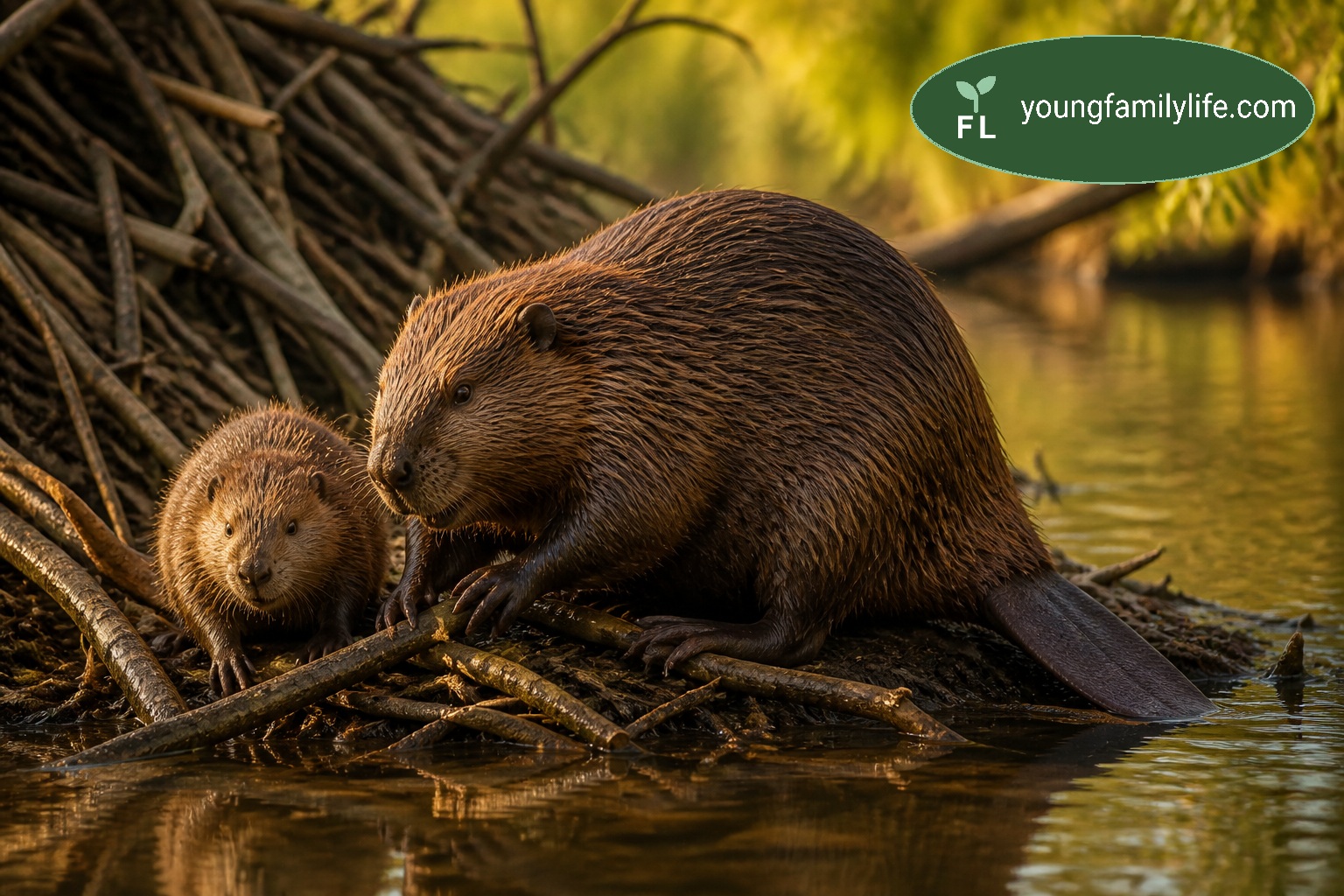
Beavers make a smaller-scale but genuinely clear example. In the wild, beavers typically live somewhere around 10 to 12 years — occasionally longer in especially safe or well-protected conditions — which is remarkable for a rodent roughly the size of a large housecat. Most rodents live nowhere near that long.
What beavers also do is spend one and a half to three years with their parents before becoming independent, learning dam-building, lodge maintenance, and how to navigate the social structure of their family group. That's a genuinely long apprenticeship for an animal that size. It isn't incidental. A beaver's survival depends on knowledge that has to be taught — which means it depends on the adults around it living long enough to actually teach it.
What this means for what "old" actually is
This changes what a long life is doing, once a species is genuinely social. The physical side of ageing — the slow accumulation of cellular damage covered elsewhere in this collection — doesn't stop happening in these animals. Their bodies still wear down at broadly the same pace physics and evolution would predict for something their size.
But there's a second process running alongside it, working in the opposite direction. While the body slowly loses ground, something else is being built and passed on: knowledge, skill, an understanding of how the group works and how to survive within it. Old age, seen this way, isn't simply decline overtaking a system that used to work better. It's closer to the tail end of a long-term strategy — one that trades a slower, more failure-prone body for the chance to hand down something a young, inexperienced animal couldn't have built on its own.
That reframes elephants living to 60 or 70, or a grandmother beaver still present in the colony years after her own breeding has ended, not as biology simply running down, but as biology finishing a job that started decades earlier — the long, expensive apprenticeship finally being repaid.
A live scientific argument this connects to
There's a genuine, ongoing debate in evolutionary biology this touches on directly, between the physiologist Denis Noble and the biologist Richard Dawkins. Dawkins's well-known gene-centric view holds that genes are what evolution really acts on — that meaningful change has to pass through DNA to count. Noble's counter-argument, built on decades of research into how living systems actually work, is that there's no single privileged level where evolution happens — that genes, cells, and the whole organism's behaviour all interact, and none of them gets sole credit.
Social knowledge — the kind passed from an old beaver to a young one, or an old elephant to a calf — sits right in the middle of that argument. None of it is written into DNA. But it's real information, genuinely shaping which individuals and which groups survive, and it can update far faster than genetic change ever could — a single generation can pass on a response to a brand-new danger or opportunity almost immediately, long before any genetic change could catch up. Whichever side of the Noble-Dawkins debate turns out to be right about genes specifically, the beaver and elephant examples make one thing hard to dispute: a lot of what keeps a long-lived, social species going isn't in its DNA at all. It's in what its elders choose to teach.
Why this matters beyond animals
None of this is really about beavers or elephants for their own sake. It's a genuine, evidence-backed reason to think about a long life differently — not as a body slowly failing at the thing it was built for, but as a strategy that was never only about the body in the first place. For social species, part of what a long life is for is the transmission it makes possible: everything an older individual has learned, made available to whoever comes after them, in a way that simply isn't possible in a species with no elders left to ask.
This piece pulls from the fourth section of the Repositorium essay Why Old? — of all things?, which goes on to look at what elder wisdom actually costs as well as what it offers — and why it doesn't turn out the same way for everyone who reaches old age.
Topics: #InOtherWords #ChildDevelopment #Evolution #EmbodiedCapital #Longevity #WhyOld
Related YFL Content
Why Old? — of all things? — The full Repositorium essay behind this whole family — all six parts, with complete evidence and citations.
Hey!, Want To Know: How Dependent We Are on Decay? — The HWTK companion — decay as a generative process, from compost heaps to dying stars, in discovery-first form.
In Other Words: The Randomness Already Inside You — The physics of why a body doesn’t need bad luck to age — quantum tunnelling writing mutation into DNA.
In Other Words: Why Bigger Doesn’t Mean Greater Longevity? — Why the animal kingdom’s real longevity record-holders aren’t the biggest or most complex — dinosaurs included.
In Other Words: When Wisdom Turns to Dogma — Why age doesn’t reliably produce wisdom or rigidity — and what actually decides which way a person goes.
In Other Words: Entropy and Syntropy — The Same Universe, Two Directions — The bridge piece connecting this whole family directly to Syntropy and the Tag.
Syntropy and the Tag: The Accidental Prophecy of the Awful Popcorn Movie Hackers — the yin/yang companion essay this whole family sits alongside.
Copyright Notice
© 2026 Steve Young and YoungFamilyLife Ltd. All rights reserved.
All original content on YoungFamilyLife — including essays, articles, frameworks, and other written material — is the intellectual property of Steve Young and YoungFamilyLife Ltd, unless credited to another source. Content is developed collaboratively using AI assistance to research sources and refine structure, while all intellectual authorship, original insight, and professional expertise remain those of the author.
No part of this website may be reproduced, distributed, or transmitted in any form without prior written permission, except brief quotations for noncommercial use.
For permission requests, contact: info@youngfamilylife.com