A cause that isn't anyone's fault
Ageing tends to get explained through things a person did or didn't do. Too much sun. Not enough sleep. A stressful job, a poor diet, bad luck with genetics. All of that plays some part — but underneath every one of those explanations sits something none of them mention: a process that would still be happening even to a person who did everything right.
That process starts at a scale far smaller than habits or lifestyle. It starts inside individual atoms, in a part of physics that has nothing to do with choices at all.
The universe's basic unfairness
Physicists describe the universe as having a built-in tendency toward disorder. Left alone, things tend to become less organised over time, not more — a tidy room slowly becomes untidy; it essentially never tidies itself. This isn't a metaphor borrowed to describe ageing. It's an actual law of physics, and ageing is one of countless things in the universe that obeys it, alongside stars burning out and mountains eroding.
What's less well known is that this same tendency shows up at the quantum level — inside the smallest building blocks of matter — in a way that connects directly to a body's own DNA.
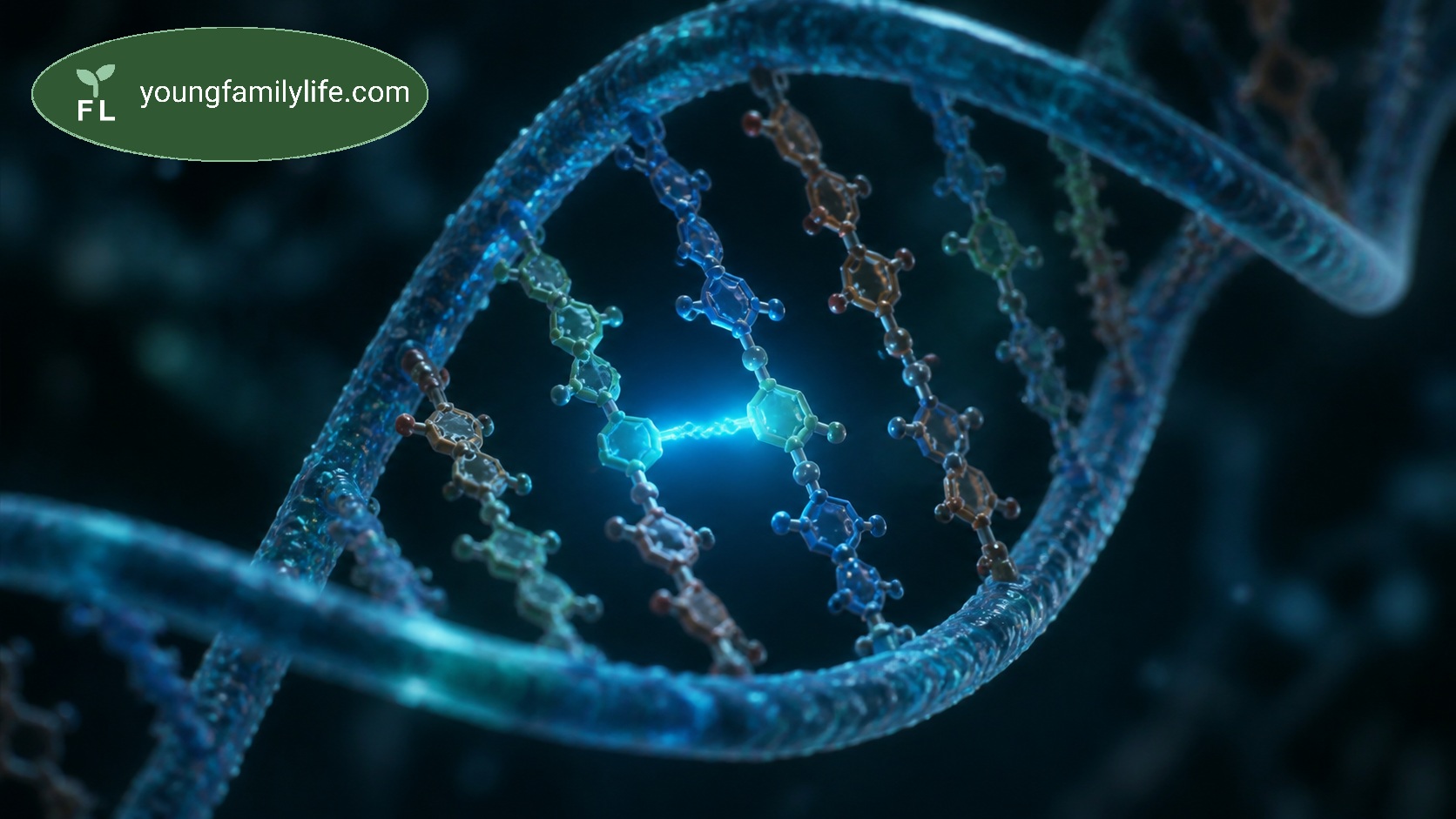
Inside every strand of DNA, the two sides of the double helix are held together by hydrogen bonds. Within each of those bonds sits a single proton. Under quantum physics, that proton doesn't stay perfectly still — it has a small but real chance of briefly shifting position through a process called tunnelling, something with no equivalent at all in the everyday, non-quantum world. When it does, it can very briefly flip a base pair into an unusual form. If a cell happens to be copying its DNA at that exact moment, the flip gets copied too — permanently, as a small, spontaneous change in the genetic code.
This idea was first proposed by the physicist Per-Olov Löwdin in 1963, and more recent research has confirmed it isn't a minor or negligible effect. Studies modelling the process in detail have found that this quantum route to mutation is actually far more significant than the ordinary, non-quantum route — and it happens at completely normal body temperature, not in some extreme laboratory condition.
In other words: a body doesn't need to be damaged by anything external for its genetic code to occasionally, randomly, change. The randomness comes built in, at the level of physics itself.
Why the body's own repair system slowly loses the race
A single change like this isn't usually a problem. Cells have repair systems whose whole job is to catch and fix exactly this kind of error, and most of the time, they do.
The difficulty is what happens over decades rather than days. Two things happen at once as a person gets older: the pace of this kind of damage builds up, and — separately — the cell's own ability to repair it gets less reliable. It isn't that damage suddenly appears in later life. It's that the system meant to catch it was never asked to keep working perfectly forever, and gradually, it doesn't.
This is where a slower, more familiar kind of change becomes visible — skin that doesn't spring back the way it once did, movement that takes more effort, recovery from an injury or illness that takes longer than it used to. These aren't failures of willpower or self-care. They're the visible, outward evidence of something that started as an invisible, random event inside a single strand of DNA, possibly years or decades earlier.
Why evolution never fixed this
A reasonable question follows from all this: if this is a real, ongoing source of damage, why hasn't evolution built better protection against it by now?
The honest answer is that evolution had no reason to. Natural selection works by favouring traits that help an organism survive long enough to reproduce and raise its offspring. Once that's happened, there's very little left for natural selection to act on — a harmful trait that only shows up after reproduction carries almost no cost that evolution can "see," so there's nothing pushing it to be removed.
This isn't a new idea for this collection. YoungFamilyLife's Changing People series makes a similar point using the recurrent laryngeal nerve — a nerve inherited from fish ancestors that loops the entire length of the chest to connect two points just a few millimetres apart. It's a strange, clearly inefficient piece of wiring, and it exists because evolution doesn't design anything from scratch. It only ever adjusts what's already there. The companion piece Influence and Adaptation: What Darwin Actually Taught Us makes the same point from a different angle: Darwin's real insight wasn't about effort or self-improvement, it was that fitness simply means being compatible with existing conditions — nothing more ambitious than that.
Ageing follows exactly the same logic. Two long-standing scientific theories describe how: one, called antagonistic pleiotropy, notes that some genes are genuinely useful early in life but only become harmful much later — past the point where evolution has any way of removing them. The other, the disposable soma theory, frames the body itself as something built to be "good enough" to reproduce, not built to last indefinitely afterwards. Continued repair, on this view, was never something evolution was under pressure to keep paying for once its job was done.
Evolution, in short, never built a body designed to last forever. It built one good enough to get the job done — running on repair systems nobody ever asked to hold up for a hundred years.
What this changes
None of this is really about physics for its own sake. It changes what ageing actually is, at the most basic level. It isn't a system breaking because of neglect, and it isn't a punishment for anything. It's the ordinary, expected outcome of two things working exactly as they always have: quantum randomness writing small, unavoidable errors into DNA, and evolution never having any reason to build a repair system that could outlast them.
That doesn't make the visible signs of ageing feel any less real. But it does mean the starting point for understanding them isn't "what went wrong" — it's a process that was always going to happen, running quietly since long before anyone noticed it, in a part of physics that has nothing to do with anyone's choices at all.
This piece pulls from the opening sections of the Repositorium essay Why Old? — of all things?, which goes further into the physics of entropy, the evolutionary evidence, and what a long life is actually for.
Topics: #InOtherWords #Ageing #QuantumPhysics #DNA #Entropy #WhyOld
Related YFL Content
Why Old? — of all things? — The full Repositorium essay behind this whole family — all six parts, with complete evidence and citations.
Hey!, Want To Know: How Dependent We Are on Decay? — The HWTK companion — decay as a generative process, from compost heaps to dying stars, in discovery-first form.
In Other Words: Why Bigger Doesn’t Mean Greater Longevity? — Why the animal kingdom’s real longevity record-holders aren’t the biggest or most complex — dinosaurs included.
In Other Words: What Long Childhoods Are For — Why elephants, orcas, and beavers all pair long lifespans with long childhoods — and what that trade buys a species.
In Other Words: When Wisdom Turns to Dogma — Why age doesn’t reliably produce wisdom or rigidity — and what actually decides which way a person goes.
In Other Words: Entropy and Syntropy — The Same Universe, Two Directions — The bridge piece connecting this whole family directly to Syntropy and the Tag.
Syntropy and the Tag: The Accidental Prophecy of the Awful Popcorn Movie Hackers — the yin/yang companion essay this whole family sits alongside.
Copyright Notice
© 2026 Steve Young and YoungFamilyLife Ltd. All rights reserved.
All original content on YoungFamilyLife — including essays, articles, frameworks, and other written material — is the intellectual property of Steve Young and YoungFamilyLife Ltd, unless credited to another source. Content is developed collaboratively using AI assistance to research sources and refine structure, while all intellectual authorship, original insight, and professional expertise remain those of the author.
No part of this website may be reproduced, distributed, or transmitted in any form without prior written permission, except brief quotations for noncommercial use.
For permission requests, contact: info@youngfamilylife.com