The assumption that doesn't survive contact with the evidence
Ask most people to guess which animals live the longest, and the answers tend to cluster around the same instinct: something big. Something impressive. An elephant, maybe, or a whale, or — for anyone thinking historically — a dinosaur, on the assumption that sheer size must have bought some kind of biological advantage.
The actual data says almost the opposite. Once the record is checked properly, the animals that live the longest aren't the biggest, the most complex, or the most dominant. They're something else entirely — and the pattern holds up across a genuinely enormous stretch of time, not just in the animals alive today.
The real record-holders
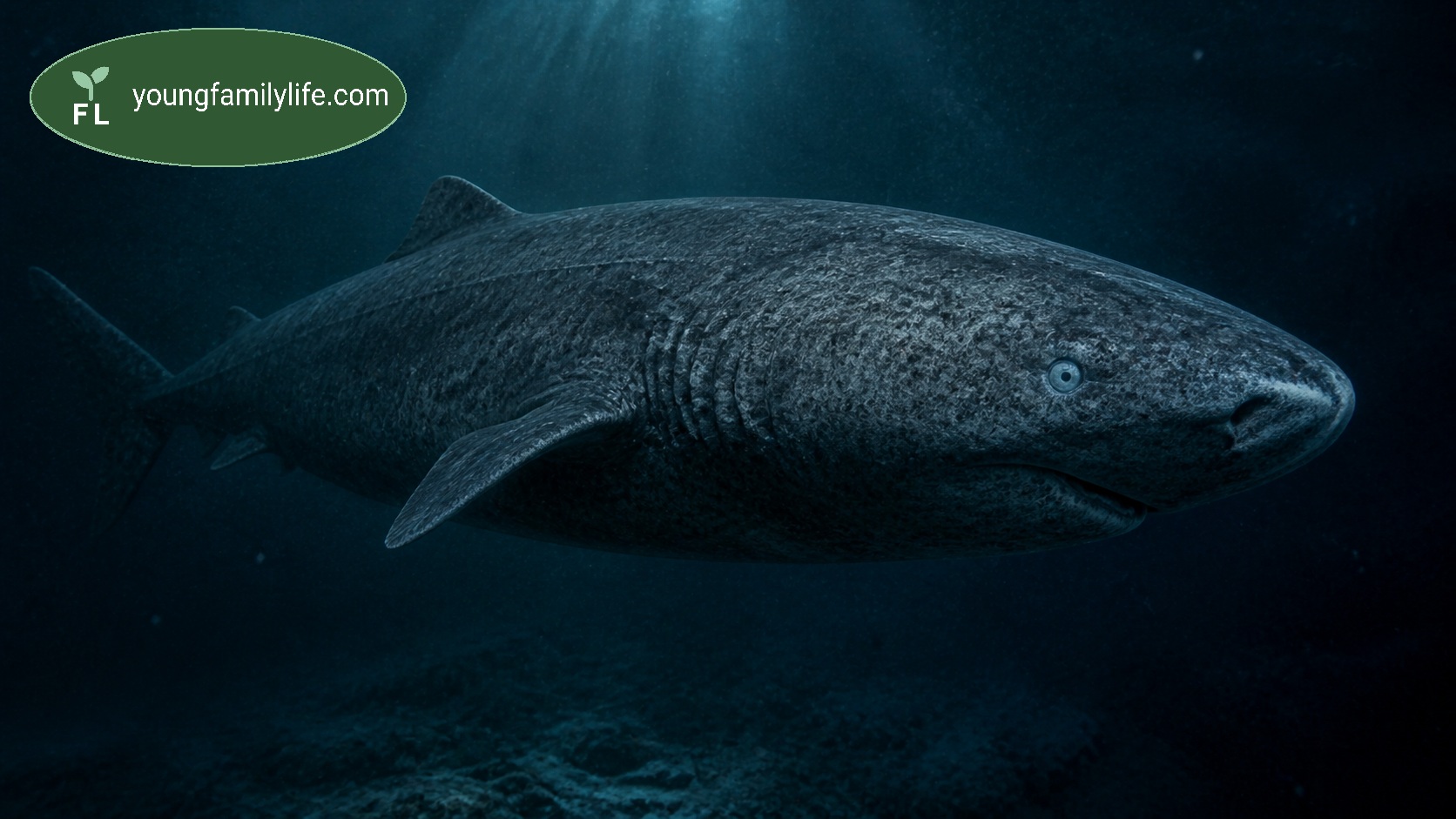
The oldest confirmed ages in the animal kingdom don't belong to anything most people would guess. An ocean quahog clam named Ming was confirmed to have lived 507 years — old enough to have been alive before the country it was eventually found near even existed in its current form. Greenland sharks are estimated, through radiocarbon dating of the lens of their eye, to live somewhere between 272 and possibly close to 400 years — and they don't even begin breeding until they're roughly 150 years old. Deep-sea tube worms, which have no mouth or digestive system at all and survive instead on bacteria that convert sulfur from hydrothermal vents into usable energy, have individuals estimated at over 300 years old.
None of these are complex, mobile, "advanced" animals in the way people usually picture impressive wildlife. They're slow, often simple in structure, and mostly live somewhere cold, dark, and undisturbed. The consistent thread running through almost the entire longevity record is metabolism, not sophistication: animals with slow metabolisms — reptiles compared with similarly sized warm-blooded animals, for instance — tend to live substantially longer. Running a body slowly, it turns out, matters more for longevity than running it well.
What the dinosaurs actually show
It would be reasonable to assume this is a modern-animal pattern, and that things were different when dinosaurs — genuinely the largest land animals to have ever lived — dominated the planet. The fossil record says otherwise, and it's worth being clear about how solid that evidence actually is.
Since the late 1990s, palaeontologists have been able to directly measure the age of individual dinosaurs using something called Lines of Arrested Growth, or LAGs — essentially growth rings inside bone tissue, closely comparable to tree rings, that can be counted under polarised light. This isn't guesswork. It's a genuine, repeatable method, and it has overturned some much more dramatic earlier estimates.
Sauropods — the enormous, long-necked herbivores that included some of the largest land animals ever to exist — hold the dinosaur longevity record. But "record" here means somewhere between 60 and 80 years, roughly comparable to a modern elephant, not the 300-year lifespans once assumed based on loose comparisons with slow-metabolism reptiles like crocodiles. That earlier estimate has been revised sharply downward as the growth-ring evidence built up.
Tyrannosaurus rex — culturally the most dominant predator most people can picture — lived shorter lives still. One of the most complete T. rex skeletons ever found, known as "Sue," was confirmed by growth-ring analysis to have died at just 33. Smaller dinosaur species lived shorter lives again, some maturing and dying within a decade or two.
The pattern is exactly the one running through the modern animal kingdom: size and dominance don't predict longevity. Metabolic pace does — and that's apparently been true for at least 165 million years, not just in the world as it exists today.
Why the correction itself matters
There's a second, quieter point worth sitting with here, separate from the animals themselves: even scientific certainty about something like this had to be earned gradually, and against the pull of a more exciting-sounding story. Three-hundred-year sauropods make for a better headline than seventy-year ones. The evidence took time to catch up and correct the more dramatic assumption — which is a useful thing to notice generally, not just about dinosaurs.
What this actually means
None of this makes size or complexity meaningless — clearly, size and complexity have mattered enormously for plenty of other evolutionary reasons. But longevity specifically was never a reward handed out for being big, being intelligent, or sitting at the top of a food chain. It's tracked much more closely by something far less glamorous: how slowly an animal's own metabolism runs, whether that animal is a Cretaceous sauropod, a Greenland shark alive today, or anything in between.
This piece pulls from the third section of the Repositorium essay Why Old? — of all things?, which goes on to explore what a long life actually buys a species that has one — and why some of the longest-lived animals on Earth turn out to be the most social.
Topics: #InOtherWords #Longevity #Evolution #Dinosaurs #Metabolism #WhyOld
Related YFL Content
Why Old? — of all things? — The full Repositorium essay behind this whole family — all six parts, with complete evidence and citations.
Hey!, Want To Know: How Dependent We Are on Decay? — The HWTK companion — decay as a generative process, from compost heaps to dying stars, in discovery-first form.
In Other Words: The Randomness Already Inside You — The physics of why a body doesn’t need bad luck to age — quantum tunnelling writing mutation into DNA.
In Other Words: What Long Childhoods Are For — Why elephants, orcas, and beavers all pair long lifespans with long childhoods — and what that trade buys a species.
In Other Words: When Wisdom Turns to Dogma — Why age doesn’t reliably produce wisdom or rigidity — and what actually decides which way a person goes.
In Other Words: Entropy and Syntropy — The Same Universe, Two Directions — The bridge piece connecting this whole family directly to Syntropy and the Tag.
Syntropy and the Tag: The Accidental Prophecy of the Awful Popcorn Movie Hackers — the yin/yang companion essay this whole family sits alongside.
Copyright Notice
© 2026 Steve Young and YoungFamilyLife Ltd. All rights reserved.
All original content on YoungFamilyLife — including essays, articles, frameworks, and other written material — is the intellectual property of Steve Young and YoungFamilyLife Ltd, unless credited to another source. Content is developed collaboratively using AI assistance to research sources and refine structure, while all intellectual authorship, original insight, and professional expertise remain those of the author.
No part of this website may be reproduced, distributed, or transmitted in any form without prior written permission, except brief quotations for noncommercial use.
For permission requests, contact: info@youngfamilylife.com