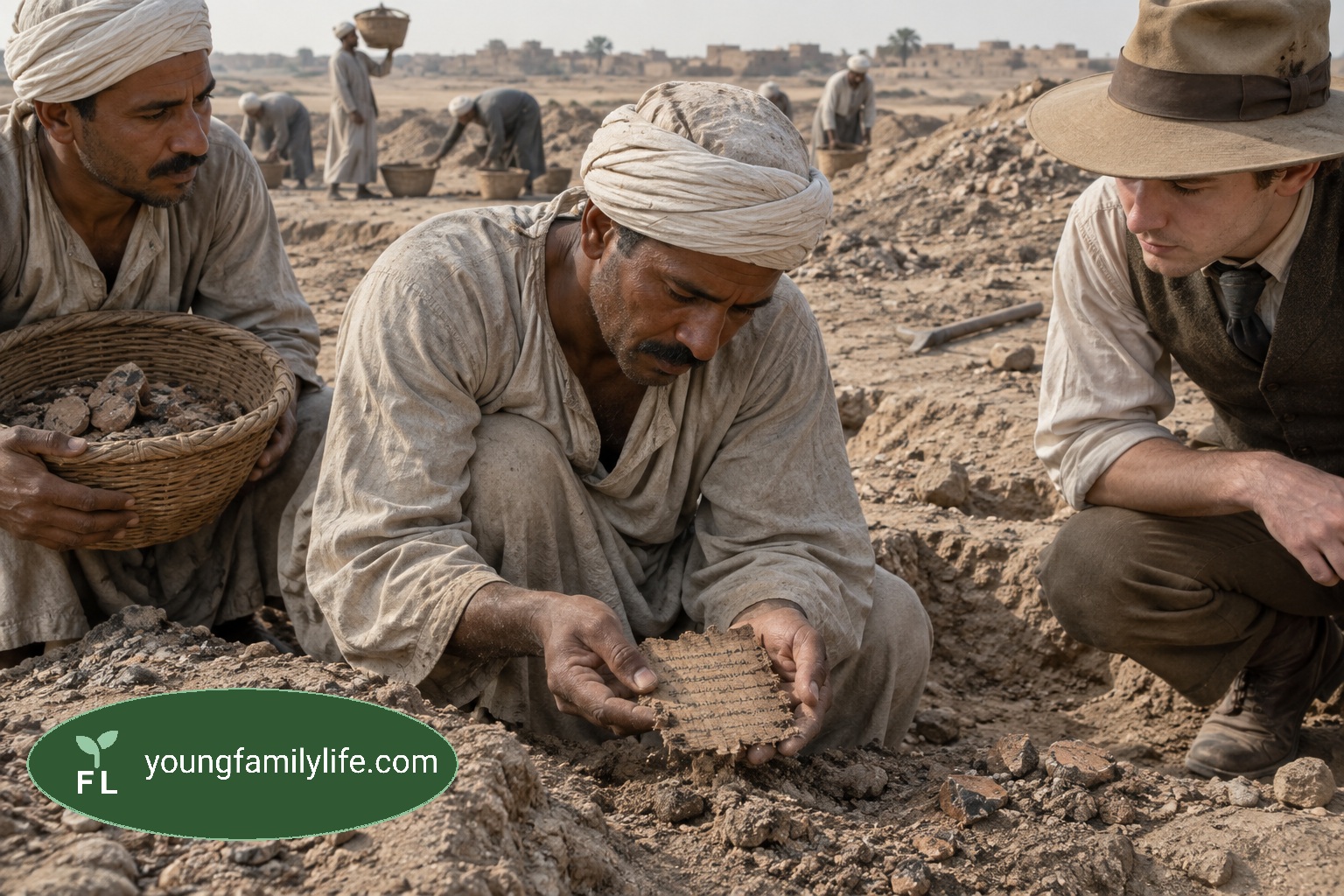
In the thirteenth century a schoolboy in Novgorod, a trading city in what is now Russia, put his name beside a drawing of a knight on a piece of birch bark. His name was Onfim, and he was, on the estimate of those who studied the finds, six or seven years old (estimates of the date run from about 1220 to about 1260). He was neither a prince nor a prodigy. Nobody is known to have kept the bark. It lay in wet clay for about seven centuries and was recovered in 1956, in the excavations that began at Novgorod in 1951 (a Russian popular-history article gives the day as 13 July; limited verification).
Most of what children said or wrote in earlier centuries has been lost. What survives reached later readers by routes that adults controlled: a clerk's pen, a family's decision, an accident like the Novgorod soil, and an editor's cuts. Whether such words are a marvel to a reader today, or of use, depends on how they came to be kept and who kept them.
1. Kinds of words, and the channels that carry them
The cases in this essay differ in how close the words are to the child. Four kinds can be distinguished. A channel is the route by which words of each kind reached a later reader, and each channel has someone who decides what passes through it.
Written by the child. Journals, letters and school exercises: Onfim, a schoolboy of medieval Novgorod; Theon, a boy in Roman Egypt; Marjory Fleming, a Scottish girl who died at eight; and Anne Frank, the Dutch diarist. Survival depends on whoever keeps or discards the paper, and on later fame.
Transcribed from speech. Evidence and testimony taken down by an adult: Joan of Arc, the French military leader tried at Rouen, and Sarah Gooder, an eight-year-old mine worker questioned in 1841. The clerk and the questioner decide what is set down.
Supplied by others. Verse cut on a tomb, a letter in a king's name, speeches composed by historians: Sulpicius Maximus, a Roman boy poet whose parents recorded his verse; Pepi II, a child king of Egypt; and Boudica, a British queen of the first century AD. Boudica was an adult, and her speeches are included as the extreme case, with her daughters, who have no words at all. The family, the official or the historian decides what survives.
An emblem. A figure with no words, such as Britannia, who lies outside this essay.
The sections below follow the channels: the clerk, the family, the child's own hand and what keeps it, and the later editor. A single source can pass through several kinds and channels. Anne Frank's diary is written by a child, rewritten by her, and then edited by her father into the text most readers have met.
2. The clerk's pen
The clerk is the channel for children who were asked.
Joan of Arc was a French military leader under Charles VII in the Hundred Years' War, credited with a major part in his consecration as king. She was captured, tried for heresy by a pro-English church court at Rouen, and executed. Her trial preserved her answers in unusual detail, which makes her the clearest case in this essay of a young person's recorded speech.
Her trial opened on 9 January 1431, and her first public interrogation was on 21 February, in the chapel of the castle at Rouen. She said she was about nineteen, and when she was asked how old she had been on leaving home she said she did not know. According to the record she first heard her voices at about thirteen, though the record gives that age more than one way (English translations of the record; the YFL essay Counting a Child's Age sets out the versions). She was executed on 30 May 1431. Her whole recorded life, and with it everything she is recorded as saying, fell before her twentieth year.
Almost all of her recorded speech comes from this one trial. Three notaries, Guillaume Manchon, Pierre Taquel and Boisguillaume, took down the questions and answers each morning and put them in order afterwards. Their French minute, written in Manchon's hand, is lost, and only two much later copies survive. The Latin text on which most translations rest was made from it, in 1431 on one view and as late as 1435 on another. Some scholars read the Latin as a retrospective version meant to make the judges look better. Daniel Hobbins, whose translation is widely used, judges that it omits very little of substance and follows correct procedure (Hobbins 2005, as described in reviews; limited verification). The notaries said at the later inquiry in the 1450s that the presiding bishop, Pierre Cauchon, had tried to press them into changes and that they refused. That inquiry annulled the verdict on 7 July 1456.
What she said about her own youth was therefore said at nineteen, to a court that condemned her, about events years before, and written down by men who then kept the record. How reconstructive memory affects testimony of this kind is the subject of Hey!, Want To Know: Why Witness Testimony is the Weakest Link?. Whether she led or was led cannot be settled from the sources, because each of them has a stake. The court of 1431 aimed, on one account, to discredit her and through her the king she had crowned. The examination by French theologians at Poitiers in 1429 survives only as a short fragment of its conclusions. The witnesses of the 1450s spoke in proceedings that also served the honour of that king, and they recalled her a quarter of a century later.
Joan's case shows the clerk's channel at its fullest. A person's own words can survive in volume and still reach a reader only as a transcript made by others, for their own purposes, and corrected or translated afterwards. At Rouen the notaries recorded the questions with the answers, which is one reason the trial record is so full.
The same channel carried the words of children who worked underground. In 1841 a government commission questioned children who worked in coal mines, and its report of 1842 led to the Mines Act of that year. One of them was Sarah Gooder, aged eight, a trapper in the Gawber pit, near Barnsley, whose evidence was taken by the sub-commissioner J. C. Symons. A trapper opened and closed the ventilation doors that let coal wagons through, often the youngest child in the pit, sitting alone and often in the dark (National Coal Mining Museum and Amgueddfa Cymru teaching pages). The record has her say that she went down at four, sometimes at half past three, and came out at five or half past; that she had to trap without a light and was scared; that she sang when she had a light but did not dare to in the dark; and that she did not like being in the pit. She is also recorded as saying that she would like to be at school far better than in the pit (Children's Employment Commission, Appendix I, evidence no. 116; the National Coal Mining Museum's extract of the printed report stops before the school remark, which appears in the longer text reproduced in document collections that cite the Parliamentary Papers; the printed paper itself has not been seen here). Her words survive because a commissioner chose to ask a girl of eight and a clerk chose what to set down.
The method was challenged at the time. A mine-owner, Lord Londonderry, told the House of Lords that the commissioners had questioned the children in ways that suggested the answers (HL Deb 24 June 1842, vol. 64, cols. 538–44, at col. 539). The objection came from an interested party, and the questions as asked are not part of the record, so the objection cannot be tested. The YFL essay Who Decided the Child Was Grown? sets out the evidence and the statute that followed, which barred females of any age from underground work. A clerk's channel can keep the answers and drop the questions that produced them.
3. The family
A family is a channel with a motive. It keeps what it values, and what it values may be one child's best moment or one version of a child.
Quintus Sulpicius Maximus was a Roman boy who competed as a poet in Greek at the Capitoline Games in AD 94 and died soon afterwards. His tomb holds the most complete record of a child's performance from antiquity. He entered the poetry competition at the third Games, one of fifty-two poets, and improvised Greek hexameters on the theme of Zeus rebuking Helios, forty-three lines on the latest count. He did not win, though the epitaph says that he left with distinction. His parents set up an altar and had the poem cut into it. The Latin epitaph states his age as eleven years, five months and twelve days, and a Greek epigram on the same monument calls him twelve (CIL 6.33976 and IG 14.2012; the epigram as given in an early English translation). In the words of the epitaph, as given in Valentina Garulli's edition, the parents had the verses inscribed so that they might not seem unduly swayed by affection for their son (Garulli 2018, from the abstract of her chapter; the Greek text itself has not been read here, and the YFL essay Marvel Children: Who Makes the Wonder? describes the monument). The altar was made after his death, and the poem survives because the family paid for the stone.
A family can also edit. Anne Frank was a Jewish girl in occupied Amsterdam whose family went into hiding, and the diary she kept there was published after the war and became one of the best-known accounts of the occupation. She began it on her thirteenth birthday, 12 June 1942, and made the last entry on 1 August 1944, a few days before the hiding place was raided on 4 August. After a radio appeal on 28 March 1944 by Gerrit Bolkestein, the Dutch Minister of Education in exile, asking people to keep diaries and letters of the occupation, she began on 20 May 1944 to rewrite and expand the diary on loose sheets (version b, which ends with the entry of 29 March 1944), leaving out some passages. Her father, Otto Frank, who received the papers after the war, prepared a third text from the two (version c, edited with a collaborator, Albert Cauvern). It appeared in Dutch on 25 June 1947 as Het Achterhuis. He left out passages on her sexuality and some unflattering remarks about his wife and about others in the Annex, reinserted some passages that she had left out, and from 29 March 1944 on used her original text (the Anne Frank House's edition of the complete works). A critical edition by the Netherlands State Institute for War Documentation, published in 1986, set out versions a, b and c, and a reader's edition prepared by the German translator Mirjam Pressler in 1991, in English in 1995, restored about thirty per cent more material.
Whether Otto Frank's editing amounts to censorship is disputed. One biographer argues that it does not: that Anne had already removed material herself, and that Otto restored some of what she had cut (Franklin, as summarised in a review essay, with the Anne Frank House edition recording that he reinserted passages she had cut; limited verification of Franklin's argument). In either case the girl was her own first editor, and the text that most readers met came through her father.
4. The child's own hand, and what keeps it
Few children's writing survives in their own hand, and in the cases here it survived by different routes.
Onfim, the Novgorod schoolboy of the opening, is a rare case of a medieval child's own writing and drawing, and an ordinary one. Seventeen birch-bark items are linked to him, twelve of them with drawings. They include the alphabet, sequences of syllables and excerpts from the Psalms, and drawings: a rider with Onfim's name beside him, a figure fighting a many-headed beast, portraits of himself and his friends (a museum catalogue entry; reference pages citing Yanin 2006 and 2009; Yanin not read, so limited verification). Nobody kept them. The soil of Novgorod preserved the bark in the wet, airless clay, and more than a thousand such documents have been found since 1951. The route here is accident.
Theon is a rare case of a letter from a child surviving from antiquity. He was a boy in Roman Egypt who wrote to his father, also called Theon, in the second or third century AD. It was found at Oxyrhynchus by the papyrologists Grenfell and Hunt and is now in the Bodleian Library (P. Oxy. I 119). The boy tells his father that it was a fine thing not to take him to Alexandria, and says that if he is left behind he will not write, speak, take his hand or greet him, and will not eat or drink. He signs with the pet name Theonas. His age is not stated, and modern estimates put him at about ten or eleven. The Greek is untidy and misspelt, and scholars read the wording as the boy's own, with an adult possibly prompting him to write. In the closing request the first editors read "send me a lyre", and a revised reading, which Parsons follows, takes it as "send for me" (Grenfell and Hunt 1898; Parsons 2007; the Greek text on papyri.info records both readings). The letter survives, and its meaning in one line is still being fixed by adult editors.
Marjory Fleming was a Scottish girl who became famous after her death as "Pet Marjorie" for the journals she left. She was born in Kirkcaldy on 15 January 1803 and died there on 19 December 1811, aged eight. Her journals cover about the last eighteen months of her life, together with letters and verses. They survived in her family and were not widely read until the 1850s (Kirkcaldy local-history pages; the YFL essay Marvel Children: Who Makes the Wonder? gives the account in full).
The routes differ. The tomb keeps a child whose parents had the means and the wish to keep him. The soil kept Onfim by accident, and excavation brought Theon's letter to light. A family and a later reader kept Marjory Fleming and Anne Frank. Both girls came from households that taught girls to write and kept the pages. Theon's letter was written to a father who had gone to Alexandria.
5. The later editor
A later editor makes the child into someone the editor can use. Marjory Fleming's writings were found in 1857 by H. B. Farnie, a Fife journalist, through her surviving sister, and published as a pamphlet, Pet Marjorie. The Edinburgh physician John Brown read it, reworked the story, and published it in 1863 in the North British Review, which made her famous; he acknowledged a debt to her younger sister Elizabeth for the loan of the letters and journals. Her friendship with Walter Scott, which Brown's essay popularised, rests on a single letter from Elizabeth to Brown (reference pages; limited verification). Victorian editions cut entries thought unsuitable for an eight-year-old, and the complete edition is Frank Sidgwick's of 1934 (Sidgwick's edition was not seen; the other details from a Morgan Library record and Kirkcaldy local-history pages). Anne Frank's diary was shaped by her father, as above. Joan of Arc was recalled by the witnesses of 1450–56 in proceedings aimed at clearing her and the king. That is also why the question whether she led or was led stays open: each channel that carries her words had a stake in the answer.
In each case the later editor gives the child a character. What emerges from an editor's work is possibly a type: the pet, the victim, the saint. The words are the child's, and the character is the editor's.
6. Which children are heard
The cases here were chosen, not sampled, and the pattern in them is limited to them. Four selections show.
First, the literate. Onfim and Theon were learning to write, and the girls who left diaries came from households that taught them.
Second, the exceptional. Sulpicius was a poet, Fleming a writer of unusual precocity, Joan a leader.
Third, children whom an institution asked. Gooder was asked by a commission and Joan by a court.
Fourth, children who died young. Sulpicius died soon after his contest, Fleming at eight, Anne Frank after her arrest, and Joan at about nineteen. It is possible that early death made their papers worth keeping, and that children who lived to adulthood and wrote nothing more notable left less.
The cases bear on girls in a specific way. Four of the named children are girls: Joan, Gooder, Fleming and Anne Frank. Joan and Gooder were heard because an institution questioned them. Fleming and Frank came to readers by way of adults: a sister, a journalist, a physician, a father. The boys in these cases reached the record by a family's stone, by soil and by excavation. No girl in this set reached it by those routes, and each came through an institution's question or an adult's editing. A set this small cannot show whether that is a rule. In the next section two daughters are present in the record with no words at all.
7. When the voice is supplied
At the far end of the range the words belong to the writer and the child supplies only a name.
Pepi II was an Egyptian king of the Old Kingdom, more than 4,000 years ago, who came to the throne as a child. A letter in his name, dated year 2 of his reign, third month of the first season, day 15, is full of excitement about a dancing dwarf, or pygmy, that an explorer, Harkhuf, was bringing him. The papyrus is lost. Harkhuf had the words cut on the front of his tomb at Qubbet el-Hawa, near Aswan, and they survive there (Lichtheim 1973, pp. 23–27; the YFL piece In Other Words... Who Governed When the King Was a Child? describes it). A popular archaeology magazine gives the king's age as eight, which is not firmly established. Whether the boy composed any of it is not known.
Boudica was the queen of the Iceni, a people of eastern Britain, who led a revolt against Roman rule in about AD 60 or 61. She was an adult, and her words are supplied in the same way. Two Roman writers give her battle-speeches, Tacitus in the Annals, written about AD 115–117, and Dio, about 140 years after the revolt, whose account survives in an eleventh-century epitome by John Xiphilinus. Both speeches are thought to be the writers' own compositions, since her words were not recorded in her lifetime (Adler 2008, pp. 173–195; a review of Gillespie 2018 judges that nothing suggests Dio's version rests on more than hearsay and imagination). In Tacitus she presents herself as an ordinary person avenging her lost freedom, her scourged body and the outraged chastity of her daughters, and he places her in a chariot with her daughters before her, going from tribe to tribe (Annals 14.35, in the Loeb and Church and Brodribb translations).
The children in the story are those two daughters. Tacitus says that their father, Prasutagus, had named them as co-heirs with the emperor Nero, and that after his death, in AD 60 or 61, the Romans scourged their mother and outraged them (Annals 14.31). Their ages are not given in the sources seen. The only words in the record about what happened to them are their mother's, as composed by a Roman historian, and nothing is attributed to them. Dio does not mention the abuse.
A personification such as Britannia, who appears on Roman coins of the second century AD, has no words at all. That figure lies outside this essay.
Novels are a further way in which an adult supplies a child's voice, and a girl's in particular, and the YFL essay The Authored Child considers it.
8. Children's accounts today
The question of how a child's account enters the record is now a matter of law. Article 12 of the UN Convention on the Rights of the Child assures a child capable of forming views the right to express them in all matters affecting the child, with due weight given in accordance with age and maturity, and the opportunity to be heard in judicial and administrative proceedings, directly or through a representative. The Committee on the Rights of the Child has said that a child should be presumed capable of forming views and that age alone cannot determine the weight of those views (General Comment No. 12, 2009, paras 20 and 29). The Children Act 1989 requires a court deciding a question about a child's upbringing to have regard to the child's ascertainable wishes and feelings, considered in the light of age and understanding (s. 1(3)(a)).
Each of these provisions still has someone ascertain a child's wishes and feelings, and someone record them. The channels are possibly the same ones as in the cases above: a representative, a clerk or a report. How the knowledge on which child protection rests is gathered and weighed is examined in The Epistemology of Safeguarding. A child can raise a referral personally, as In Other Words... What Happens When a Family is Referred to Children's Services describes. The distinction between honesty and saying everything, which bears on what any child's account leaves out, is considered in In Other Words... why children lie.
9. What survives, and what it is worth
In these cases a child's own words were kept when an adult had a reason to keep them, and the reasons were few.
When the child is asked. A commission wanted evidence about work in the mines, and a court wanted an account from Joan. Sarah Gooder and Joan are in the record because someone put questions and someone wrote down the answers.
When the child is mourned. Sulpicius's parents had his poem cut in stone after his death, and Otto Frank prepared his daughter's diary for print. Grief kept the words, and it also chose them.
When the paper is thrown away and chance keeps it. The soil of Novgorod preserved Onfim's bark, and Theon's letter came out of the ground at Oxyrhynchus. These are the only cases here in which no adult is known to have chosen to keep a child's words, and both children are boys.
When the child becomes famous afterwards. Marjory Fleming's journals stayed in her family and became a book when a journalist and then a physician took them up.
Writing is a kind of record because it fixes words in a form that can be read after the child is gone. It does not keep them. Making a record, keeping it and editing it for readers are three separate acts, and in these cases different people did them at different times.
What a reader gains from the words. A child's recorded words give what adults' accounts of children do not. A girl of eight in a pit said that she sang when she had a light and did not dare to sing in the dark. A boy of six or seven put his name beside a drawing of a knight, on a piece of bark that also carries alphabet practice. A boy in Egypt bargained with his father by threatening to stop eating. A girl revised her own diary for readers after the war. Each shows a child planning, bargaining, imagining or editing, which adult accounts of children possibly show less often than they show a child being cared for or managed. The words also carry a second kind of evidence. A reader who knows who asked, who kept and who edited can weigh what the words show, and what they leave out.
What the cases say about girls. In this set the four girls reached the record through an institution's question or an adult's editing, and none by the routes that kept the boys' words. The set is too small to show a rule. Boudica's daughters have no words at all. Looking for girls' voices in these cases means looking first at who asked and who edited.
Marvel, or use, or both. The wonder in these cases is real: a drawing that has outlasted about seven centuries, a threat that still reads as a child's. A marvel can also be made by the channel. Marjory Fleming became "Pet Marjorie" through her editors, and the YFL essay Marvel Children: Who Makes the Wonder? examines how adults frame what a child did. Who authors the stories a society keeps is the subject of The Noble Lie and the Ministry of Truth: Who Gets to Author the Story. The cases are useful today in a narrower way. The three acts that shaped these records still shape children's accounts, as section 8 describes, and what a child writes or says now is held by schools, courts, families and possibly companies. Whether it is kept will again depend on who has a reason to keep it. The three authors at work in social media, the person, the crowd and the algorithm, are described in Who Writes a Social Media Story: The Person, the Crowd, or the Algorithm?. The cases do not say how much weight a child's account should carry. They show that the weight depends on a channel the child does not control, and that the words and the channel need to be read together.
10. A note on the evidence
The essay draws on legislation, parliamentary records and Hansard where these could be read, on translations of primary texts where available, and on reviews, scholarly summaries and reference pages for other points. Claims that rest on secondary sources only, or that have had limited verification, are marked as such where they appear. The cases are chosen to show how the channels differ and are not a sample. The patterns drawn from them are provisional.
---
References
- Adler, E. (2008). Boudica's speeches in Tacitus and Dio. The Classical World, 101(2), 173–195.
- Anne Frank House (2019). The Collected Works of Anne Frank, trans. S. Massotty. London: Bloomsbury Continuum. [edition presenting Anne's diary text, her rewritten version and Otto Frank's version]
- Champion, P. (ed.) (1920–21). Procès de condamnation de Jeanne d'Arc. Paris.
- Children Act 1989 (c. 41), s. 1(3)(a).
- Children's Employment Commission (Mines) (1842). Reports and appendices, Parliamentary Papers. Appendix I, evidence no. 116.
- Committee on the Rights of the Child (2009). General Comment No. 12: the right of the child to be heard.
- Dio Cassius. Roman History, 62.1–12 (epitome of John Xiphilinus).
- Barrett, W. P. (trans.) (1932). The Trial of Jeanne d'Arc. New York: Gotham House (first published London: Routledge, 1931). [first unabridged English translation; not read]
- Brown, J. (1863). Pet Marjorie: a story of child-life fifty years ago. North British Review.
- Duparc, P. (ed.). Procès en nullité de la condamnation de Jeanne d'Arc. Paris.
- Franklin, R. Review essay on the diaries of Anne Frank. (details not confirmed; seen only as a web essay)
- Frank, A. (1947). Het Achterhuis. Amsterdam: Contact.
- Netherlands State Institute for War Documentation (1986). De dagboeken van Anne Frank [critical edition]; English edition 1989, The Diary of Anne Frank: The Critical Edition. (editors and publisher not named)
- Frank, A. (1995). The Diary of a Young Girl: The Definitive Edition, ed. O. H. Frank and M. Pressler, trans. S. Massotty. [German original 1991]
- Farnie, H. B. Pet Marjorie (serialised in the Fife Herald from 1857 and issued as a pamphlet). (date of the pamphlet not confirmed)
- Garulli, V. (2018). A portrait of the poet as a young man: the tomb of Quintus Sulpicius Maximus on the Via Salaria. In N. Goldschmidt and B. Graziosi (eds), Tombs of the Ancient Poets. Oxford University Press.
- Grenfell, B. P. and Hunt, A. S. (1898). The Oxyrhynchus Papyri, Part I, no. 119. London: Egypt Exploration Fund.
- Gillespie, C. (2018). Boudica: Warrior Woman of Roman Britain. Oxford University Press. [seen through a review]
- Hansard. HL Deb 24 June 1842, vol. 64, cols. 538–44.
- Hobbins, D. (trans.) (2005). The Trial of Joan of Arc. Harvard University Press.
- Lichtheim, M. (1973). Ancient Egyptian Literature, vol. 1: The Old and Middle Kingdoms. Berkeley: University of California Press. [Harkhuf and the letter of Pepi II, pp. 23–27]
- Murray, T. D. (1902). Jeanne d'Arc, Maid of Orleans, Deliverer of France. (publisher and place not confirmed; translations of the record; excerpts read)
- Parsons, P. (2007). City of the Sharp-Nosed Fish. London: Weidenfeld and Nicolson. [translation of P. Oxy. 119, p. 129]
- Quicherat, J. (ed.) (1841–49). Procès de condamnation et de réhabilitation de Jeanne d'Arc. Paris.
- Sidgwick, F. (ed.) (1934). The Complete Marjory Fleming. London.
- Tacitus. Agricola 15–16; Annals 14.31–37.
- Tisset, P. and Lanhers, Y. (eds) (1960–71). Procès de condamnation de Jeanne d'Arc. Paris: Société de l'Histoire de France.
- United Nations Convention on the Rights of the Child (1989), art. 12.
- Yanin, V. L. (2006). Medieval Novgorod. (venue and pages not confirmed); Yanin, V. L. (2009). The Birch Bark Post of the Centuries. (details not confirmed)
Topics: #ChildrensVoices #HistoryOfChildhood #HistoricalRecord #ChildrensRights #Archives #Testimony