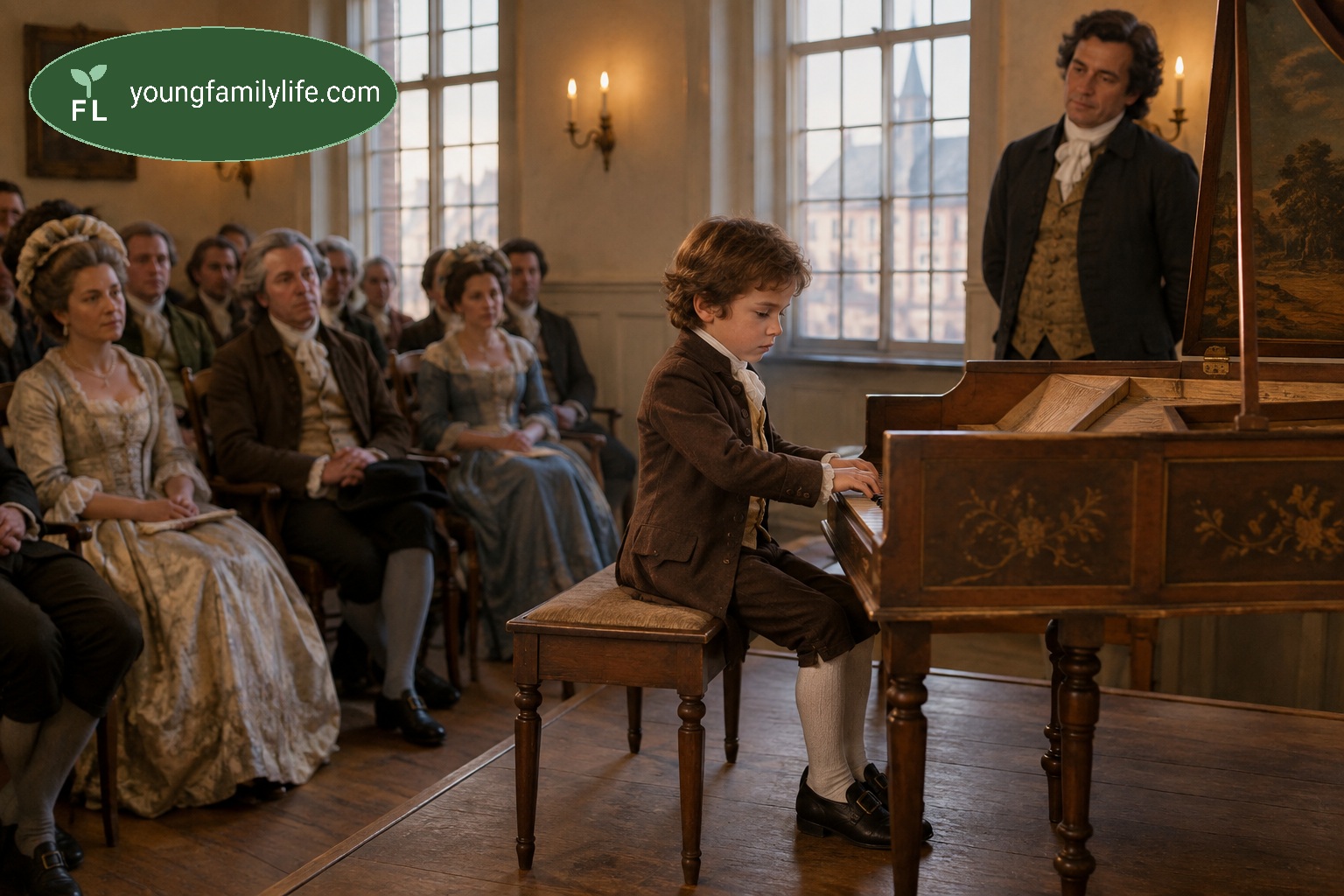
1. A poster and a register
On 26 March 1778 a poster in Cologne announced a concert by a six-year-old keyboard player. The player was seven. Ludwig van Beethoven was baptised on 17 December 1770, and the Beethoven-Haus in Bonn records the figure on the poster as wrong. His father, Johann van Beethoven, has often been suspected of taking a year off his age to recall Mozart, who had toured Europe as a child in the 1760s, but the Beethoven-Haus says that the family was itself unsure of Beethoven's exact age.
Mozart's own age was misreported in London. He was born on 27 January 1756. London notices of 1764 described him as about eight, and notices in 1765 still said eight, when he was nine. The editors of Mozart: New Documents note that the pattern of misreported ages runs through all the known documents from the family's stay in London (Edge and Black). A letter printed in the Public Advertiser on 10 May 1765 defended the stated age of eight against doubt, including the suggestion that the performer was not a child but "a Man reduced by some Defect" (Edge and Black).
Daines Barrington, a lawyer and naturalist who was a Fellow of the Royal Society, tested the boy and wrote up the result. His paper says that he had suspected the father of understating the age, and that he settled the matter by obtaining a copy of the Salzburg register of christenings through Count Haslang, the Bavarian envoy. The copy is signed 3 January 1769. The paper was read to the Society on 15 February 1770 and published in the Philosophical Transactions, more than four years after the test. It dates the test to June 1765 and gives Mozart's age then as eight years and five months. The register copy printed in the paper gives the birth date as 17 January 1756, an error for 27 January (Edge and Black). On either date Mozart was nine years and five months old in June 1765. The register check, in other words, produced a figure that was still a year too young.
Barrington's tests were designed to rule out coaching. He gave the boy a manuscript duet scored in five parts to read at sight, asked him to improvise a love song and a song of rage, and produced a treble, under which the boy wrote a bass. The paper treats age as the premise that made the tests worth reporting: a boy of that age doing those things was remarkable. Had the boy been nine, the account would still have been remarkable. It would have been less so.
2. Fathers who toured their sons
Mozart, Beethoven and Franz Liszt had the same kind of father: a court musician or official with enough training to teach the boy, and enough ambition to take him on the road.
Liszt was born on 22 October 1811 at Raiding, in Hungary. His father, Adam Liszt, was an official on the Esterházy estates and a gifted amateur musician. Adam began teaching the boy at about six. In October 1820, aged nine, Franz played in public at Sopron, reportedly performing a concerto by Ferdinand Ries, and in November he gave a concert of his own at Pressburg (reference works; limited verification). Several Hungarian nobles who heard him took on the cost of his further education. In 1822 the family moved to Vienna, where Franz studied piano with Carl Czerny and composition with Antonio Salieri. He gave his first public concert in Vienna on 1 December 1822 (reference works; limited verification).
In 1823 Adam resigned from the Esterházy service and took the family to Paris. The Conservatoire refused to admit Franz. Its director, Luigi Cherubini, applied a rule against admitting foreigners, and the boy's precocity did not change it. The Paris press took him up instead, writing his name as "Le petit Litz". Two visits to England followed in 1824 and 1825, and a third in 1827. On 17 October 1825, a few days before his fourteenth birthday, his one-act opera Don Sanche was first performed at the Paris Opéra (reference works citing Walker; limited verification).
Adam Liszt died at Boulogne-sur-Mer in August 1827, when Franz was fifteen. Franz considered giving up the concert platform, settled in Paris, and supported himself and his mother by teaching. On 23 October 1828, the day after his seventeenth birthday, the newspaper Le Corsaire printed a report of his death. He was alive (Walker, chapter headings of The Virtuoso Years). The error says something about how far the "wonder child" had faded from view in the year after his father's death. It says it with some caution, since a single newspaper's mistake is a thin base for a general claim.
Johann van Beethoven's career ended less cleanly. He sang in the electoral choir at Bonn, where a report for the new Elector in 1784 described his voice as "very stale". In 1789, on his son's petition, the Elector ordered half of his salary paid to Ludwig (Classic FM biographical guide; limited verification).
3. Goethe, and Clara Wieck
Felix Mendelssohn, born on 3 February 1809, came from a wealthy banking family in Berlin. He is said to have made his first public appearance at nine, in a chamber concert in Berlin (reference works; limited verification). In November 1821, at twelve, he travelled to Weimar with his teacher Carl Friedrich Zelter to play for Johann Wolfgang von Goethe. He stayed about two weeks. Goethe, who had heard the seven-year-old Mozart at Frankfurt in 1763, when Goethe himself was fourteen, told Zelter that what the boy could do stood in the same relation to the Mozart of that time as "the cultivated talk of a grown-up person" to "the prattle of a child". Zelter had asked him whether he had not heard Mozart in his seventh year. Goethe agreed that he had. Mendelssohn wrote his String Octet in October 1825, at sixteen.
The remark compares performance, not age. The comparison is between the child's skill and an adult's, and the judge had the earlier case in memory. Clara Wieck's early career followed a different pattern. She was born in Leipzig on 13 September 1819. Her father, Friedrich Wieck, a piano teacher, trained her from early childhood. She made her first public appearance on 20 October 1828, aged nine, at the Leipzig Gewandhaus, in a concert given by the pianist Caroline Perthaler of Graz (the Schumann-Portal; some reference works give 28 October). Her father allowed no further public appearance until 1830 (Open University). She gave her first full solo concert there on 8 November 1830, aged eleven, and set out on an extended tour in 1831. Wieck directed her concerts, and, according to Nancy Reich's biography, wrote parts of her early diary in her voice (Reich, not read; limited verification). Her marriage to Robert Schumann took place on 12 September 1840, the day before her twenty-first birthday. Wieck had opposed it, and the couple had gone to court. Accounts differ on what followed: some say that at twenty-one she would have been free to marry without his consent, others that consent was needed whatever her age and that the court's ruling in Schumann's favour allowed the marriage. The YFL essay Counting a Child's Age sets out the difference.
Mendelssohn and Clara Wieck belong to the same period and the same musical world. Goethe's judgement of Mendelssohn at twelve was a comparison of his skill with Mozart's. In Clara's case the record shows a father who trained her, chose her first appearance, directed her concerts and opposed her marriage.
4. A tomb in Rome
The most complete record of a child's performance from antiquity is on a tomb. In AD 94 an eleven-year-old, Quintus Sulpicius Maximus, entered the poetry competition at the third Capitoline Games in Rome. He was one of fifty-two Greek poets. He improvised in Greek hexameters on the theme of Zeus rebuking Helios for lending his chariot to Phaethon. A recent study counts forty-three lines; an older article counted forty.
He did not win. The epitaph says he left the contest with distinction. His parents, Quintus Sulpicius Eugramus and Licinia Januaria, set up an altar for him, and had the poem cut into it.
The Latin inscription states his age to the day: eleven years, five months and twelve days. The Greek epigram on the same monument calls him a boy of twelve (the reading is from J. Raleigh Nelson's early English translation; the Greek text has not been checked here). One monument therefore gives the age exactly in one language and rounded up in the other.
One sentence in the epitaph separates two things. It says that he turned the favour his tender years had won into admiration for his talent. The audience first responded to his age, and then to the verses. The distinction is the same one Goethe drew for Mendelssohn, and the same one Barrington's tests were designed to make. The inscription also records a motive. According to a recent edition and translation by Valentina Garulli, the parents said they inscribed the verses so that they would not seem swayed by affection for their son (Nelson's translation of the Latin; Garulli's abstract; the Latin and Greek texts have not been checked here). The child died soon afterwards.
Another child poet, Lucius Valerius Pudens of Histonium, won the Latin poetry prize at the Capitoline Games of AD 106, at thirteen (CIL IX 2860 = ILS 5178; the contest and date from a database of ancient contests, the age from a Cambridge study of the Sulpicius inscription; the inscription itself was not read). The record of Sulpicius Maximus is longer because his parents paid for stone.
5. Wonder made afterwards
For some children the wonder was constructed after their deaths, from fragments.
Marjory Fleming was born in Kirkcaldy on 15 January 1803 and died there on 19 December 1811, aged eight. Her surviving journals cover the last eighteen months or so of her life, together with letters and verses. They were not widely read until the 1850s. H. B. Farnie, a journalist at the Fife Herald, came across the writings in 1857 through her surviving sister, serialised them, and published them as a pamphlet entitled Pet Marjorie. The Edinburgh physician and essayist John Brown read the pamphlet, reworked the story, and published it in 1863 in the North British Review. Brown's essay made her famous. It also linked her to Walter Scott, a link that appears to rest on a single letter from her sister Elizabeth to Brown (Kirkcaldy local-history pages and a Morgan Library record; Sidgwick's introduction not seen; limited verification). Victorian editions cut entries that editors thought unsuitable for an eight-year-old. The complete edition is Frank Sidgwick's The Complete Marjory Fleming, published in 1934.
Carl Friedrich Gauss is the opposite case: a child credited with a feat in a story that grew. The earliest full telling is in a memorial volume by Wolfgang Sartorius von Waltershausen, published in 1856, a year after Gauss died. The teacher, Büttner, set the class a problem in summing an arithmetic series. Gauss laid his slate on the table almost at once, and his answer was right. Sartorius says "an arithmetic series" and does not name the numbers. The detail that the series ran from 1 to 100 first appears in print in 1938, according to Brian Hayes's survey of the versions (American Scientist, 2006). Gauss's age in the story varies between versions, from seven to about nine.
In both cases the child's own work survives, and in both the form in which readers met it came from adults who came later.
6. What the cases show
Three parties shape the extraordinary child in these records.
The first is the child. The evidence of what a child actually did is uneven. For Sulpicius Maximus there is a poem on stone. For Fleming there are manuscripts. For Mozart there is a published test. For Gauss there is a retelling at second hand.
The second is the adult who frames the performance. Johann van Beethoven's poster and Leopold Mozart's notices stated the age. Leopold Mozart and Adam Liszt chose the audiences and left other work to travel with their sons. Friedrich Wieck trained Clara, chose her first appearance, directed her concerts and opposed her marriage. Zelter took the twelve-year-old Mendelssohn to play for Goethe. A Paris conservatoire turned Liszt away on a rule about nationality, whatever his age or skill. Sulpicius Maximus's parents framed their son's performance by recording it.
The third is the later narrator. Farnie and Brown made Marjory Fleming the "Pet Marjorie" the Victorians knew. Sartorius, and the writers who followed him, made Gauss's classroom story. Three authors at work on one story is also the pattern traced for social media in Who Writes a Social Media Story: The Person, the Crowd, or the Algorithm?, where the person, the crowd and an algorithm each write part of it.
Age works as a lever for all three. Promoters lowered it (Beethoven's poster, Mozart's notices). Audiences registered it as part of the attraction (the epitaph's "tender years"). Later writers adjusted or fixed it (Gauss at seven, or at nine). Those who tried to check it could still err (Barrington's register). Contemporaries did not simply treat these children as under-eighteens, nor as small adults. They asked what the child could do, who stood behind the child, and how old the child was, and the answers to the three questions were not always consistent.
Some of the costs show in the record. Liszt's career faltered when his father died. Clara Wieck's career was directed by her father until her marriage. Marjory Fleming and Sulpicius Maximus died young, and the later stories were told about them as children who had died. The records do not say how any of these children felt about the attention. Only fragments of their own words survive.
References
- Barrington, D. (1770). Account of a very remarkable young musician. Philosophical Transactions of the Royal Society, 60, 54–64.
- Brown, J. (1863). Pet Marjorie: a story of child-life fifty years ago. North British Review.
- Edge, D. and Black, D. (eds). Mozart: New Documents (online), entries for 13 March 1765, 10 May 1765 and 4 November 1771.
- Deutsch, O. E. (1965). Mozart: A Documentary Biography. A. & C. Black / Stanford University Press.
- Garulli, V. (2018). A portrait of the poet as a young man: the tomb of Quintus Sulpicius Maximus on the Via Salaria. In N. Goldschmidt and B. Graziosi (eds), Tombs of the Ancient Poets. Oxford University Press.
- Hayes, B. (2006). Gauss's day of reckoning. American Scientist, 94(3), 200–205.
- Nelson, J. R. The boy poet Sulpicius: a tragedy of Roman education. The School Review, pp. 384–395 (volume and year not confirmed).
- Reich, N. B. (1985; rev. 2001). Clara Schumann: The Artist and the Woman. Cornell University Press.
- Sartorius von Waltershausen, W. (1856). Gauss zum Gedächtniss. Hirzel, Leipzig.
- Sidgwick, F. (ed.) (1934). The Complete Marjory Fleming: Her Journals, Letters and Verses. Sidgwick & Jackson.
- Thayer, A. W. Life of Beethoven, ed. E. Forbes (1964). Princeton University Press.
- Todd, R. L. (2003). Mendelssohn: A Life in Music. Oxford University Press.
- Walker, A. (1983; rev. 1987). Franz Liszt: The Virtuoso Years, 1811–1847. Knopf; Cornell University Press.
- Beethoven-Haus Bonn. Picture biography: announcement of Beethoven's first concert, 26 March 1778.
- Open University. Notes on Clara Schumann, Piano Trio, op. 17 (A level music).
- Schumann-Portal. Leipzig, 1819–1844.
Topics: #ChildProdigies #HistoryOfChildhood #MusicHistory #Mozart #Liszt #AgeOfMajority