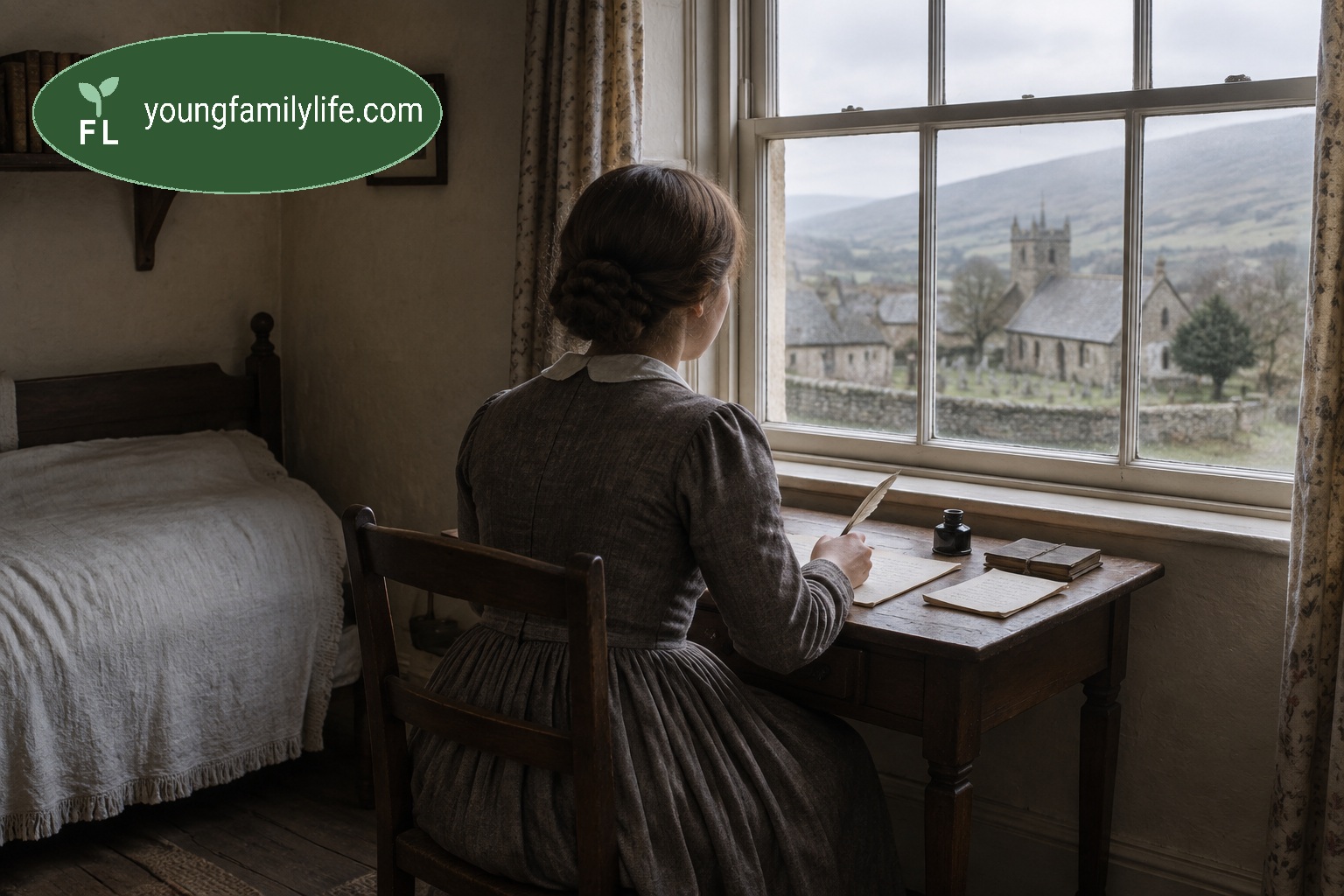
In August 1830 a girl of fourteen in Haworth, Yorkshire, listed her own books. There were twenty-two titles, among them A Book of Rhymes, written on a sheet a little over four inches long in a tiny hand, and she had made the books themselves, some as hand-sewn miniatures in handwriting so small that her first biographer later said they were almost impossible to read without a magnifying glass. The girl was Charlotte Brontë, the daughter of the local clergyman, and she became the author of Jane Eyre.
A novel can carry a child's voice further than a court record or an epitaph can. It can also remake that voice. The voice in a novel belongs to an author who was once a child, and the author's name, sex and reputation affect whether readers believe it. Whether such a voice is a marvel, or evidence, or of use to a reader now depends on whose voice it is.
1. Three tests for a girl's voice
Charlotte Brontë was born in 1816, the third of six children of the Reverend Patrick Brontë. Her sisters Emily and Anne and her brother Branwell wrote as she did. A girl's voice in the 1830s and 1840s had three tests to pass, and her case shows each.
Writing. She wrote her earliest known work at ten, and by her own count she had completed over twenty works by fourteen (Morgan Library, on her 1830 catalogue). With Branwell she imagined the world of Angria, and Emily and Anne imagined Gondal. Their father encouraged them to read books usually kept from girls, among them unabridged Byron and Shakespeare, and writing was by one account a shared activity in the household (Chawton House exhibition notes; limited verification).
Publishing. At twenty Charlotte wrote to Robert Southey, then poet laureate, and sent him poems. His reply, dated 12 March 1837, said that literature cannot be the business of a woman's life and ought not to be. She answered on 16 March, from Roe Head, the school where she taught, that she trusted she would never again feel ambitious to see her name in print, and that if the wish arose she would look at Southey's letter and suppress it (both letters are printed in Gaskell's Life, vol. 1, ch. 8, and in Margaret Smith's edition of Charlotte's letters; the wording is as quoted in reviews and in an educational resource). In May 1846 the three sisters published Poems as Currer, Ellis and Acton Bell. Charlotte explained in 1850 that they had not liked to declare themselves women, because authoresses were liable to be looked on with prejudice (Biographical Notice of Ellis and Acton Bell).
Being believed. Jane Eyre appeared on 16 October 1847 as an autobiography edited by Currer Bell. Reviewers argued over whether Currer Bell was a man or a woman. In December 1848 Elizabeth Rigby, an art critic and one of the first women to write for the Quarterly Review, whose editor, John Gibson Lockhart, had commissioned the review, wrote that if the author were a woman, she must be one who had long forfeited the society of her own sex. Charlotte answered in the preface to Shirley (1849). Thomas Newby, who had published Emily's and Anne's novels, had by then claimed that the three Bells were one man, and Charlotte and Anne travelled to London between 7 and 11 July 1848 to show Charlotte's publisher, George Smith, that there were at least two of them (a National Library of Scotland blog and Brontë society pages; Rigby's wording confirmed by a library abstract and by an online transcription of the Jane Eyre part of her review; the printed pages have not been seen).
The sisters tied the pseudonym to the second test in their own account, and the reviews show that the third test followed anyway.
2. The child's own hand, kept by others
The Brontë juvenilia are among the best-known writings of girls in their own hand, and what survives of them depended on adults and on chance.
The first public sight. Gaskell's Life of Charlotte Brontë (published 25 March 1857, two years after Charlotte's death) reproduced Charlotte's catalogue of her juvenile productions, with a specimen page (Gaskell's own table of contents). Elizabeth Gaskell was a novelist and Charlotte's friend, whom Patrick Brontë had asked to write the biography. For most readers the first sight of the child's writing was a facsimile in a biography. The catalogue is not exact: Charlotte compiled it from memory, made a few errors and left out at least eight manuscripts (Morgan Library).
The widower and the dealer. After Charlotte's death her husband, Arthur Bell Nicholls, kept her youthful manuscripts. He later sold a large collection, including many of the miniature "little books", to the dealer Thomas J. Wise, through the Brontë biographer Clement Shorter, in a sale the Poetry Foundation dates to 1895 for Emily's manuscripts. Wise had many of the books bound and sold to collectors worldwide. Manuscripts by Branwell were passed off as Charlotte's, and by Wise's death in 1937 few Brontë manuscripts remained with him (Brontë Parsonage Museum, exhibition notes). Harvard's Houghton Library holds nine of the miniature books, six by Charlotte and three by Branwell, said to be nearly half of those that survive (a Harvard preservation study; limited verification).
The tin box. The stories and plays that Emily and Anne wrote about Gondal have not survived, and their poems have. The diary papers of 1834, 1837, 1841 and 1845 were kept folded in a tin box that had been a gift from Branwell to Emily, who used it as a sewing box. The first, of 24 November 1834, was composed jointly by Emily, aged sixteen, and Anne, aged fourteen, and written out by Emily. It records the pets they fed and the apples they peeled for Charlotte's pudding. In 1895 Nicholls found a secret compartment in the box and the papers inside (a Brontë society website; limited verification). In the 1845 papers the sisters planned a new entry for 30 July 1848, and none has been found.
These are girls' own pages. They survive because the girls became famous women, because a widower held on to them, and because collectors paid for them. The widower's decision kept the pages and the dealer's decision scattered them. The YFL essay Children's Own Words in the Record sets out the routes by which a child's writing reaches readers: a clerk, a family, the child's own hand, a later editor. The Brontë pages passed through a family and a later editor.
3. The adult who speaks as the child
A child's voice can also reach readers because an adult writes it. Two authors in the 1840s did so in the first person, and each connection was made public later by a biographer.
Charlotte Brontë and Lowood. Jane Eyre places its heroine in a charity school called Lowood. Charlotte had gone at eight to the Clergy Daughters' School at Cowan Bridge in Lancashire, in August 1824, after her elder sisters Maria and Elizabeth, and Emily followed in November. Both older girls fell ill there and died soon after they were taken home, Maria on 6 May 1825 and Elizabeth on 15 June (Smithsonian Associates chronology; Calderdale companion). Jane's friend Helen Burns, who dies at Lowood, is based on Maria, and the headmaster, Mr Brocklehurst, was based on the school's founder, William Carus Wilson.
Gaskell's Life made the connection with Cowan Bridge explicit in 1857. Patrick Brontë and Carus Wilson both complained of misrepresentation, a second edition appeared on 9 May, and Gaskell's solicitors published a retraction on 27 May (Smithsonian Associates handout; limited verification). A defence of the school published afterwards argued that the picture was exaggerated (a late-Victorian reference work; limited verification). The child's voice in the novel is a grown woman's, looking back, and the record behind it was disputed by those it implicated.
Charles Dickens and the blacking warehouse. Charles Dickens (1812–1870) was one of the leading novelists of Victorian England. In 1824, at twelve, he was taken from school and sent to work at Warren's blacking warehouse while his father was in the Marshalsea prison for debt. For years he told no one. In the late 1840s he wrote an account of it, the "Autobiographical Fragment", for his friend and future biographer John Forster. The public learned of it only in Forster's Life of Dickens, from 1872, two years after Dickens's death.
David Copperfield, serialised from May 1849 to November 1850, was the first of Dickens's novels written entirely in the first person. Its Murdstone and Grinby warehouse has its basis in the blacking warehouse. Readers took the child's voice as a fictional boy's for more than twenty years before learning that its origin was the author's (Penguin reader's guide to David Copperfield; limited verification).
The two cases share a pattern. Each author turned a real childhood into first-person fiction, and in each the link between the fiction and the real childhood reached readers through a biographer, Gaskell in 1857 and Forster from 1872. The barriers were different. For Dickens the barrier, on his own account to Forster, was the grief and humiliation of the memory. For Charlotte Brontë it was the reviewers' response to a woman's name. Joan of Arc, the French military leader tried at Rouen in 1431, gave an account of her own youth at about nineteen to a court that wrote it down; the YFL essay Children's Own Words in the Record describes her case, which has the same shape, a childhood told by someone older. How a recalled childhood is reconstructed and not replayed is the subject of Why Memory? — of all things? and, in plain speak, In Other Words... why our recall of the past is never nothing but the truth?.
4. From evidence to novel
The third route runs from official evidence about children to fiction.
The Children's Employment Commission questioned working children in the coal mines in 1841, and its evidence, including that of Sarah Gooder, an eight-year-old mine worker, is described in the YFL essay Children's Own Words in the Record. The report that reached Dickens was not the mines report but the commission's second report, on trades and manufactures, published at the end of February 1843. On 6 March 1843 Dickens wrote to Dr Thomas Southwood Smith, a physician and social reformer and one of the commissioners, that he was "so perfectly smitten" by the blue book that he thought of writing a very cheap pamphlet, "An Appeal to the People of England on behalf of the Poor Man's Child". Four days later he wrote that he would defer it to the end of the year, and that what he had in mind would strike with many times the force of the pamphlet.
On 14 September 1843 he visited a Ragged School for destitute children off Saffron Hill. Four weeks later he began A Christmas Carol. He finished it on 2 December and it was published on 19 December 1843, and the first edition of 6,000 copies sold out by Christmas Eve (Mathew Lyons, on the origins of the Carol; the letter of 6 March 1843 survives in the Free Library of Philadelphia, with a copy at the British Library, and its wording is as quoted in an auction record; the Pilgrim edition has not been seen).
Dickens had put a child at the centre of a novel before: Oliver Twist ran in Bentley's Miscellany from 1837 to 1839. The Carol differs in that its stated origin was a government report of children's evidence taken down by clerks, and what readers received was an author's fiction. The difference between telling people and giving them a story, of which Dickens's change of plan is one instance, is set out in The Instruction That Doesn't Land and, in plain speak, In Other Words... Why Good Advice Sometimes Doesn't Work, and a Story Does.
5. What the novel did to the idea of the child
The historian Hugh Cunningham treats the Romantic movement of the late eighteenth and early nineteenth centuries as the key moment in the history of childhood in the West. For the Romantics, in his account, innocence became the template for the child, and children were given something not articulated before, a right to childhood, including a right to have their innocence protected and prolonged. He also argues that definitions of childhood are primarily adult constructs, imposed on children's lives (Cunningham 1995 and 2005, as summarised in a History & Policy lecture and in a review; limited verification).
The novels in this essay came after that moment. Their children are innocent in the Romantic sense and are denied what innocence was supposed to be owed: a charity school that starves its pupils, a warehouse, a ragged school. Whether such novels changed what readers believed or what legislators did is not shown by the sources used here. The Mines Act received royal assent on 10 August 1842, sixteen months before the Carol was published, and the commission's evidence is a more direct route to that statute than any novel. A novel can still do something a transcript cannot, which is to give a reader an interior for a child, the sense of what it was like. That interior is the author's.
6. What survives, and what it is worth
Return to the girl listing her books in August 1830. She had no pseudonym then, and she wrote in a household where, by one account, writing was shared. Her catalogue reaches readers now by way of a biographer's facsimile and a library, and possibly because she later became Currer Bell.
In these cases a child's voice reached readers through fiction by three routes.
Kept. A child's own pages survive when someone keeps them and others find them worth buying: the Brontë little books, kept by a widower and dispersed by a dealer, and the diary papers kept in a tin box.
Remembered. An adult writes the child he or she was. The voice has an adult's skill and an adult's selection, and the real childhood behind it can be checked only through other records: Cowan Bridge in the school's history, the blacking warehouse in Dickens's account to Forster.
Evidenced. An author turns official evidence about children into fiction, as Dickens did after the commission's second report. The children's own answers stay in the report, and the novel carries the author's version.
What a reader gains. The novel gives what a transcript does not: Lowood and the warehouse as places a child lived in, told by someone who knew them. A reader who also knows the route, who kept, who remembered, who drew on a report, can tell how far the voice is the child's and how far it is the author's.
What the cases say about girls. A girl's voice had to pass an extra gate before it reached these routes: Southey's reply, the pseudonym, and Rigby's review. The Brontës passed it by changing the name on the title page, and the girl's own pages came afterwards, in a biography and in a widower's sale. The set is small and the sisters were exceptional. It shows one girl's voice crossing three tests, not a rule.
Marvel, or use, or both. There is wonder in a fourteen-year-old's catalogue of twenty-two books, and in two girls aged sixteen and fourteen recording an ordinary Monday on a folded sheet. A marvel can also be made by the route: Jane Eyre made Lowood and David Copperfield made the warehouse, and each was read as a child's voice by readers who did not know the author's life. Novels remain a way in which children's lives become known to readers who never meet the records behind them. Whether a novel informs or replaces the record depends on whether the reader can reach the record, and the YFL essay Children's Own Words in the Record describes the channels that carry it. Who authors the stories a society keeps, and with what effect, is the subject of The Noble Lie and the Ministry of Truth: Who Gets to Author the Story.
7. A note on the evidence
The essay draws on parliamentary and library records and on translations and editions where these could be read, and on reference pages, museum and library notes, biographies and summaries for other points. Claims that rest on secondary sources only, or that have had limited verification, are marked as such where they appear. The cases are chosen to show the routes and are not a sample. The conclusions drawn from them are provisional.
References
- Brontë, C. (1847). Jane Eyre: An Autobiography, edited by Currer Bell. London: Smith, Elder.
- Brontë, C. (1849). Shirley. London: Smith, Elder. [preface]
- Brontë, C. (1850). Biographical notice of Ellis and Acton Bell. In Wuthering Heights and Agnes Grey, new edition. London: Smith, Elder.
- Brontë, C. The Letters of Charlotte Brontë, ed. M. Smith (1995–2000). Oxford: Oxford University Press. [letters to Southey of 1837; seen as quoted]
- Brontë Parsonage Museum. Exhibition notes on the dispersal of the Brontë manuscripts. (details not confirmed)
- Cunningham, H. (1995; 2nd ed. 2005). Children and Childhood in Western Society since 1500. Harlow: Longman.
- Dickens, C. (1849–50). David Copperfield. London: Bradbury and Evans.
- Dickens, C. (1843). A Christmas Carol. London: Chapman and Hall.
- Dickens, C. Oliver Twist (serialised in Bentley's Miscellany, 1837–39).
- Forster, J. (1872–74). The Life of Charles Dickens, vol. 1 (the autobiographical fragment). London: Chapman and Hall.
- Gaskell, E. (1857). The Life of Charlotte Brontë. London: Smith, Elder. [vol. 1, ch. 8 (the letters to and from Southey); the catalogue and specimen page; Cowan Bridge chapters; seen through contents lists and quotations]
- Mines and Collieries Act 1842 (5 & 6 Vict. c. 99; royal assent 10 August 1842).
- National Library of Scotland. Blog on Charlotte Brontë, Currer Bell and Jane Eyre (the visit to London, July 1848; Rigby's review).
- The Letters of Charles Dickens, Pilgrim Edition, vol. 3 (1842–43). Oxford: Clarendon Press. [letters of 6 and 10 March 1843 to T. Southwood Smith; edition not seen; manuscript catalogue records of the letter of 6 March 1843 (Free Library of Philadelphia; British Library RP 10886) and an auction description of the letters]
- Lyons, M. (2022). Charles Dickens and the origins of A Christmas Carol. (web essay; details not confirmed)
- [Rigby, E.] (December 1848). Vanity Fair—and Jane Eyre. The Quarterly Review, 84 (167), 153–185. [printed pages not seen; the Jane Eyre part reproduced online]
- Southey, R. Letter to Charlotte Brontë, 12 March 1837. [as printed in Gaskell's Life, vol. 1, ch. 8; manuscripts acquired by the Brontë Parsonage Museum in 1995; seen as quoted]
- The Morgan Library and Museum. Charlotte Brontë, Catalogue of my Books (up to 3 August 1830); blog entry "Charlotte Brontë's Teenage 'Catalogue of Books'". (manuscript catalogue entry not cited)
- Children's Employment Commission (1842, 1843). First report (mines) and second report (trades and manufactures). Parliamentary Papers.
- Poetry Foundation. Biographical entry for Emily Brontë. [secondary]
- Harvard University, Houghton Library. Lowell collection of Brontë juvenilia, MS Lowell 1. [as described in a preservation study; secondary]
Topics: #ChildhoodInFiction #CharlotteBronte #CharlesDickens #ChildrensVoices #HistoryOfChildhood #VictorianLiterature