Egypt: A Boy on the Throne
Tutankhamun is the Egyptian king whose tomb, found in 1922, was full of gold. He was about nine when he became king of Egypt, and he died about nine years later.
A king that young cannot run a country. Advisers, including the general Horemheb and the chief minister Ay, helped him rule. He stayed king all the same.
Egypt did this many times. Thutmose III, who grew up to be one of Egypt's great conquering kings, was a child king too. His stepmother, Hatshepsut, ruled for him at first. By about his seventh year she was calling herself king. Hatshepsut was one of the few women ever to rule Egypt as king. The stand-in had taken the title.
Pepi II, the last well-known king of Egypt's Old Kingdom, the age of the pyramid builders, came to the throne as a child, over 4,000 years ago. A letter in his name, from his second year, is full of excitement about a dancing dwarf an explorer called Harkhuf was bringing him. The letter was probably written on papyrus, the paper of ancient Egypt. That copy is lost. Harkhuf was proud of it, and he had the words cut in hieroglyphs on the front of his tomb at Qubbet el-Hawa, near Aswan. They survive there. A child king's excitement has lasted over 4,000 years because an official carved it in stone. An ancient king list gives Pepi II a reign of over ninety years. Many modern scholars think about sixty-four.
England: The Old Knight Who Ran the Kingdom
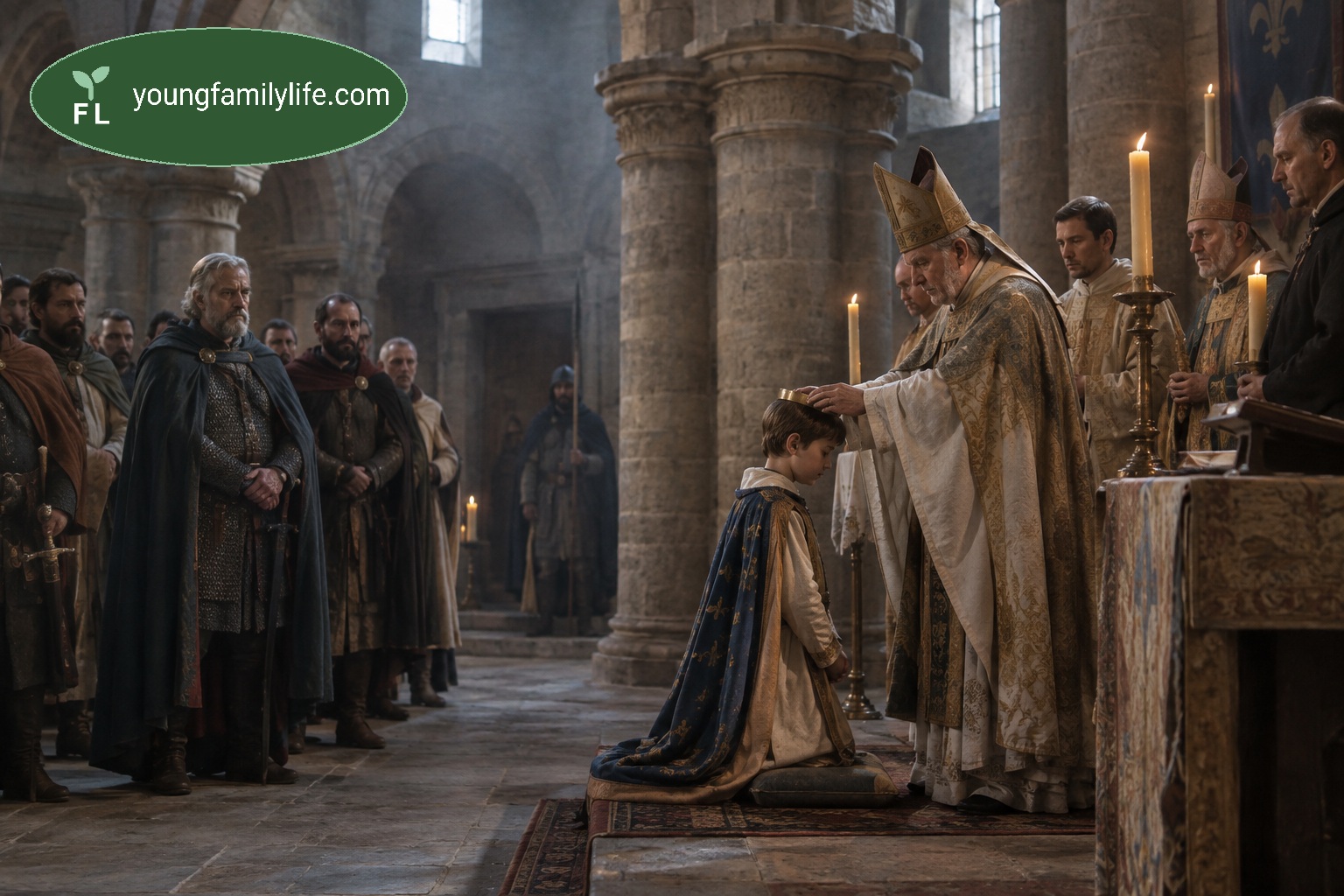
Henry III was king of England from 1216 to 1272. He was the son of King John, the king who had been forced to sign Magna Carta in 1215. Henry was crowned at nine, at Gloucester, in October 1216. England was in the middle of a civil war.
The man who ran the kingdom was William Marshal, a famous old knight. His title was rector regis et regni. In plain English, ruler of the king and of the kingdom.
Marshal gave up the job in April 1219 and died the next month. Others took over. Henry took control of his own seal in December 1223, aged sixteen. He was not declared of age until January 1227, when he was nineteen.
Historians usually call Marshal a "regent". One historian, Emily Ward, argues that is a modern word. At the time, she says, people saw two separate jobs: being the king, and looking after him. Marshal did the second.
Henry VI, the son of the warrior king Henry V, who won the battle of Agincourt, was king of England before his first birthday. He was crowned in England at nearly eight and in Paris at ten. He took full control in 1437, a month before he turned sixteen, though sources differ on the exact date.
Rome: Two Boy Emperors and the Men Behind Them
Honorius ruled the western half of the Roman empire. He was eight when he was made emperor in AD 393. At ten he became sole emperor in the west. A general, Stilicho, held the real power.
Valentinian III was another western emperor, and he was six when he became emperor, in AD 425. His mother, Galla Placidia, ruled for him. From AD 433 a general, Aetius, took over.
A historian of this period, Meaghan McEvoy, argues that Rome did not see this as a freak event. It became a working system. A child sat on the throne. A strong adult stood behind it.
France: A Law for the King's Birthday
France decided to fix the age in law. In 1374 King Charles V, known as Charles the Wise, ordered that a king of France came of age when he began his fourteenth year. That is thirteen full years.
The rule was used. Louis XIV, the "Sun King", who went on to rule France for 72 years, became king at four, in 1643. He was born on 5 September 1638. His majority was declared on 7 September 1651. That was two days after his thirteenth birthday.
Tibet: Fifteen and Suddenly in Charge
The Dalai Lama is the spiritual leader of Tibetan Buddhism and, in this period, headed Tibet's government too. Tibetans believe each Dalai Lama is the rebirth of the one before. After the 13th Dalai Lama died in 1933, oracles and a vision in a sacred lake sent search parties out to find the boy. They found a farmer's son, Lhamo Thondup, born in 1935 in north-eastern Tibet: at two he recognised a lama disguised as a servant, and he later picked out the 13th Dalai Lama's belongings from a set of similar objects. Oracles and senior lamas confirmed him, and he was enthroned in February 1940, aged four. Regents ran the government until 1950.
In October 1950 Chinese troops captured the town of Chamdo, in eastern Tibet. On 17 November 1950 the Dalai Lama took full power. He was fifteen. Traditionally a Dalai Lama took full power at eighteen, so this was three years early. Tibetan sources give his age as sixteen, by Tibetan reckoning.
China: A Boy of Three on the Throne
Puyi was the last emperor of China. The Guangxu Emperor died in November 1908 with no son. The dying Empress Dowager Cixi, who ran the court, chose his two-year-old nephew Puyi as the next emperor. She died the next day. Puyi was enthroned on 2 December 1908, when he was not yet three. His father, Prince Chun, was regent until December 1911. Then the Empress Dowager Longyu took over.
On 12 February 1912, an edict in the name of the Empress Dowager Longyu, the widow of the emperor before him, gave up the throne for him. Puyi had just turned six.
What Happened When They Grew Up
Some child kings kept their guides for years. Others struck fast.
Henry III of England declared himself of age in 1227. He kept Hubert de Burgh, the minister who had run the kingdom since Marshal's death, for five more years. In July 1232 he dismissed him and put him in prison on a charge of treason. Hubert was pardoned two years later.
Edward III of England was fourteen when his father was overthrown in 1327. His mother, Isabella, and her lover Roger Mortimer ruled in his name for almost four years. On the night of 19 October 1330, at seventeen, Edward had Mortimer seized in Nottingham Castle. Mortimer was hanged that November. Isabella was spared, but she was pushed out of politics.
Akbar, the great emperor of Mughal India, took the throne in 1556 at thirteen. His guardian, Bairam Khan, ran the empire for him. In 1560, at about eighteen, Akbar ended the regency. Bairam's enemies at court pushed him into a revolt, which failed. Akbar pardoned him and let him go on pilgrimage to Mecca. In 1561 an Afghan whose father Bairam had killed murdered him on the way.
Peter the Great, the Russian tsar who later turned his country into a major power, became tsar at ten, in 1682. His half-sister Sophia ruled as regent. In 1689, at seventeen, Peter turned on her. She was shut away in a convent, and her main supporters were exiled or executed.
Louis XIV was twenty-two when Cardinal Mazarin, who had run France for him, died in March 1661. Louis said he would be his own chief minister. Six months later he had Mazarin's finance minister, Nicolas Fouquet, arrested. The court spared Fouquet's life. Louis changed the sentence to life in prison.
In Rome, Honorius had the general Stilicho, who had run the western empire for him, put to death in 408. Valentinian III killed the general Aetius with his own hands in 454. Valentinian was thirty-five. A year later two of Aetius's followers murdered him.
Thutmose III was different. Hatshepsut died when he was a grown man, and he had no regency left to escape. More than twenty years after her death, he had her names and images chiselled off her monuments. Historians still argue about why. Some say revenge. Others say he was protecting his own claim to be the rightful heir.
In these stories the first act of a grown king was usually to remove a person, not to repeal a law.
What They Had in Common
The same few things turn up in every story.
First, the child kept the title. Nobody thought a king of nine could be less of a king.
Second, an adult did the work. A knight, a general, a mother, a father, a group of officials.
Third, the end did not come on a birthday. It came with an event: a seal, a law, an invasion. In France, a king's age was written into law. In England, Henry III simply declared himself of full age in January 1227, on the advice of his chief minister.
There was a risk in this. The adult who ruled for a child king could keep the power. Egypt's Hatshepsut did. Rome's generals held it for years. There was a risk for the adult too. A king who grew up could remove them.
Topics: #InOtherWords #ChildKings #Regency #HistoryOfChildhood #RoyalMinorities