A Mind That Wants to Know
A healthy mind, at any age, wants to know things. Not because a teacher has asked it to, and not because a test is coming — just because finding something out feels genuinely good to do, on its own terms. Children are usually better at following that feeling than adults are, right up until school, screens, and busy evenings start crowding it out.
This isn't just a human thing, either. Young brains across a huge range of species — puppies, crows, dolphin calves, human toddlers — arrive already wired to want to find things out. It's one of nature's more reliable habits: a young mind that pokes about, watches closely, and investigates its surroundings tends to do better than one that doesn't bother. In species that live and grow up in groups, humans included, there's a second layer on top of that: the more this natural curiosity actually gets encouraged rather than shut down, the more the brain responds by building itself further, forming more connections between brain cells. That extra wiring is what turns a passing interest into something properly learned, remembered, and usable later on. Curiosity that gets fed doesn't just fill an evening. It leaves the brain a little more built than it was before.
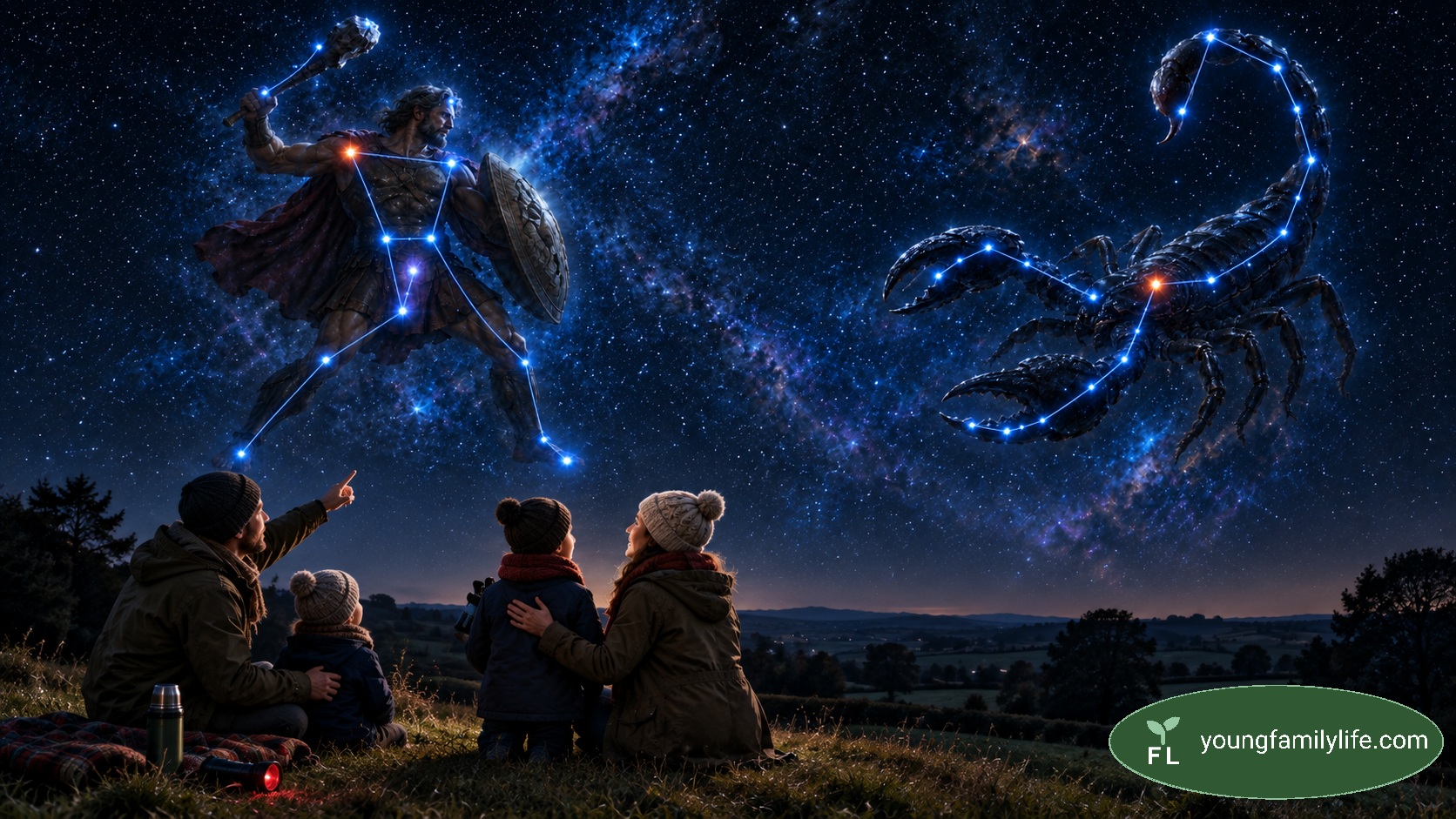
The night sky happens to offer two completely different doors into that same wanting, both opening from exactly the same view. One door leads toward science: what a star actually is, how far away it sits, why it's a particular colour, what happens when one runs out of fuel. That's physics, chemistry, and maths, encountered as genuine curiosity rather than a worksheet. The other door leads somewhere else entirely: the stories people told about those same points of light — a hunter, a bear, a scorpion, a queen — and why those particular stories, out of every possible story, are the ones that survived. That's literature, psychology, and the study of how whole societies pass on what matters to them.
Neither door is the "proper" one. A family standing outside on a dark night gets to walk through both at once, without choosing, and without either parent or child needing to already know the answers before starting.
A Torch, a Flask, and the Lights Going Out
There's a particular moment in a night walk that does something to a child's imagination no classroom can quite manage: the moment the torch clicks off. Eyes take a few minutes to adjust. Then, gradually, the sky stops being a flat dark ceiling and becomes something with depth — hundreds of points of light, then thousands, then, on a proper dark night, a pale smudge of the Milky Way arcing overhead that most children living anywhere near a town have simply never seen.
Right now is a genuinely good time to try it. The nights are drawing in fast through September and October, which means proper darkness arrives at a much more sociable hour than it does in June — often before a young child's bedtime — while it's still mild enough to stand around outside in a coat rather than full winter kit. It's a short, comfortable window, and it's open right now.
Why This Particular Activity Earns Its Keep
It would be easy to file stargazing under "nice thing to do," alongside a walk on the beach or a trip to the park. The research on what actually happens for children during and after it suggests it's doing more specific work than that.
Learning to pick out a pattern in a genuinely confusing field of thousands of points of light is a real cognitive skill — noticing structure, holding a shape in mind, checking it against what's actually there — and it's the same skill that underlies a great deal of early scientific and mathematical thinking, just practised somewhere far more captivating than a worksheet. Reading or being told the stories behind what's been spotted adds a second, different kind of learning on top: vocabulary, narrative structure, cause and effect, and — for many children — the first real encounter with the idea that other cultures, in other centuries, looked at the exact same sky and told a completely different story about it.
None of this requires equipment, a telescope, or any prior knowledge on a parent's part. A few myths, a flask of something warm, and enough patience to stand still for twenty minutes is the entire cost of entry.
The Stories Still Do the Heavy Lifting
The companion essay to this piece, The Warrior in the Winter Sky, makes the case that ancient constellation myths were never simply decoration. They were a memory system — a way of making a genuinely useful, checkable fact (a particular pattern of stars rises here, at this time of year, and is gone by summer) memorable enough to survive being retold for thousands of years without ever being written down.
That's still exactly how the myths work on a child hearing them for the first time tonight. A pattern of stars is, on its own, a fairly abstract thing to hold in a five-year-old's mind. A hunter, a bear, a queen chained to her throne, a hunter and a scorpion kept forever apart on opposite sides of the sky — those stick. Once the story is attached, the pattern usually is too, and a child who can find Orion's belt at seven often still can, unprompted, at seventeen.
Where to Actually Go
Norfolk and Suffolk are, by national standards, unusually well placed for this. Several officially recognised Dark Sky Discovery Sites sit within a manageable drive of most of the region, chosen specifically because they meet strict national standards for low light pollution and a clear, open view of the horizon:
- Kelling Heath and Wiveton Downs, North Norfolk's two designated sites, both regularly rated among the best in the country, with genuinely dark skies and, on the right night, a chance of the aurora
- RSPB Titchwell Marsh, on the North Norfolk coast, with wide, uninterrupted views over the marsh and occasional public stargazing evenings with astronomers on hand
- Barrow Common, near Brancaster, an elevated, open site with good sightlines in every direction
- Westleton Common and Walberswick, in Suffolk, both open coastal heathland with a free, all-year car park
None of these require booking or equipment, though binoculars help if a family has a pair lying around. A red-filtered torch (or a torch with red cellophane taped over the lens) is worth the five minutes it takes to make, since it preserves everyone's night vision far better than a phone screen switching on and off.
A Few Apps Worth Having, Used Sparingly
A phone is genuinely useful for this, held the right way. Point one of the current identification apps at any patch of sky and it will overlay the names of what's actually there in real time, which turns "is that a star or a plane" into an answered question in seconds rather than a five-minute squint. A few worth knowing:
- Stellarium Mobile — the free version is open-source, ad-free, and genuinely comprehensive; the closest thing to a proper planetarium in a pocket, and a sensible first download for a family not sure they'll stick with the hobby
- Star Walk 2 — the most visually polished option, with illustrated constellation artwork rather than just star-to-star lines, an augmented-reality view, and built-in quizzes that tend to land well with younger children specifically
- Night Sky — free, iOS only, a solid alternative with a similar point-and-identify approach
One genuine caution, echoed by nearly everyone who reviews these apps professionally: a bright phone screen resets night vision instantly, undoing the ten or so minutes it took eyes to adjust to the dark in the first place. The fix is the same one already mentioned for a torch — use the app's night mode or a red screen filter if it has one, keep brightness as low as it will go, and treat it as a brief check-in rather than something to keep glancing at throughout. The point of the evening is to look at the sky, not the screen; the app is there to answer the odd question, not to replace the looking.
What's Coming This Winter
Right now, in September, the sky on offer is the tail end of summer's stars, low in the west after dark. But there's a reason to keep the habit going into the darker months rather than treating this as a one-off outing. Orion — the single most recognisable and mythologically rich constellation in the sky, the subject of this piece's companion essay — begins climbing into the pre-dawn sky from around now, is rising at a reasonable evening hour by November, and dominates the whole of the winter sky by December and January. A family that starts the habit on a mild September evening has a clear, obvious next chapter waiting for them within a couple of months, with a proper story attached and ready to tell.
Curiosity Worth Keeping, at Any Age
None of this needs treating as an educational activity, and that's rather the point. Following a question because it's interesting, with no test at the end of it, is one of the simplest and best-documented ways a mind — child or adult — stays engaged and well. That doesn't stop being true once school starts; if anything, a child who gets regular practice at wanting to know things for their own sake tends to carry that same appetite back into the classroom, where curiosity is usually asked for but rarely modelled.
A parent standing in a dark field asking the same questions as their child — what is that, why does it do that, who first told a story about it — isn't running a lesson. They're doing the thing itself, alongside their child, which is a different and rather better position to be in. The sky doesn't run out of new things to wonder about, and neither, given the chance, does the mind looking up at it.
Topics: #HeyWantToKnow #Stargazing #Astronomy #FamilyLearning #Curiosity #NorfolkAndSuffolk #NightSky #HWTK
Further Reading
These sources dig deeper into the topics covered here:
Going Deeper:
- Onlypassionatecuriosity.com (2024). 24 Life Skills Kids Can Learn Through Stargazing — a plain-language summary of the literacy, pattern-recognition, and environmental-awareness benefits referenced here.
- Great British Life / Norfolk Coast AONB Partnership — official guidance on Norfolk and Suffolk's Dark Sky Discovery Sites, their criteria, and accessibility.
- SkyWhen and TelescopeGuides (2026) — independent reviews of current stargazing apps, including the night-vision/screen-brightness caution referenced here.