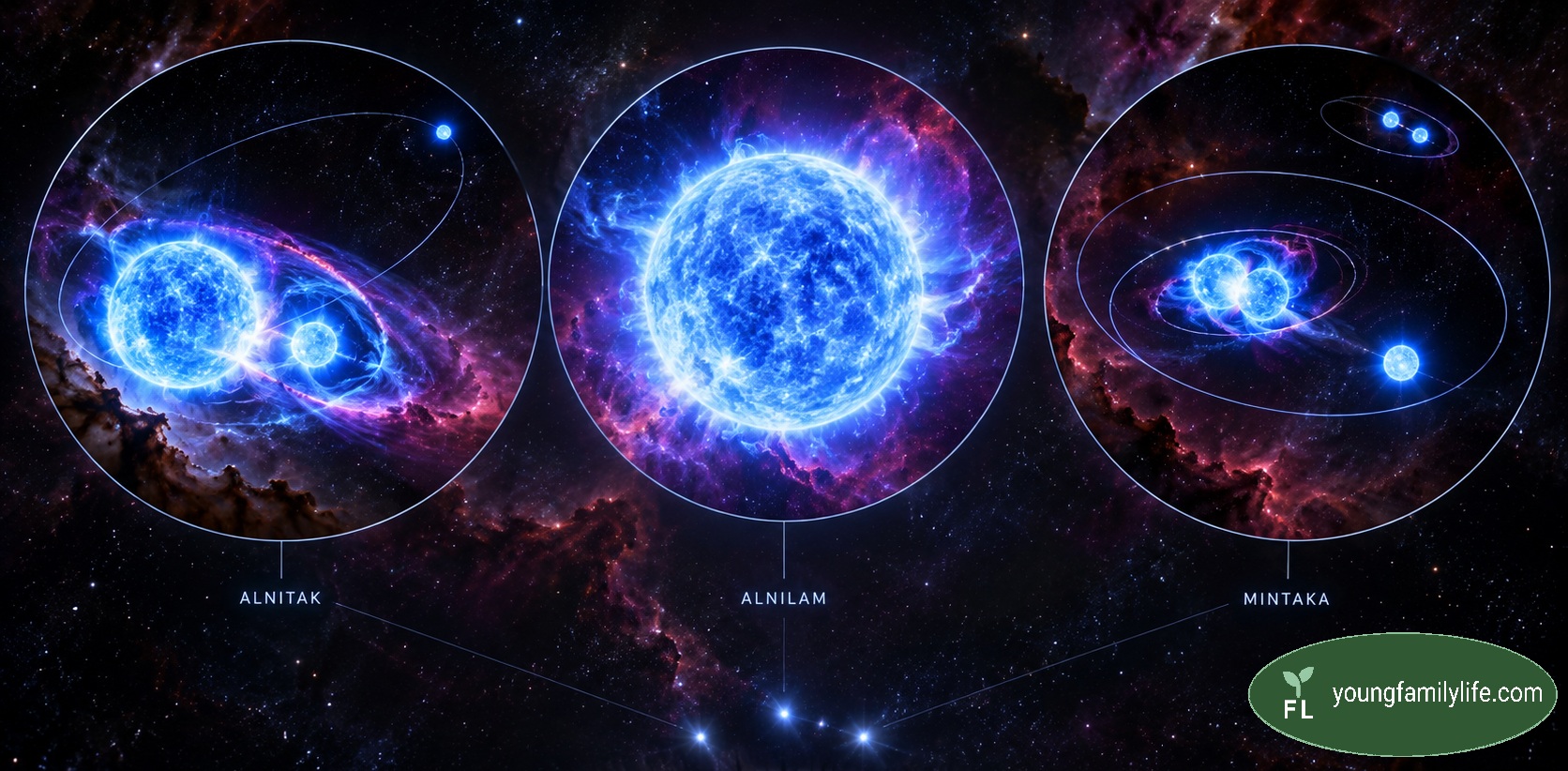
Orion's Belt, close up — scary beyond imagination.
The Belt Has Its Own Monster, and It's Real
Look at Orion's belt — the three evenly spaced points anyone can pick out without trying — and it looks like the simplest, most orderly part of the whole night sky. It isn't. Alnitak, on one end, isn't one star at all; it's at least three, two of them locked in an orbit so close that no unaided eye could ever separate them, with a third caught in the same system. Mintaka, on the other end, is stranger still — a tight cluster of five stars bound together. Only the middle one, Alnilam, is genuinely just a single star. The "three stars" that anyone can point at on a clear night are, once actually measured, closer to ten.
None of them are quiet, either. They're blue supergiants, burning through their own fuel so fast that, put together, they outshine the Sun by roughly a million times over. And the whole belt sits inside a dense stretch of gas and dust that's still forming brand-new stars right now, this year, glowing in shapes photographers now call the Flame Nebula and the Horsehead Nebula.
None of that needed a scorpion, a hunter, or an invented monster to be worth feeling something about. A star burning through its own mass fast enough to outshine a million suns combined is genuinely startling, in a way no myth had to exaggerate to achieve. The physics isn't the dull, factual alternative to the story. It's just as capable of being strange, alarming, and hard to quite believe — it simply doesn't need anyone to add meaning on top, because what's actually there is already more than enough.
Two Ways to Wonder About the Same Sky
A healthy mind, young or old, wants to know things — not because it's told to, just because finding something out feels good in itself. The night sky happens to open two completely different doors into that same wanting. One door leads toward science: what a star actually is, how far away it sits, why some burn blue and others red. The other door leads toward something just as real but completely different: why people, in every century and every culture, have looked at the exact same lights and told stories about them — and why some of those stories, astrology included, still feel oddly convincing today.
This piece is about that second door. Not because it's less important than the science, but because the psychology behind why a horoscope feels true is its own genuine subject — closer to literature and psychology than astronomy, and just as worth understanding properly.
What a Horoscope Actually Is, and Where It Came From
For most of the last hundred years, a newspaper had a handful of must-read sections that pretty much everybody flicked to first — the weather, the football and horse racing results, the crossword, and the horoscope column. The horoscope was a short daily or weekly forecast — a paragraph or two for each of twelve star signs, promising something about love, money, or luck depending on when someone was born. The first one appeared almost by accident. In 1930, a British newspaper called the Sunday Express asked an astrologer named R. H. Naylor to write a horoscope to mark the birth of a royal baby, Princess Margaret. It was meant to be a one-off. Readers loved it, so the paper asked him to keep going, and other papers quickly copied the idea. Within a few years, writing a full personal chart for every single reader proved far too slow, so Naylor switched to writing one short forecast per star sign instead — the same twelve paragraphs, printed everywhere, applying to millions of people at once. That format is still exactly what a newspaper horoscope looks like today.
For decades, a horoscope column was close to a fixture — nearly every newspaper carried one, whatever the people running the paper actually thought of it. That has started to change. Some major newspapers dropped their horoscope column altogether over the last fifteen years or so, and one of the longest-running horoscope magazines in America, in print since 1935, closed for good in 2020. Print newspapers generally have far fewer readers than they used to, and horoscopes have followed that decline — though the appetite behind them has not gone away, it has mostly just moved onto phones and social media instead.
Because of all this, most people today still know their own star sign, even people who have never read a horoscope in their life. The story behind the symbol itself is a different matter — it rarely comes up at all. Take Cancer, one of the twelve. It is a crab. Why a crab? In the old Greek story, the hero Hercules was fighting a monstrous many-headed serpent called the Hydra, and partway through the fight, the goddess Hera — who hated Hercules — sent a giant crab to bite him and put him off. It grabbed his foot. Hercules, mid-battle, simply stamped on it. That was the entire heroic career of the crab: one bite, then crushed underfoot. Hera, apparently satisfied with the effort anyway, placed it among the stars as a reward. It is fitting, in a strange way, that Cancer is one of the faintest, hardest-to-spot constellations in the whole zodiac — barely a smudge of stars for a monster that barely got a fight in.
There's a genuine coincidence sitting right next to that story, and it has nothing to do with astrology at all. The disease also called cancer got its name from a crab too — entirely separately. Around 400 BC, the Greek physician Hippocrates was looking at tumours and thought the swollen blood vessels spreading out from them looked like a crab's legs, so he called them karkinos, the same Greek word for crab. A Roman doctor later translated that into Latin as cancer, which is where the English word comes from. Nobody planned it. One crab comes from a myth about Hercules and a bad-tempered goddess; the other comes from a doctor squinting at a tumour two and a half thousand years ago. They just happen to share a name, because both, independently, reminded somebody of the same animal.
The Test Where Everyone Got the Exact Same Answer
In 1948, a psychologist tried a strange little experiment for real. A class of students each filled in a personality quiz. A week later, everyone was handed what they were told was their own personal result, based on their own answers. Almost everyone said it was accurate — some said it described them "very well" or "exceptionally."
Every single student was given the exact same piece of paper. Word for word. The psychologist hadn't even used their quiz answers. He'd copied the whole thing out of a newsstand astrology book.
Nobody in that room was foolish. They were doing something every human brain does, all the time, without meaning to: when a description is worded just vaguely enough — can be quite outgoing, but at other times prefers to keep to themselves — almost anyone reading it thinks, that's me. It isn't magic, and it isn't really about the stars at all. A sentence loose enough to fit nearly everyone will feel, to each person reading it, like it was written just for them.
Why We See Shapes in the Stars
Long before anyone could explain what a star actually is, people looked up and saw hunters, bears, queens, and scorpions in the scattered dots overhead. That's not because the stars are secretly arranged that way. Most of the stars in a single constellation aren't even near each other — they just happen to line up from wherever a person is standing on Earth, at this particular moment in a very long history. Wait long enough — tens of thousands of years — and the shapes drift apart and stop looking like anything at all.
So why does almost every human culture do this — find hunters and bears in randomly scattered lights? Because spotting a pattern, even a pattern that isn't really there, has always been useful for staying alive. A brain that occasionally sees a tiger in the shadows that isn't actually there loses nothing much. A brain that fails to notice a tiger that is there might not get a second chance. Because of that, brains got built to jump to "that's a shape, that's a face, that's an animal" first, and only stop to check properly afterwards — and spotting a "hunter" in the night sky is that exact same habit, just landing somewhere harmless.
How People Remembered Things Before Anyone Could Write
The old myths are worth taking seriously for a reason that has nothing to do with whether the astrology itself is true. For nearly all of human history, there was no writing. If a fact mattered enough to keep — which plants were poisonous, which star pattern meant winter was coming, which stretch of ocean led home — it had to survive being told, out loud, from memory, over and over, for generations, without ever being written down.
A flat fact is hard to remember that way. A story is easy. Give a wandering star pattern a name, a personality, a grudge against another constellation, and suddenly a genuinely useful fact — this pattern rises here, at this time of year, and is gone by summer — becomes something a child can repeat back word for word after hearing it only once or twice. Sailors crossing oceans without a single instrument memorised the sky this way. So did farmers timing their planting by which stars appeared before dawn. Take the story away, and most of that knowledge would simply have been forgotten within a generation or two — the story is the reason it lasted thousands of years instead.
What This Means for Reading a Horoscope
None of this means astrology is secretly true, and it doesn't mean the people who enjoy reading their horoscope are being silly. Surveys in Britain find that hardly anyone actually expects the stars to predict next week — but a much larger number will read a description of their star sign and think it sounds like them, in exactly the way that class of students did in 1948. That's not proof the stars are talking. It's proof that almost anyone, shown a warm, flattering description and told it was written just for them, will find a way to see themselves in it — stars or no stars.
The sky itself is doing something far stranger and better documented than any horoscope claims — Orion's belt, back at the start of this piece, already showed it: real physics, real chemistry, stars being born and stars dying, at distances too large to properly picture. That story doesn't need any invented meaning added on top. It's already, on its own terms, one of the strangest and best true stories there is.
The crab is worth one last thought here. A disease and a star sign have carried the same name for two and a half thousand years for no reason at all beyond two different people, in two different centuries, looking at two completely different things and thinking of the same animal. Nobody designed that connection, and it doesn't mean anything — but it's exactly the kind of coincidence a pattern-seeking mind is primed to notice and want to read significance into. Knowing where the two crabs actually came from doesn't make the story less interesting. If anything, it's a better story once the workings are visible.
Both doors — the psychology of why a vague sentence feels personal, and the physics of what a star actually is — start from the exact same place: a curious mind looking at the same sky and asking a genuine question. Following either question just because it's interesting, with nobody grading the answer, is a good habit at any age, and one that tends to feed straight back into how a child engages with a proper science lesson, or a proper English lesson, once term starts again.
Topics: #InOtherWords #Astrology #Zodiac #Psychology #CriticalThinking #Astronomy #Wonder
Related YFL Content
In Other Words... The Warrior Who Forever Defends Against the Monster — the myth this piece keeps returning to, told in full, alongside the physics hiding inside the same ten stars.
The Warrior in the Winter Sky: Orion's Myth and Its Machinery — the constellation myths in this piece, followed all the way into one warrior's full story and the real physics hiding inside it.
Hey!, Want To Know: How a Starlit Sky on a Mild Autumn Night Might Be the Best Playground for a Developing Mind? — how to actually go and try any of this, tonight, with a torch and a warm coat.