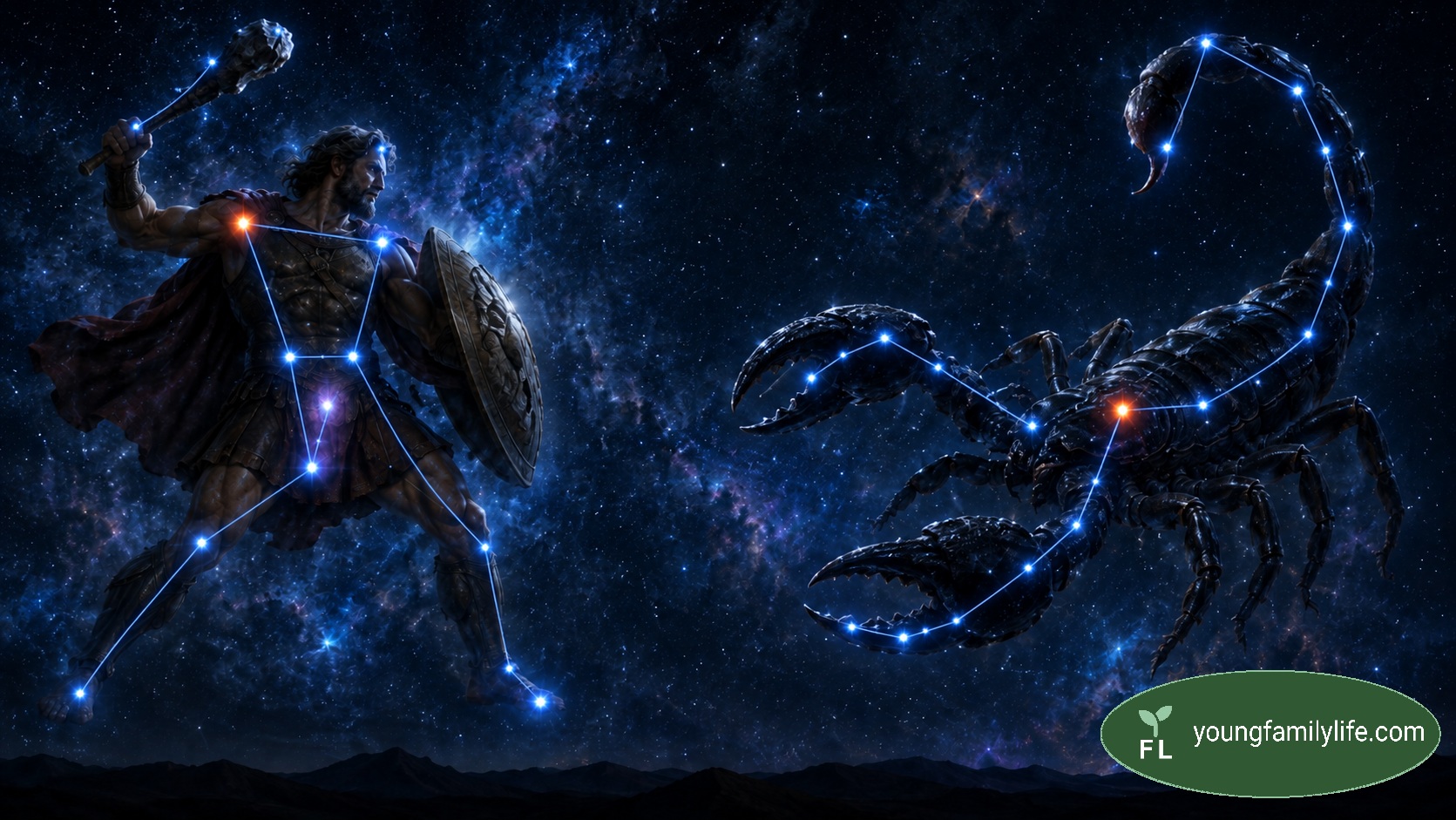
On a clear evening in late autumn, low in the east after dark, a familiar shape begins to climb: three stars in a short, even line, a bright reddish point above one shoulder, a brilliant blue-white point below the opposite hip. By midwinter the same shape stands high overhead at a reasonable hour. By late spring it has slipped away into the daylight sky entirely, not to be seen again until the following autumn brings it back.
This is Orion, and the seasonal drama of its arrival and retreat is not folklore layered on top of an astronomical fact. It is the astronomical fact, read a particular way. Orion sits almost exactly on the celestial equator, which is why it is visible from nearly everywhere on Earth — but the reason it appears only in the evening sky for half the year is simply the Earth's own orbit around the Sun, carrying the night side of the planet to face a different portion of the sky as the months pass. Orion has not moved. The Earth has.
Ancient sky-watchers noticed this rhythm long before they had any concept of orbital mechanics to explain it, and they did what humans reliably do with a pattern that repeats on a schedule: they told a story about it. The story they told is one of the oldest and most complete pieces of narrative astronomy that survives, and it turns out to encode the very physical fact that produced it.
The Hunter and the Scorpion
In the most widely told version of the Greek myth, Orion was a giant and peerless hunter — so confident in his own skill that he boasted he could kill every animal on Earth. This boast reached Gaia, the Earth goddess, who took it as an intolerable threat and sent a scorpion to destroy him. Orion died from the scorpion's sting, and the gods placed both hunter and scorpion among the stars — but on opposite sides of the sky, so arranged that as one rises the other sets, and the two can never occupy the heavens together.
This is, quite literally, a story about the constellations' seasonal behaviour, encoded as a narrative about pursuit and permanent avoidance. Orion is a winter constellation; Scorpius is a summer one. When Scorpius climbs into the evening sky, Orion has already dropped below the horizon, and the reverse holds true six months later. The myth does not merely accompany this fact. Bruner's distinction between paradigmatic and narrative modes of thought, discussed in this essay's companion piece, is visible here in unusually pure form: the paradigmatic version of this fact is a sentence about orbital geometry and axial tilt; the narrative version is a story about a boastful hunter who can never meet his killer again, and the story is what actually survived, unaided, for well over two thousand years before anyone could state the orbital mechanics that produced it.
The boast itself is worth pausing on, because a modern reading tends to arrive with a modern set of assumptions already built in. To a listener with no direct experience of predation and no dependence on hunted meat, a man who claims he can kill every animal on Earth sounds like a description of indiscriminate slaughter — arrogance calling out to be punished, which is exactly how the myth is now usually told and understood. To the boast's original audience, the same claim would have carried an entirely different weight. For a Bronze Age or Iron Age community, dangerous predators were a constant and immediate threat to human life, and meat was not a lifestyle choice but the difference between a tribe that was adequately fed and one that was not. A man capable of killing anything was not a menace to be feared; he was a guarantee — protection from what hunted people, and provision of what kept them alive. Orion's boast, heard this way, is not hubris inviting punishment. It is closer to a superhero's origin story: the standard every hunter in the tribe measured themselves against, and the person a community would have wanted, not feared, to have among them. The gods' response — sending Gaia's scorpion to end him — reads today as a morality tale about pride. It may equally have begun as something closer to tragedy: the community's protector and provider, brought down by a threat he never saw arriving from ground level.
Either way, what has stayed fixed between the two readings is not the stars themselves — it is the shape they appear to make. Every star in Orion is in genuine motion through space, and has been moving throughout the roughly two and a half thousand years separating Homer's audience from this one; the motion is simply too small, from this distance and over that short a stretch of time, for the naked eye to register. The belt's three stars and the shoulder's supergiant are not even at the same actual distance from Earth — Betelgeuse sits around 500 to 640 light-years away, the belt stars a further 1,200 to 2,000 light-years beyond that — so the "shape" of the hunter is a coincidence of perspective, ten or more separate stars at wildly different real distances, aligned only as seen from this one particular vantage point at this one particular moment in the galaxy's much longer history. Given enough time — tens of thousands of years, astronomically brief — that alignment will drift apart entirely and the hunter will stop looking like a hunter at all. What genuinely hasn't changed across those two and a half thousand years is not the sky. It is only the meaning a given audience reads into a pattern that merely looks, for now, unchanging — a small, human-scale echo of the same argument this essay makes about the sky's physics: the pattern is a temporary trick of distance and viewpoint, and it is the observer's needs and circumstances that decide which story gets told about it while it lasts.
Orion is not unique in receiving this treatment, but it is unusually well documented across cultures, and each version reads the same physical pattern through a different cultural need. Ancient Greek and Roman sailors used Orion's rising as a seasonal marker warning of the onset of stormy Mediterranean weather. The Māori saw the same stars as a great celestial canoe, its appearance marking specific seasonal changes important for fishing and planting, and its position used as a genuine navigational aid for voyages across vast stretches of open Pacific water. Among the Crow Nation of Montana, the same stars became a woman's severed hand placed among the stars, carrying an entirely different story with an entirely different moral weight. None of these cultures shared a myth. All of them were encoding, in narrative form, the same underlying fact: a fixed pattern of stars, appearing and disappearing on a reliable seasonal schedule, useful enough to remember that it was worth wrapping in a story precisely so it would be remembered.
A Recurring Character in Human Storytelling
Few constellations have gone on to have as long or as varied a literary career as Orion, and tracing it end to end gives an unusually clean view of how one fixed pattern keeps getting handed new work to do, millennium after millennium.
Homer names Orion in both epics, roughly eight centuries before the Common Era. On the shield forged for Achilles in the Iliad, Orion appears among the constellations Hephaistos works into the metal itself — the hunter set among the fixed patterns of the heavens even within the poem's own fiction. In the Odyssey, Orion turns up twice more: once as a guide, when Calypso instructs Odysseus to keep the constellation on his left as he sails home, and once inside the underworld itself, where Odysseus sees Orion's shade still hunting the animals he killed in life, forever re-enacting the same pursuit. Hesiod, a contemporary of Homer, used Orion's position in the night sky in Works and Days as a working farmer's calendar — a set of practical instructions for exactly when to plough, harvest, and sail, keyed to when the constellation rose and set.
The Hebrew Bible names the same stars independently, calling the constellation kesil — a word that also carries the sense of "fool," possibly recalling an older, now-lost story about a rebel chained to the sky for defying heaven. The Book of Job invokes Orion twice, in both cases as a demonstration of a power far beyond human reach — "Can you loose the belt of Orion?" is God's own rhetorical challenge to Job, and the constellation appears again alongside the Pleiades as evidence of the Creator's authority over the fixed order of the heavens. Amos names it a third time, in the same register. Centuries later, Virgil's Aeneid calls the same constellation nimbosus Orion — "stormy Orion" — carrying forward, in Latin epic poetry, precisely the sailors' seasonal warning that Greek tradition had already encoded. Horace's Odes and Aratus's Phenomena name it too, meaning that by the close of antiquity, the same ten points of light had already been independently woven into the founding literature of at least three civilisations, none of which needed the others' permission to find it meaningful.
The thread does not break with antiquity; it simply changes costume. Richard Henry Horne's 1843 epic poem Orion took the mythological hunter as the frame for an extended Victorian meditation on ambition and human progress — the same figure, several thousand years on, still being handed new moral weight to carry.
And the thread runs, perhaps more surprisingly, all the way to 1978, when Douglas Adams gave the constellation one of its more unexpected modern cameos. In The Hitchhiker's Guide to the Galaxy, the character Ford Prefect — an alien stranded on Earth for fifteen years, posing as an out-of-work actor — explains his origins with a single, throwaway line: he is from a small planet in the vicinity of Betelgeuse. The joke works precisely because it borrows a real, nameable, look-it-up-yourself star to anchor a piece of pure comic invention — Adams did not need to invent a fictional star system when Orion's dying red supergiant was sitting there, genuinely alien, genuinely almost incomprehensibly distant, and already carrying several thousand years of cultural association with the uncanny and the vast. It is, in miniature, the same move Homer and the author of Job were making: reaching for a fixed, universally recognisable point in the sky and asking it to carry meaning far beyond its own physics — the meaning simply updated, this time, for an audience raised on space travel rather than sea voyages and harvests.
Ten Stars Pretending to Be Three
Look at Orion's belt — the three evenly spaced points that make the whole constellation instantly recognisable even to a child seeing it for the first time — and the eye reports a simple, almost decorative symmetry. The physical reality is considerably less simple. Of the three, only the central star, Alnilam, is genuinely a single star. Alnitak, the easternmost, is a triple system: a close binary pair (Alnitak Aa and Ab, orbiting each other roughly every seven and a third years) with a third, more distant companion. Mintaka, the westernmost, is more complex still — a multiple system usually described as having five components.
All three systems owe their brilliance to one or more blue supergiants, stars burning through their fuel at a ferocious rate compared to a star like the Sun. Alnitak's primary alone is estimated at up to twenty-eight times the Sun's mass and twenty times its diameter, and is the brightest star of its particular spectral class visible anywhere in the night sky. Between the ten stars that make up what looks to the naked eye like three simple points of light, the combined luminosity is roughly a million times that of the Sun. The belt sits within a young stellar association, its component clusters only a few million years old — a blink of an eye by stellar standards — and its easternmost star, Alnitak, is embedded directly in a dense region of gas and dust that includes two of the sky's most photographed objects: the glowing Flame Nebula and the dark, horse-head-shaped silhouette of the Horsehead Nebula.
What looks, from Earth, like the simplest and most orderly part of the whole constellation — three dots in a tidy row — is in fact its most structurally dense region: young, massive, still-forming stars, densely clustered, embedded in the wreckage and raw material of their own birth.
The Shoulder That Is Already Dying
Above and to one side of the belt sits Betelgeuse, marking the hunter's shoulder, and it could hardly be a more different kind of star. Where the belt's stars are young, blue, and burning hot, Betelgeuse is old — relative to its own kind — cool, and red, and it is dying.
Betelgeuse is a red supergiant, one of the largest stars known, with a diameter estimated at somewhere around a thousand times that of the Sun. Placed at the centre of the solar system, its surface would extend past the orbit of Mars and, on some estimates, past Jupiter's orbit as well. Despite this almost unimaginable size, its mass is only around ten to twenty times the Sun's — a reminder that a star's size and its mass are not the same kind of largeness, and that this particular star has become so vast precisely because it has entered the final, unstable, ballooning phase of a massive star's life. It burns at a surface temperature of around 3,600 Kelvin, noticeably cooler than the Sun's roughly 5,800 Kelvin — which is exactly why it glows red rather than white or blue.
Betelgeuse is shedding itself as it dies, losing roughly one solar mass of material every ten thousand years into a surrounding nebula of its own making, a cloud of lost stellar material that now extends to roughly two hundred and fifty times the star's own diameter. Astronomers are confident Betelgeuse will eventually end its life in a supernova explosion, bright enough to be visible in daylight for weeks when it happens — but "eventually," in this context, means anywhere from the next hundred thousand to the next million years, a timescale so vast that it carries no more personal urgency for a human observer than the fact that the sun will eventually engulf the Earth. At a distance of somewhere between five hundred and six hundred and forty light-years, whatever damage a supernova might inflict on a nearby system would not reach Earth; the distance is simply too great to pose any risk here, however spectacular the display.
Recent observations have added a further wrinkle: astronomers have proposed that Betelgeuse may have a smaller companion star, provisionally named Betelgeuse B, orbiting so close to the supergiant that from the companion's own vantage point, Betelgeuse would fill roughly half its entire sky. Confirmation is expected around 2027, when the companion should have completed enough of its orbit to be checked against its earlier position. Even Orion's most famous single star, it turns out, may not be single at all.
A Nursery, Not a Graveyard
Hanging below the belt, forming what early sky-watchers described as a sword hanging from the hunter's waist, is the Orion Nebula — the nearest large region of active star formation to Earth, and one of the most intensively studied objects in the sky. Where Betelgeuse represents a star's ending, the nebula represents beginnings: a vast cloud of gas and dust in the process of collapsing into thousands of new stars, many of them still surrounded by protoplanetary discs — the raw, flattened clouds of material from which planets eventually form.
In 2023, the James Webb Space Telescope, studying one of these discs around a young star in the Orion Nebula, detected the methyl cation — a carbon-based molecule whose existence in interstellar space had been predicted since the 1970s but never directly observed. The molecule matters because it plays a central role in the carbon chemistry thought to underpin the eventual origin of life; astronomers studying it are, in a very literal sense, working to understand both how life developed on Earth and how it might develop elsewhere in the universe. The disc in question sits in a part of the nebula known as the Orion Bar, where fierce ultraviolet radiation from a cluster of massive young stars — the Trapezium — is actively eroding the surrounding cloud and, in doing so, appears to be reshaping the chemistry of the very planetary systems forming nearby.
This is the wonder that no myth-maker could have anticipated, because it was invisible to every instrument available to any human culture until the last century. The same patch of sky that ancient sailors read as a seasonal storm-warning, and that a boastful hunter's death explained to a culture with no other way to record it, is a site where the chemical building blocks of life are being assembled, in real time, around infant stars that in most cases will outlive every person now alive to read about them.
Two Machines, One Sky
Orion's myth and Orion's physics are not competing explanations of the same object, and treating them as rivals misses what makes the constellation such a complete example of the wider argument this essay's companion piece sets out. The myth is not a failed or superstitious attempt at astronomy; it is a genuinely successful piece of narrative engineering, encoding a real, checkable, seasonal fact — this pattern rises here, at this time, and is gone by summer — in a form built to survive the retelling. It has now survived roughly two and a half thousand years of retelling, considerably longer than any purely factual statement about axial tilt has needed to.
The physics, meanwhile, does something the myth was never built to do: it keeps finding new machinery inside the same fixed points of light. A belt that looked like three stars is at least ten. A shoulder that looked like a single red point is a dying giant possibly hiding a second star in its glare. A sword that looked decorative is a nursery assembling the chemistry of life. None of this makes the story about a hunter and a scorpion wrong, on its own terms — it was never trying to answer the question the physics answers. It was answering a different, older question: how does a pattern this important get remembered, faithfully, by people with no other way to write it down. Orion, alone among the constellations, offers a working answer to both questions at once, using the same ten points of light.
References
Note: full reference list carried over from the working draft, citation-verification pass still outstanding for this essay (see Betelgeuse figures in particular). Do not treat as final until that pass is complete.
Almanac.com. (n.d.). Orion the Hunter reigns in the winter sky.
BibleHub Topical. (n.d.). Orion.
Celestron. (2024). Winter constellations spotlight: Orion the hunter.
EarthSky. (2023). Life's building blocks found in Orion Nebula.
Emmaus Road Ministries. (2026). The real story in the stars, part 29: Orion, the mighty hunter.
ESA/Webb. (2023). Webb studies the Orion Nebula.
Fox News / Space.com. (2016). Giant star Betelgeuse may have devoured sun-size companion.
GradeSaver. (2020). The Hitchhiker's Guide to the Galaxy glossary.
Irish Astronomical Society. (2025). Orion's Belt — the three kings.
Night Sky Tourist. (2025). Orion across 3 cultures: One sky, many stories.
Nineplanets.org. (n.d.). Betelgeuse star: Facts, summary, structure, size and formation.
Scientific American. (2026). When will Betelgeuse go supernova?
Sky & Telescope. (2022). Meet Betelgeuse, the red giant of Orion.
Space Fact File Wiki. (2026). Alnitak.
Space.com. (2023). Orion's Belt: Stars, location and mythology of the famous asterism (citing Robert Massey, Royal Astronomical Society).
Star-Facts.com. (2026). Alnitak (Zeta Orionis): Facts, name, location.
Text and Telescope. (2024). Are you strong enough?
Theodora.com Encyclopedia. (n.d.). Orion (mythology).
Universe Guide. (n.d.). Betelgeuse (Alpha Orionis) star distance, age, mass, colour, size, location and other facts.
Britannica. (n.d.). Orion: Location & facts.
World History Encyclopedia. (2017). Orion: The hunter who became a constellation.
Additional secondary summaries consulted for cultural/mythological context: EBSCO Research Starters (Orion constellation); Scientifically.blog (Star stories: How cultures saw gods and hunters in Orion); Pigeon Roost (Season of Orion).
Additional secondary summaries consulted for stellar and nebula physics: Astrophotographylens.com (Betelgeuse star facts); Museum of Science Boston (Getting to know Orion: the belt); Astronomicca (The Orion constellation in the night sky).
Note: per standing YFL convention, external hotlinks have been stripped from this list. Each entry gives sufficient detail for independent verification.
Topics: #Orion #Astronomy #Mythology #Wonder #NightSky #IndependentEnquiry