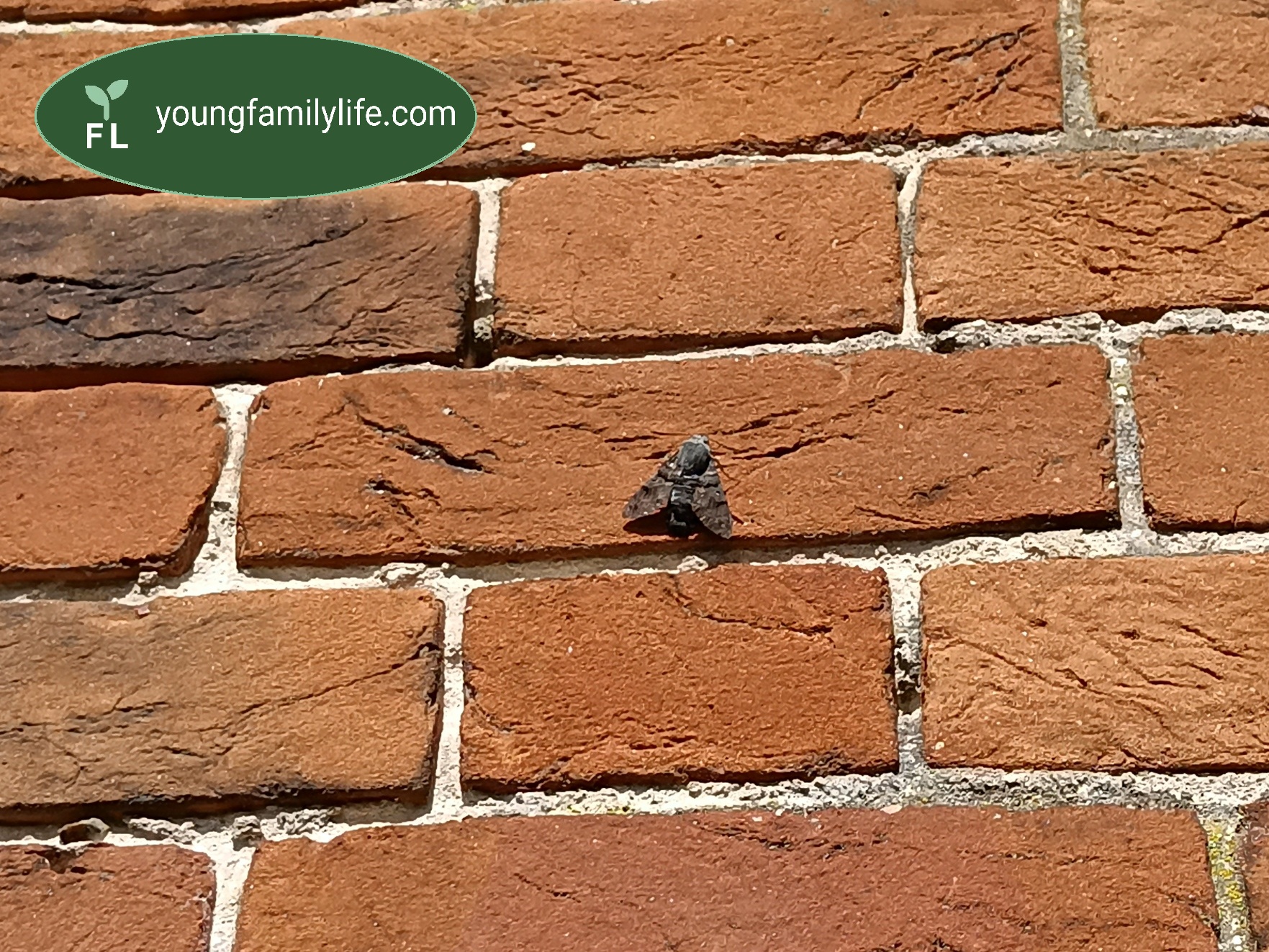
A bush, a moth and a common: who decides what belongs, how the decision is made, and what it means for a piece of Suffolk grassland that stays open only because people keep it that way.
1. The Bush and the Moth
In summer 2026 a Hummingbird Hawk-moth (Macroglossum stellatarum) rested on a sunlit brick wall in Bungay, warming itself, a few yards from a neighbour's Buddleja.
The two organisms sit in different categories. Buddleja (Buddleja davidii) is a Chinese shrub that reached British gardens in the 1890s. It is found in almost every town, along railway lines and on waste ground. It is resident, and it is not native. The moth is a summer migrant from the Mediterranean and North Africa. It arrived under its own power, carried north by weather, and the shrub was a place to feed. Whether it counts as resident is still an open question.
The title's question comes from the second of these. If a migrant keeps returning, and then breeds and overwinters, how old does it have to be before it counts as belonging? The answer turns out to be that age alone does nothing, and that the route a species took matters more than the years it has spent. The essay then applies the question to Outney Common in Bungay, where the answer bears on how the land is looked after.
2. Two Words: Native and Indigenous
In official Great Britain usage, a non-native species is one that has been introduced outside its native range by human action, intentionally or unintentionally (Defra et al., 2023). Native is the opposite: a species that reached a place without that human help. Indigenous is often used as a near-synonym for species, but for peoples it carries legal and political weight that the ecological sense does not. This essay uses native for species and leaves the wider word alone.
3. How Native Status Is Decided
British botany separates plants into three groups by how and when they arrived.
- Native: arrived without human help.
- Archaeophytes: alien plants that became established in Britain before AD 1500, introduced by humans deliberately or by accident from the Neolithic onward. They include arable weeds that came in with early crops (Preston et al., 2004; Botanical Society of Britain & Ireland, n.d.).
- Neophytes: alien plants introduced after 1500. The date is tied to the period of radical change in trade and agriculture that followed the European discovery of the New World (BSBI, n.d.).
Two features of this system matter for the question in the title.
The decision rests on evidence of arrival, not time served. The authors of the standard British list of archaeophytes say the evidence is indirect, so the history of a species is usually impossible to establish with certainty. They describe the suggestion that a species is an archaeophyte as a hypothesis to be tested by further studies, and note that archaeophytes that have invaded semi-natural habitats are likely to be overlooked as natives (Preston et al., 2004). A plant does not graduate from neophyte to native by lasting long enough.
Status differs between countries. Preston et al. compared the status of Britain's archaeophytes in the Czech Republic, Germany, Poland and Finland. Over half are treated as archaeophytes in central Europe, but in Finland many are absent or present only as casual introductions, and some species treated as archaeophytes elsewhere are regarded as natives in Britain (Preston et al., 2004). The same plant can carry different statuses in different countries.
These terms belong to botany. This essay has not found a matching published framework for insects, so the moth is treated on the terms used for natural colonists.
Which doors are open
The archaeophyte category answers the title's question by closing it. It covers introductions made by people before 1500, so nothing arriving after that date can join it, and a migrant that arrives without human help was never an introduction. Buddleja, brought by people after 1500, is a neophyte and stays one.
A natural migrant has a different route. Official definitions turn on human action, so a species that arrives by its own dispersal from a native population falls outside the definition of non-native (Defra et al., 2023). JNCC adds one refinement: a species that arrives by natural dispersal from a non-native population in Europe is also counted as non-native (JNCC, n.d.). Route counts, and so does the source population.
The Little Egret shows the path. It was a rare vagrant until the 1980s, an influx in 1989 made it an uncommon winter visitor, it first bred in Dorset in 1996, and by 2015 more than 1,000 pairs nested in England, Wales and Northern Ireland (BTO, 2026). Wood and Stillman (2014) describe it as a natural colonisation event in its early stages, and refer to the species moving outside its native range. Even the scientific literature therefore describes the status of a natural colonist in more than one way.
This does not fully answer "how old is old enough?" for a natural colonist. As of 2026 this essay found no published threshold, such as a number of years or breeding pairs, at which a colonist stops being a newcomer. The egret's history shows a sequence (vagrant, visitor, breeder, spreading population) and recorders judge on that evidence. It does not show a rule.
The label is also not permanent. A 2017 genetic study challenged the assumed native status of the crucian carp in England, finding strong support for human introduction. Its authors note that separating natural from human-assisted colonisation is often difficult for British fauna (Jeffries et al., 2017).
4. The Bush: Resident, Not Native
Buddleja davidii was introduced to Britain in 1896 and first recorded outside cultivation in 1922 in Merioneth. A 2018 risk assessment describes it as common throughout Great Britain, most of all in towns and along railways and other transport routes (Non-native Species Secretariat, 2018). Owen and Whiteway (1980) place its colonisation of waste land and building sites from the 1930s.
Its reputation has divided.
- In favour: the same study found that no other native or introduced plant produces flowers so attractive to butterflies and other insects, that eleven species of Lepidoptera caterpillar feed on the leaves or flowers, and that the shrub exploited a previously unfilled niche (Owen & Whiteway, 1980).
- Official assessment: the Non-native Species Secretariat describes it as a naturalised invasive alien species in Europe. Its 2015 entry records rapid spread through lowland Britain and says it can form dense thickets that out-compete native vegetation, while also noting that it provides food for a variety of insects and cover for mammals (NNSS, 2015).
- In law: it is not listed in Schedule 9, Part II of the Wildlife and Countryside Act 1981, the list of plants it is an offence to plant or cause to grow in the wild, which includes Japanese knotweed and giant hogweed (Wildlife and Countryside Act 1981, as at 27 September 2026). London Wildlife Trust suggests that its popularity as a garden plant and its tendency to damage infrastructure rather than crops helped it avoid listing (London Wildlife Trust, n.d.).
In the GB framework, a risk assessment does not take the benefits of a non-native species into account. Benefits and management options are weighed separately, in risk management (Defra et al., 2023).
Context changes the judgement. The same shrub can be a resource for pollinators on brownfield land and a problem on protected open habitat. Which it is depends on the place, and on what the place is for.
5. The Moth: Arriving, and Perhaps Staying
Butterfly Conservation describes the Hummingbird Hawk-moth as a migrant from the Mediterranean and North Africa that can be seen almost anywhere in the UK. It can arrive from April to December, with numbers peaking in summer. In 2026 the charity reported that some breed here, and that it is possible a few of the offspring survive milder winters (Butterfly Conservation, 2026). Its species page lists its status as "immigrant, suspected resident" and gives the caterpillar food plants as Lady's Bedstraw, Hedge Bedstraw and Wild Madder. Adults overwinter in unheated outbuildings and in crevices in walls and trees (Butterfly Conservation, n.d.).
Summer 2026 was unusual. The Guardian reported that butterfly and moth experts thought it could be a bumper year for the species after a boom in sightings. Hot weather and strong winds appeared to have brought many moths north. Richard Harrington of the Royal Entomological Society suggested that warm southerly winds and drying food plants in Mediterranean breeding areas might both play a part. Ray Barnett of the British Entomological and Natural History Society noted that sunny weather may have put more people in their gardens to notice them. Richard Austin of Butterfly Conservation said the charity had received many more sightings and enquiries, and cautioned that it was too early to compare numbers with previous years. Barnett added that if current weather patterns continue the moth could survive winters regularly, making it closer to a resident than a purely migratory species (Baraniuk, 2026).
Buddleja appears in these accounts as a feeding place, not a cause of arrival. Butterfly Conservation lists Buddleja among the flowers the moths favour, alongside honeysuckle and red valerian (Butterfly Conservation, 2023). One insect therefore ties together a garden shrub and the bedstraws of open grassland.
The Little Egret is the nearest comparison (Section 3). It moved from vagrant to visitor to breeder over roughly thirty years. The moth's path is unknown, and it may not follow the same one.
Residence and visitation are different tests. A single moth on a wall is a sighting. Evidence of residence would be caterpillars on bedstraw, repeated overwintering records, or a run of years with breeding. Recorders assess this from observations sent in by ordinary people, and status rests on that accumulated record.
6. A Short Aside About People
Humans are not native to Britain in any simple sense. Stone tools at Happisburgh in Norfolk and Pakefield in Suffolk show a human presence between roughly 950,000 and 700,000 years ago (Natural History Museum, n.d.). Footprints at Happisburgh, dated to between about 1 million and 780,000 years ago, are the oldest known hominin footprints outside Africa (Ashton et al., 2014). The oldest anatomically modern human fossil in northwestern Europe, a jaw fragment from Kents Cavern in Devon, dates to about 44,200 to 41,500 years ago (Higham et al., 2011).
The land bridge to the continent (Doggerland) was flooded around 7,800 years ago, and the great majority of species considered native recolonised Britain during the last 18,000 years, as the ice retreated (Jeffries et al., 2017).
The test that separates native from introduced asks whether an organism arrived without human help. The people applying it are the one species it cannot sensibly be applied to.
7. Outney Common: When Native Is Not the Same as Wanted
The first half of this essay asked how a species comes to belong. Outney Common turns the question round, because there the plants pushing against the habitat that people value include native ones. Through spring and summer the Common's grassland grows oak saplings, brambles, shrubs and bushes. Oak is as native as a tree can be. Belonging, on the Common, does not decide what is wanted.
Outney Common is about 400 acres inside a loop of the River Waveney at Bungay. It is privately owned by the Common Owners, divided into around 300 historic grazing rights ("goings"), and managed by a Chairman and six elected Reeves (Bungay Town Trust, n.d.). The higher ground, the Hards, has heathland character: acid grassland, gorse, bramble, and stunted oak, pine and birch, which the Broads Authority calls relatively unusual in the Broads area (Broads Authority, n.d.). The Town Trust describes one of the largest areas of acid grassland in the Waveney Valley and says the Common, apart from the golf course, is in a stewardship scheme administered through Natural England. The published management aims are to protect the Common's open character, its heathland and its water meadows (Bungay Town Trust, n.d.).
Why open ground needs help. Natural England describes lowland dry acid grassland as typically occurring on nutrient-poor, free-draining soils with a pH of about 4 to 5.5, over sands and gravels, and often as part of lowland heath landscapes (Natural England & RSPB, 2014). Buglife advises that light grazing keeps succession to scrub and woodland in check, and that poor management or neglect leads to rank overgrowth and to bracken and scrub encroachment. Overgrazing can also be a serious problem, destroying important plant communities (Buglife, 2019). Left alone, ground like the Hards would probably trend towards oak woodland. That is a reading of the general guidance, not a statement from the Common's managers.
Natural England's own adaptation options for the habitat include maintaining suitable grazing regimes while avoiding over-grazing or under-grazing, permitting scattered scrub because it gives a wider range of microclimates and soil conditions, and monitoring and controlling the spread of potential native and non-native invasive species. It adds that some changes in a site's species may be inevitable or even desirable, such as an otherwise threatened species colonising a new site, and that site objectives and management should be flexible enough to recognise this (Natural England & RSPB, 2014).
The missing herbivores. Frans Vera's wood-pasture hypothesis says that large wild herbivores, among them the aurochs (the extinct wild ox), wild horse, European bison and elk, kept the post-glacial landscape open, creating a mosaic of grassland, scrub and grove (Vera, 2000; Knepp Wildland, 2023). How much they did so is disputed. A comparison of oak and hazel pollen between regions with large herbivores and Ireland, where they were excluded, was used to argue for rejecting the hypothesis (Mitchell, 2005). A later study of 96 pollen records from the Last Interglacial, before modern humans, found light woodland and open vegetation covering on average more than half the landscape, with wide variation (Pearce et al., 2023). The evidence does not settle it.
Cutting as a substitute. In autumn 2026 the Common's grassland that had grown oak saplings, brambles and shrubs through the spring and summer was due to be cut by machinery. Cutting resembles grazing without being the same. Government scheme guidance for very-low-nutrient grassland describes cutting for conserved forage, and says the cuttings from a second cut should be removed (GOV.UK, 2026a). On the Common, cuttings have been baled and taken away. In one year some were left in a small pile, which became a decaying heap that offered shelter and nesting material for small animals and insects.
A lay observation since 2011
What follows is recollection from a Bungay resident since 2011, kept without notes or records and not checked against documents. Memory is fallible, so the details are approximate.
- In the first couple of years after 2011, cattle grazed the Hards area fairly regularly, sometimes twice a year, for short spells of about two weeks.
- After that, spells lengthened to roughly four to six weeks within an April–November season.
- Around 2013 or 2014 came one exceptional stay of six to eight weeks, in very wet, mild weather. The cattle turned that area largely to mud, leaving only trees and well-established bushes. To a lay eye, the ground looked healthier afterwards, turned over and enriched by dung.
- By autumn 2026 the cattle had not grazed that area for some years.
What the ground looked like is one thing, and what it did for the habitat is another. This essay cannot say whether the mud year helped or harmed acid grassland, and the published guidance points both ways. Buglife advises keeping a range of vegetation heights, including very early successional stages, bare ground and short turf, and notes that grazed sites can hold a sizeable dung-associated fauna (Buglife, 2019). Against that, scheme guidance for very-low-nutrient grassland requires an intact sward throughout the year, without compacted areas or poaching (GOV.UK, 2026a), and guidance for species-rich grassland also prohibits management that causes poaching or overgrazing (GOV.UK, 2026b). These are national rules for the schemes in force in 2026, not the terms of the Common's own agreement, which had not been published as of 2026.
The reasons for the change from grazing to cutting are not documented either. Science, scheme rules, funding, the availability of graziers and the practicalities of fencing and stock could each play a part. This essay records the pattern and offers no verdict on any body's decisions.
8. Same Tool, Different Purpose: Somerleyton, Knepp and Outney
The absence of large wild grazers produces opposite responses at different places.
At Somerleyton, on the Norfolk–Suffolk border, and at Knepp in West Sussex, management has been withdrawn. Grazers such as cattle, pigs, Exmoor ponies and, at Somerleyton, water buffalo are introduced at low densities, and the land is left to become what it becomes (Young, 2026). Knepp's own account of its grazing ecology draws directly on Vera's wood-pasture ideas: trampling, puddling, rootling and rubbing, together with nutrient transfer and seed dispersal, would have stimulated a complex mosaic of habitats (Knepp Wildland, 2023). The approach is process-led.
At Outney the aim is a specific state, open acid grassland and heathland, which grazing or cutting holds in place. The approach is target-led. Neither is treated here as better. Somerleyton removed roughly 1,000 acres from arable production and Knepp began on land that was unprofitable to farm (Young, 2026). Outney is a small common with historic rights and a stated habitat to maintain.
The grazers themselves raise the essay's opening question a second time. The animals introduced at these sites can be read as proxies: they do some of the work of the large herbivores Britain has lost, without being those animals. That mirrors Buddleja, which is not native yet feeds pollinators that native plants also feed. In both cases the ecological question, what does it do here, is separate from the status question, how did it arrive.
9. Summary
Native, archaeophyte and neophyte are defined by how and when a species arrived, and the dividing date of AD 1500 is a convention. The same plant can carry different statuses in different countries. On those definitions Buddleja is a neophyte, and a migrant such as the Hummingbird Hawk-moth cannot be an archaeophyte. In 2026 Butterfly Conservation listed the moth as an "immigrant, suspected resident". For a natural colonist, the sources point to the route taken and to evidence recorded over time, not to age. No published threshold was found.
On Outney Common, the habitat that is valued has been held open, since at least 2011, by a shift from grazing towards cutting, and the plants that would close it include native oak. At Somerleyton and Knepp, grazers are used to let land change. At Outney, grazing and cutting hold the land in a chosen state.
What Remains Unknown
- Whether the Hummingbird Hawk-moth is becoming a resident breeder in Britain, which needs further years of records, and what status the recording bodies would then give it.
- What the Common's management plan and stewardship agreement require. Neither had been published as of 2026.
- Whether the mud year helped or harmed the Common's acid grassland.
- How open the pre-human British landscape really was.
References
Ashton, N., Lewis, S. G., De Groote, I., Duffy, S. M., Bates, M., Bates, R., Hoare, P., Lewis, M., Parfitt, S. A., Peglar, S., Williams, C., & Stringer, C. (2014). Hominin footprints from early Pleistocene deposits at Happisburgh, UK. PLoS ONE, 9(2), e88329.
Baraniuk, C. (2026, July 30). "Grey lump with orange wings": Hummingbird hawk-moths descend on UK gardens. The Guardian.
Botanical Society of Britain & Ireland. (n.d.). Archaeophytes. Accessed September 2026.
British Trust for Ornithology. (2026, January 19). Egret expectations. Accessed September 2026.
Broads Authority. (n.d.). Landscape character assessment: Part 3, Areas 1 to 8 (Waveney: Outney Common and Bath Hills area).
Buglife. (2019). Lowland dry acid grassland. Accessed September 2026.
Bungay Town Trust. (n.d.). Bungay Common. Accessed September 2026.
Butterfly Conservation. (n.d.). Humming-bird Hawk-moth. Accessed September 2026.
Butterfly Conservation. (2023, March 13). Did you spot the moth that looks like a Hummingbird in your garden? Accessed September 2026.
Butterfly Conservation. (2026, May 27). Migratory moths to look out for in 2026. Accessed September 2026.
Defra, Scottish Government & Welsh Government. (2023). The Great Britain invasive non-native species strategy: 2023 to 2030. GB Non-native Species Secretariat.
GOV.UK. (2026a, June 17). CLIG3: Manage grassland with very low nutrient inputs (updated for SFI26). Accessed September 2026.
GOV.UK. (2026b, March 12). CGS22: Manage priority habitat species-rich grassland. Accessed September 2026.
Higham, T., Compton, T., Stringer, C., Jacobi, R., Shapiro, B., Trinkaus, E., Chandler, B., Gröning, F., Collins, C., Hillson, S., O'Higgins, P., FitzGerald, C., & Fagan, M. (2011). The earliest evidence for anatomically modern humans in northwestern Europe. Nature, 479(7374), 521–524.
Jeffries, D. L., Copp, G. H., Maes, G. E., Lawson Handley, L., Sayer, C. D., & Hänfling, B. (2017). Genetic evidence challenges the native status of a threatened freshwater fish (Carassius carassius) in England. Ecology and Evolution, 7(9), 2871–2882.
Joint Nature Conservation Committee. (n.d.). UKBI: Invasive species. Accessed September 2026.
Knepp Wildland. (2023, August 9). Grazing ecology. Accessed September 2026.
London Wildlife Trust. (n.d.). Buddleia: Butterfly buffet or bush of burden? Accessed September 2026.
Mitchell, F. J. G. (2005). How open were European primeval forests? Hypothesis testing using palaeoecological data. Journal of Ecology, 93(1), 168–177.
Natural England & RSPB. (2014). Climate change adaptation manual: Evidence to support nature conservation in a changing climate (NE546), chapter 19, Lowland dry acid grassland. Natural England.
Natural History Museum. (n.d.). First Britons. Accessed September 2026.
Non-native Species Secretariat. (2015, November 26). Buddleia (Buddleja davidii). GB Non-native Species Information Portal. Accessed September 2026.
Non-native Species Secretariat. (2018). Buddleja davidii (butterfly bush): Risk assessment.
Owen, D. F., & Whiteway, W. R. (1980). Buddleia davidii in Britain: History and development of an associated fauna. Biological Conservation, 17(2), 149–155.
Pearce, E. A., Mazier, F., Normand, S., Fyfe, R., Andrieu, V., Bakels, C., et al. (2023). Substantial light woodland and open vegetation characterized the temperate forest biome before Homo sapiens. Science Advances, 9(45), eadi9135.
Preston, C. D., Pearman, D. A., & Hall, A. R. (2004). Archaeophytes in Britain. Botanical Journal of the Linnean Society, 145(3), 257–294.
Vera, F. W. M. (2000). Grazing ecology and forest history. CABI Publishing.
Wildlife and Countryside Act 1981, s. 14 and Sch. 9, Pt II (revised text, up to date to 27 September 2026). legislation.gov.uk.
Wood, K. A., & Stillman, R. A. (2014). Do birds of a feather flock together? Comparing habitat preferences of piscivorous waterbirds in a lowland river catchment. Hydrobiologia, 738, 87–95.
Young, S. (2026, June 12). The land that heals itself: Britain's ecological farming revolution. YoungFamilyLife.
Topics: #MigrantSpecies #NativeSpecies #Archaeophyte #Neophyte #Buddleja #HummingbirdHawkMoth #OutneyCommon #Bungay #AcidGrassland #Grazing #Rewilding #Somerleyton #Knepp #NaturalEngland #LandManagement #YoungFamilyLife