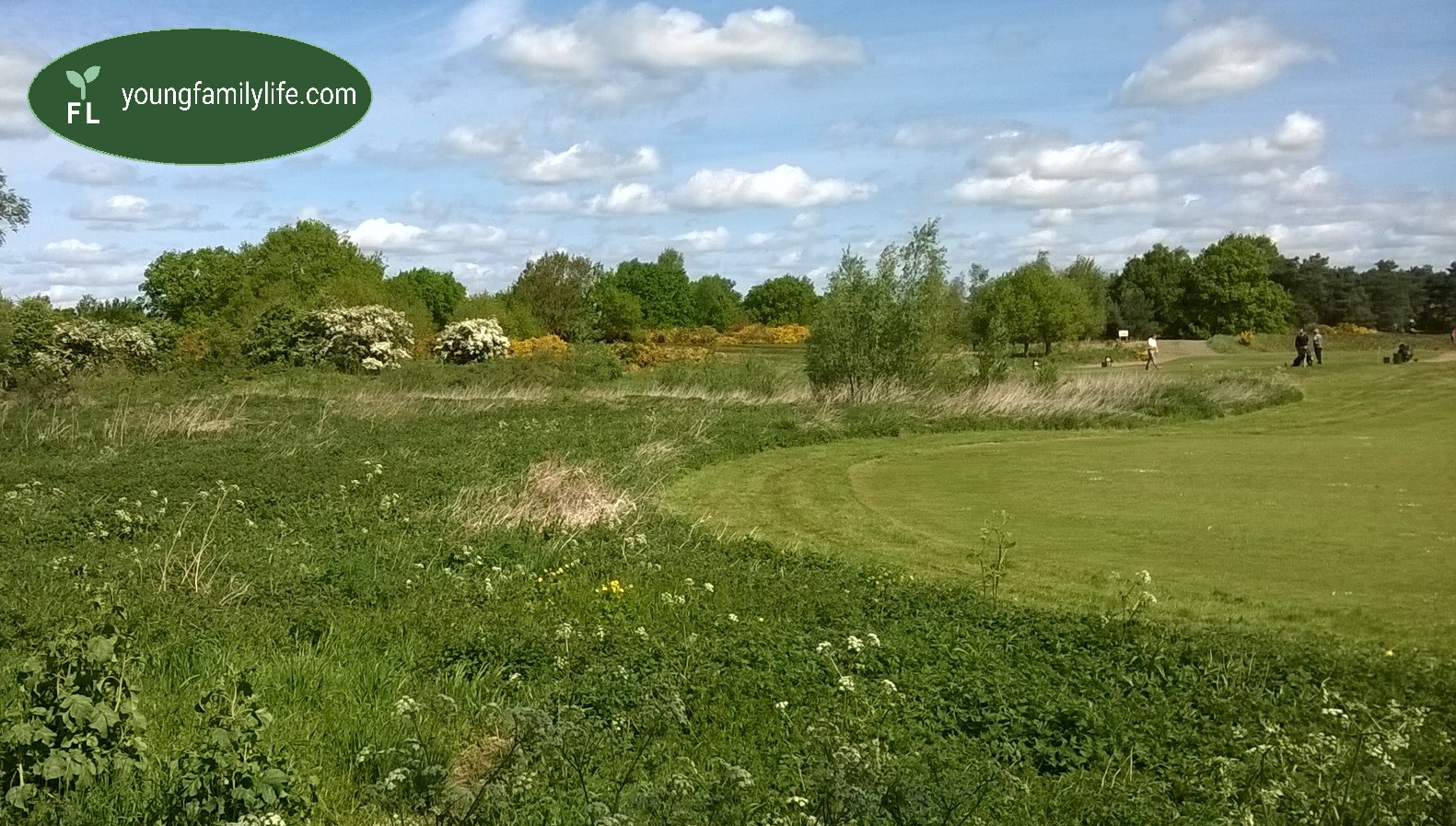
Immediately north of Bungay town centre, the River Waveney does something unusual: rather than passing the town, it nearly encircles it. Over thousands of years the river has cut a huge meander — technically an oxbow-in-the-making, the loop not yet cut off — around a slightly raised area of land, and it is inside that loop that Outney Common sits. The river forms almost the entire boundary; it is the Waveney, more than any fence or road, that defines where the Common begins and ends. The Norfolk–Suffolk county boundary itself follows the same loop, which is why a short walk across the Common’s northern edge, over the footbridge onto Bath Hills, takes a walker out of Suffolk and into Norfolk without a road, sign, or building in sight.
The 400 acres inside the loop split naturally into two halves. The Lows, low-lying grazing land bordering the river to the east, floods seasonally — the Waveney here is a working floodplain, not merely a river with a common beside it, and winter flooding is routine rather than exceptional. The Hards, the slightly higher, better-drained ground at the centre, has stayed dry enough for permanent use for as long as anyone has kept records — an 1880s map already shows the Hards as a distinct name for that raised ground, and it is here that the Common’s golf course and its Right to Roam heathland now sit. That basic geography — flood on one side, permanently usable higher ground on the other, both inside a river loop — is almost certainly what made this particular patch of land worth holding in common in the first place. People have been present on this stretch of the Waveney for a very long time indeed: archaeological records place activity on the Common’s riverbank as far back as the Mesolithic, and Roman vineyards are recorded on the neighbouring slopes at Bath Hills.
Walk out along the Lows on a summer evening, or up onto the Hards where the golf course gives way to open heath, and all of that history sits quietly underfoot. The Common feels like exactly what its name promises: a shared place, open to everyone, belonging to no one in particular. That feeling is not wrong, exactly. But it is not quite the legal reality either — and the gap between the two is worth understanding, because it is the same gap that runs underneath most of England’s relationship with its own land.
What “Common” Does Not Mean
The word “common” is one of the most misleading in English land law. It sounds like it means “belongs to everyone.” It doesn’t. Common land is, and has always been, privately owned — the “common” part refers not to ownership but to a set of rights that other people hold over it: rights to graze animals, cut turf, gather wood, take fish. Land can be called a common, look like a common, and function socially like a common, while remaining, on paper, someone’s private property with other people’s rights attached to it.
Outney Common is a textbook case. Its roughly 400 acres are divided into around 300 “goings” — the right to graze one animal — that were, perhaps as long as a thousand years ago, attached to specific properties in Bungay. Those goings have long since been sold away from the houses they originally belonged to, and are now held by around fifty individuals and organisations, among them the Bungay Town Trust, which alone owns 62 of the 300. Those “going” owners, collectively, are the Common Owners — the actual legal proprietors of the land, managing it through a Chairman and six Common Reeves elected annually.
None of that is unusual. It is, in miniature, exactly how common land works everywhere in England: a right of access built on top of a right of ownership, with the two kept carefully separate for centuries.
The Wider Pattern Outney Sits Inside
That structure — rights of common surviving on land whose ownership has been carved up and sold — did not happen by accident. Between the mid-eighteenth and late-nineteenth centuries, Parliament passed over 5,200 separate Enclosure Acts, each one moving a parish’s shared land out of open, common-rights use and into fenced, private hands. It happened one Act at a time, one parish at a time, voted through by the same landowning class who then held the enclosed land. Nothing about it was illegal. The law was the mechanism.
Bungay’s own common survived that process more or less intact — which is itself unusual. A great many English commons did not: John Clare watched his own village of Helpston fenced within his lifetime and wrote some of the angriest poetry in the language about it. At Otmoor in Oxfordshire, around a thousand people tore down enclosure fences by hand. At Kinder Scout in 1932, ramblers staged a mass trespass onto grouse moor that had been closed to the public for generations; six were arrested, five imprisoned.
What survived nationally, after two centuries of enclosure and the long campaigns that followed it, was the Countryside and Rights of Way Act 2000 — roughly a million hectares of “access land” across the whole of England, unevenly distributed (77% of it in the North, less than 3% in the South East), on which the public has a foot-only right to roam. Landowners can still close it for up to 28 days a year without giving a reason. Only around 3% of England’s rivers carry an undisputed public right to be on the water at all.
Outney Common’s Right to Roam area — the heathland section of the Hards, bordering the river — is often described locally as designated Right to Roam land. That is worth treating with some care: public access there rests on long-standing permission granted by the Common Owners, not on a confirmed statutory designation under the 2000 Act, and the two are legally different things — one is a right that survives regardless of the owner’s wishes, the other is a permission the owners could in principle withdraw. Which of the two actually applies to this stretch of the Common is not entirely settled by the sources available, and is exactly the kind of local detail residents themselves may be able to clarify.
A Local Complication, Not Fully Resolved
Outney Common’s own paper trail carries a complication worth naming honestly rather than glossing over. The Common does appear on the official commons register, held under the reference “Outney Common — Bungay — Waveney D, No. CL.3,” and there is a substantial Commons Commissioner’s decision on file relating to that registration. What exactly that decision concerns is not something this piece can confirm with confidence. Local accounts vary: some suggest the original 1965–1970 registration process ran into difficulty locally — whether through an administrative gap, an objection during the provisional stage, or something else — with knock-on questions later raised about how that affected the Common’s legal status and the standing of the Common Owners and Reeves who administer it. Other readings hold that whatever happened, the underlying private ownership by the going-holders was never in serious doubt, since statutory common-land status and freehold ownership are legally distinct in English law, and a lapse in one does not automatically unsettle the other.
Both readings could be partly right, and without sight of the Commissioner’s decision itself — or a proper local history such as Terry Reeve’s A Common Privilege: The Story of Outney Common, Bungay — this piece isn’t going to adjudicate between them. It’s set out here deliberately unresolved, in the hope that readers with clearer memories, family archives, or access to the original paperwork can fill in what the record itself doesn’t yet make plain.
Why the Distinction Still Matters
None of this is simply historical colour. The legal architecture that separates ownership from access is still live, and still occasionally tested. In 2023, a hedge fund manager who had bought roughly 4,000 acres of Dartmoor commons took the Dartmoor National Park Authority to the Supreme Court over the right to wild camp there — and lost, unanimously. The case turned on exactly the same question Outney Common answers every day: what a right of access actually permits, and what it doesn’t, on land someone else owns.
Understanding Outney Common this way changes very little about how it is used day to day — walkers, swimmers at Sandy River, dog walkers, fishermen, and golfers will carry on exactly as before. But it changes what the Common is, in a way worth knowing: not empty land that happens to be open, and not “everyone’s” in the way the word suggests, but a specific, six-centuries-deep settlement between private ownership and public and communal rights — one of the relatively rare places in England where that settlement was never entirely undone.
References
- Bungay Town Trust — Bungay Common (bungaytowntrust.uk)
- Bungay-Suffolk.co.uk — Outney Common
- Eastern Daily Press / Beccles & Bungay Journal — reporting on the 2023 “one common” going sale, and on the Jubilee Woods tree-felling dispute with Natural England
- Association of Commons Registration Authorities (ACRA) — common land register, unit CL.3 “Outney Common — Bungay — Waveney D”
- Broads Authority — Waveney Valley Landscape Character Assessment
- Suffolk Heritage Explorer — Mesolithic riverbank activity record, Outney Common
- Broadland Catchment Partnership
- Terry Reeve, A Common Privilege: The Story of Outney Common, Bungay
Topics: #OutneyCommon #Bungay #CommonLand #RightToRoam #EnclosureActs #LocalHistory