Where Is the British One?
Americans are often openly proud of their Constitution. It is a single document, short enough to read in an afternoon, which can be pointed to, quoted and displayed. It is reasonable for someone in the UK to ask where the British equivalent is, and why nobody ever seems to quote it. The honest answer is that it is not kept in a single place, and that is where the story starts.
The Surprise: It Is Mostly Written Down
The UK does have a constitution, meaning the set of rules about how power is shared and used. It is described as uncodified, which means there is no one document that collects it. Most of it is written down, but in several places.
Acts of Parliament. Laws passed by Parliament, such as the Bill of Rights 1689, which limited the Crown after the Glorious Revolution, the Acts of Union that joined England and Scotland in 1707, the Parliament Acts of 1911 and 1949 that limit the power of the House of Lords, and the Human Rights Act 1998.
Court rulings. Decisions by judges over centuries, known as the common law, which set out principles such as the limits on the Crown’s powers.
Conventions. Habits that are followed because breaking them would be very costly, such as the monarch giving royal assent to bills passed by Parliament.
Historic documents and guides. Magna Carta (1215), an agreement between King John and rebel barons that set written limits on the Crown, and official guides such as the Cabinet Manual, which describes how government works in practice.
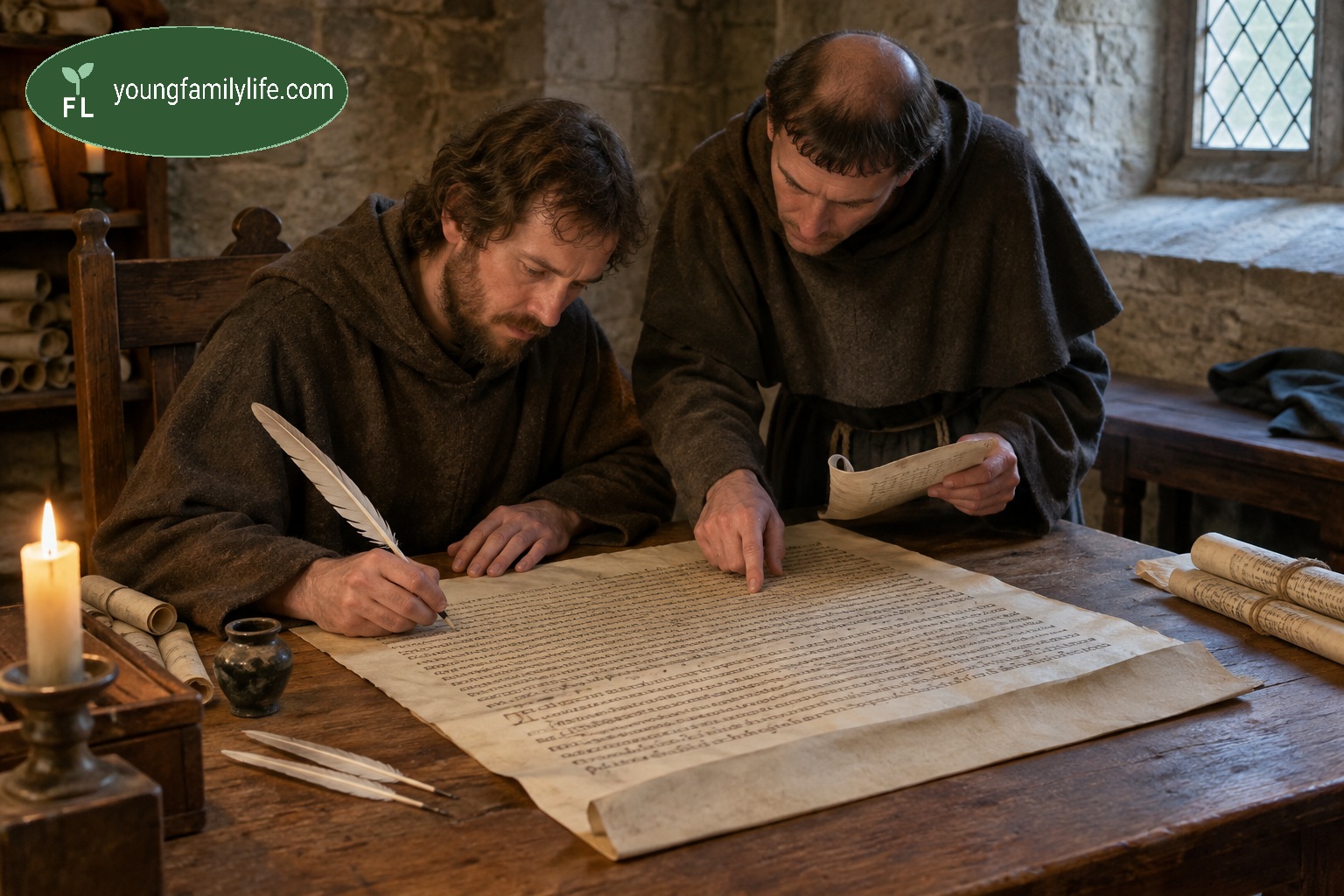
Who drafted Magna Carta is not certain. Limited circumstantial evidence links two churchmen to the drafting: Elias of Dereham, who served the Archbishop of Canterbury as steward and was a canon of Salisbury, and Gervase of Howbridge, a canon who later became chancellor of St Paul’s. Neither can be identified for certain as the author.
The One Time Britain Tried It
Britain has had one written constitution. In 1649, after the English Civil War between the king and Parliament, King Charles I was executed, and England was left without a monarch for eleven years. Oliver Cromwell, the army commander who had won the war for Parliament, became the country’s leader. In 1653 he took the title Lord Protector under a written document called the Instrument of Government. It set out how the country would be run, with a Protector, a Council and a Parliament. A second written document replaced it in 1657.
Cromwell died in 1658. In 1660 the monarchy returned under Charles II, and the written constitutions ended with the rule that had made them.
Why It Did Not Happen Since
Many countries wrote a constitution at a moment of new beginning. The United States did so in 1787, after independence, and Germany did in 1949, after the Second World War. Each had a clean break from what went before.
The UK has not had one in the same way. After 1688 the old institutions, including the monarchy, Parliament and the courts, stayed in place and changed step by step. The Bill of Rights 1689 settled the major dispute between Crown and Parliament by an ordinary Act of Parliament. There was no single moment when the country drew up a new foundation for all of it, so the rules grew over time, one dispute and one law at a time.
What Parliament Being Sovereign Means
The key difference is that in the UK there are no “higher” laws that Parliament cannot change. The nineteenth-century lawyer A. V. Dicey, whose book on the constitution is still widely read, described this as parliamentary sovereignty: Parliament can make or unmake any law, and no court can strike down an Act of Parliament.
That means an ordinary law can change constitutional arrangements. In 2011 Parliament passed a law fixing the time between general elections at five years, and in 2022 it passed another to remove that fixed term. Both were passed in the same way as any other Act. In a country with a codified constitution, a change of that size might need a special vote or a referendum.
Who Else Does It This Way?
Very few countries have no single constitutional document. New Zealand and Israel are often named as other examples. New Zealand’s arrangements include the Constitution Act 1986 and conventions, and Israel uses a series of laws called Basic Laws. Neither is identical to the UK, and each has its own history.
What It Gives and What It Costs
What supporters point to. Flexibility. The system can adapt without a formal rewrite, and it has done so through two world wars and the loss of an empire.
What critics point to. Unclear rules. Many arrangements depend on convention and goodwill, so a dispute can arise about what the rule is. When the Prime Minister was ill in 2020, for example, no written rule said who should stand in, and the arrangement was made on the day.
Both views have been argued for a long time, and neither has settled the matter.
Could It Be Written Down?
The idea comes up regularly. In 2014 a committee of MPs published a report on whether the UK should have a codified constitution, and it recommended a public debate on the idea. Other voices argue the opposite: that attempts to write it down would be contested and could freeze the system in place.
No government has taken the step so far. For now, the answer to the question of where the British constitution is kept remains that it is not in one place, and that its rules are found in many.
Topics: #HeyWantToKnow #UKConstitution #WrittenConstitution #ParliamentarySovereignty #Convention #OliverCromwell #BillOfRights
Further Reading
These sources go deeper into the topics covered here:
Official sources:
- Cabinet Office, The Cabinet Manual (2011) — a guide to the laws, conventions and rules on how government operates
- House of Commons Political and Constitutional Reform Committee, A new Magna Carta? (2014) — the report on whether the UK should have a codified constitution
Books and research:
- A. V. Dicey, Introduction to the Study of the Law of the Constitution (1885) — the classic account of parliamentary sovereignty
- Vernon Bogdanor, The New British Constitution (2009) — how the constitution changed from the late twentieth century
- The Constitution Unit, University College London — research on constitutional reform
How This Essay Reflects YFL Values
YFL treats readers as capable adults who can weigh evidence for themselves. This piece sets out how the UK constitution works, the arguments on each side, and what remains open, and leaves the conclusions to the reader.
Related YFL Essays and Resources
The big picture
In Other Words... Who Is Actually in Charge of the United Kingdom? — the layers of power the constitution describes.
The monarch and the Crown
Hey!, Want To Know... When Did a Monarch Last Refuse to Sign a Law? — an example of a convention in action.
How Parliament took over the Crown’s powers
In Other Words... How Parliament Took Over the Monarch’s Powers — the history behind the 1689 settlement.
Hey!, Want To Know... Who Was Thomas Cromwell, and How Did He Change the Way Laws Are Made? — the chief minister who used Acts of Parliament to break with Rome.
Hey!, Want To Know... Why Did England Put King Charles I on Trial? — why the 1649 trial happened and what followed.
The Prime Minister and ministers
In Other Words... What Happened When the Prime Minister Was in Intensive Care — a test of unwritten rules.
Holding State Power: The Crown, the Prime Minister and the Civil Service — the full Repositorium essay behind these pieces.