The Short Answer
In April 2020, with the UK in its first Covid-19 lockdown, the Prime Minister, Boris Johnson, spent about three days in intensive care. No law said who should run the government while he was there. A senior minister, Dominic Raab, stood in. The Cabinet, the civil service and Parliament carried on, and the government kept working.
The episode is useful because it was a real test of how the UK handles a Prime Minister who cannot work, with no written procedure to follow.
What Happened, and When
Late March 2020. Boris Johnson, Prime Minister since 2019, tested positive for Covid-19 and continued to work while isolating at Downing Street.
5 April. His symptoms persisted, and he was admitted to St Thomas’ Hospital in London on his doctors’ advice.
6 April. His condition worsened and he was moved to intensive care. Downing Street said he had asked Dominic Raab to deputise for him “where necessary”.
9 April. He left intensive care. He left hospital on 12 April and returned to work on 27 April.
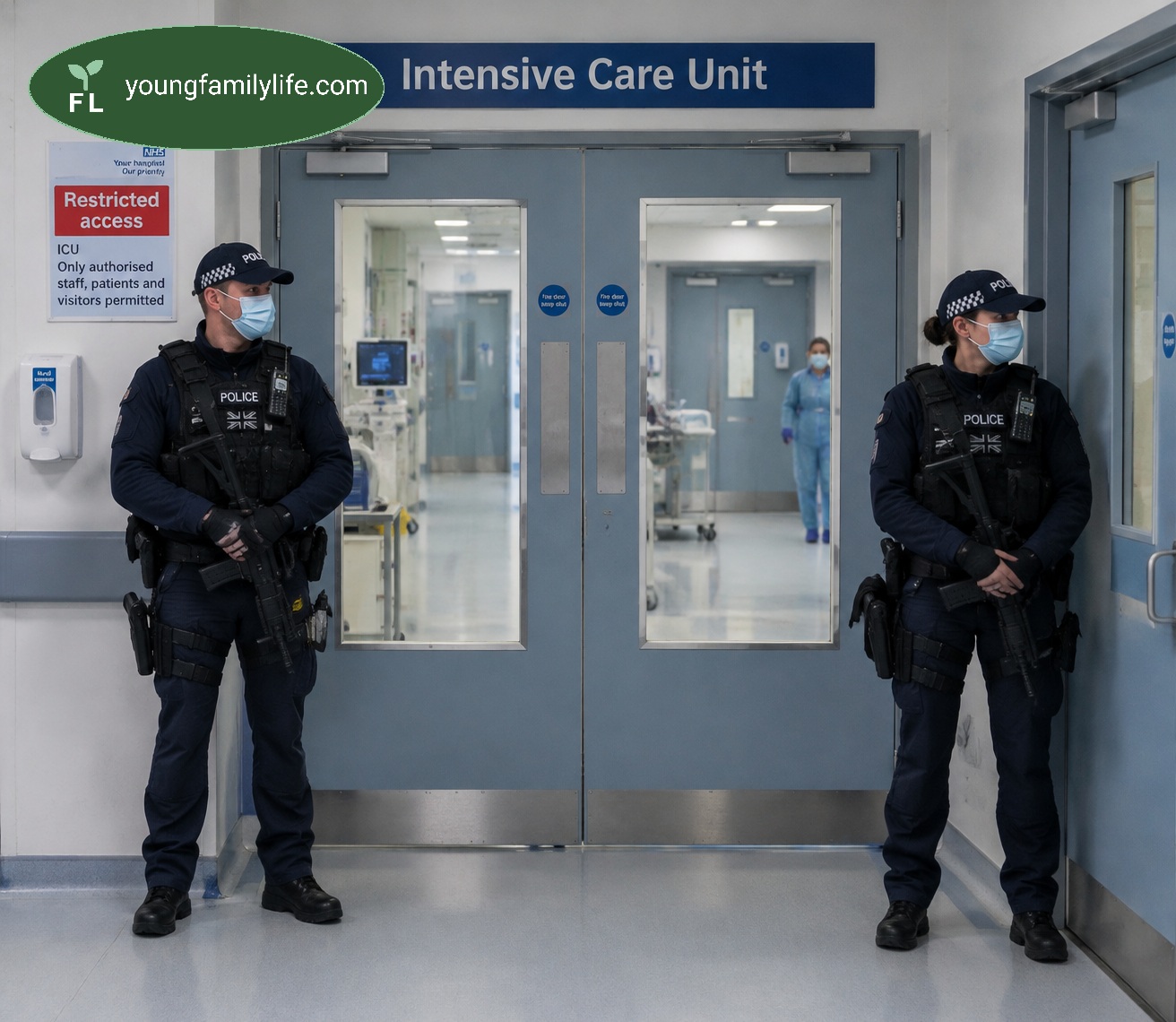
A Prime Minister is protected by specialist police officers at all times, some of them armed, including when in hospital. The image above illustrates that general arrangement and is not a record of the ward.
Who Stood In, and What That Meant
Dominic Raab was the Foreign Secretary, the minister in charge of relations with other countries. He also held the title First Secretary of State, which a Prime Minister can give to a senior minister and which usually signals a senior position in Cabinet. The title carries no powers of its own.
No law or written rule defined what Raab could decide. In practice he chaired the daily Covid-19 meeting of senior ministers, scientific advisers and officials. In mid-April the lockdown rules were due for their legal review. That review went ahead, and Raab announced the outcome. Decisions still came from the Cabinet as a whole, which is the group of senior ministers who meet to agree government policy. Raab said the government’s focus would be on carrying out the Prime Minister’s direction.
Raab was not Prime Minister and did not become one. He acted for the Prime Minister for a period, appearing to act by agreement with colleagues, on the understanding that the government of the day continues.
What Carried On
Cabinet and ministers. The Cabinet kept meeting, and each minister kept running a department.
The civil service. The departments, the Cabinet Secretary’s office (the most senior civil servant’s team) and the government’s medical and scientific advisers carried on working. This is one reason the UK has a permanent civil service that does not change with the Prime Minister’s health or with elections.
Parliament. It kept sitting, and from late April MPs could take part from home by video link.
The courts. The lockdown rules were later challenged in court. The Court of Appeal held in 2020 that the main rules had been lawful.
The devolved governments. Public health is devolved, which means Scotland, Wales and Northern Ireland made their own rules and timetables. The decisions described above applied in England.
What Was Not Settled
Some questions had no clear answer. Raab’s authority was clear in practice but not written down. It was reported at the time as unclear whether he would stand in for the Prime Minister on other duties, such as the regular call with the monarch. And nothing set out when, or by whom, a decision would be made that the Prime Minister could no longer do the job.
The Prime Minister was ill but recovered, and only a few days passed. A longer or more serious incapacity would have tested the arrangement further. The question of nuclear authority was also asked at the time and was not answered in public, as described below.
Who Has the Finger on the Button?
People often ask this question when a Prime Minister is ill. Some of what is said about it is myth, and much of the detail is deliberately not public.
There is no button. The phrase is a figure of speech. The UK’s nuclear weapons are Trident missiles carried on four submarines, and at least one is always on patrol at sea. A launch would be ordered by a coded message sent to a submarine.
Who can authorise a launch. It is widely reported that only the Prime Minister can authorise a nuclear strike. In a House of Commons debate in 2016, Theresa May, then Prime Minister, said yes when asked whether she would be prepared to authorise one, and added that the deterrent only works if others know the UK would use it. The detailed rules are not published.
The letters of last resort. Soon after taking office, each new Prime Minister writes by hand a letter to the commander of each of the four submarines. Each letter is kept sealed in a safe within a safe on board. They are for one case only: an attack so severe that the UK government no longer exists. What they say has never been officially published, and most Prime Ministers have never said. Existing letters stay in force until a new Prime Minister replaces them.
April 2020. When Boris Johnson was in intensive care, the question was asked in public, and the government would not say who held the authority. Michael Gove, then a Cabinet Office minister, said “there are well developed protocols” and that he could not talk about national security issues. Downing Street said the letters would stay in place and that “the Prime Minister remains the Prime Minister”. It also said the First Secretary of State and the Cabinet had the authority and ability to respond to national security matters in the Prime Minister’s absence.
So the reality is plainer than the pub version. Nobody sits with a finger over a button, and the authority sits with the office of Prime Minister. Who would use it if the Prime Minister could not act is not public. That is a different thing from there being no plan.
How Another Country Handles It
The United States has a written procedure for a president who cannot serve. The 25th Amendment to its constitution allows a president to hand over power in writing, and sets out a way for others to declare a president unable to serve. No comparable written procedure appears to apply in the UK, and the 2020 arrangement was settled between the people in post.
Defenders of the UK approach point to its flexibility, because the right person can be chosen for the situation. Critics point to the lack of a rule that could be read in advance, when everyone is calm, and not worked out during a crisis.
Back to the Question
Who ran the UK when the Prime Minister was in intensive care? A senior minister stood in, the Cabinet decided, the civil service kept the departments working, and Parliament and the courts carried on. The government did not stop, because power in the UK is spread across several layers, including ministers, the civil service, Parliament and the courts, that each continue on their own. What the episode did not show is a written rule, because there was none to follow. On the question people ask most, who has the finger on the button, the authority sits with the office of Prime Minister, and who would exercise it if the holder could not act is not public.
Topics: #InOtherWords #PrimeMinister #UKConstitution #Governance #Covid19 #Succession #NuclearDeterrent #Resilience
Related YFL Content
The big picture
In Other Words... Who Is Actually in Charge of the United Kingdom? — the layers of power that kept working in April 2020.
The Prime Minister and ministers
In Other Words... What the Prime Minister Is, and Is Not — the office, how someone gets it, and what the post can and cannot do.
Officials, checks and line management
In Other Words... Who Employs the Civil Service? — who hires, pays and answers for officials.
In Other Words... Line Managers at the Top — who looks after the people at the top of government, including leave and illness.
In Other Words... Who Checks the Government? — the checks on ministers and the Prime Minister.