Who Watches the People in Charge?
The UK government holds a great deal of power: a Prime Minister, a Cabinet and a civil service of over half a million people. What stops that power going wrong? There is no single answer. There are several checks, run by different bodies, each with its own strengths and gaps.
The House of Commons
The main check is built into how a government exists at all. A government stays in office only while it can command the confidence of the House of Commons. If it loses a confidence vote, it must resign or call an election. This has happened rarely: the 1979 Labour government of James Callaghan lost by a single vote.
On a more ordinary day, ministers have to appear in the Commons. The Prime Minister takes questions every Wednesday, and other ministers answer on a rota. Bills have to pass the Commons and the House of Lords, and the Lords can ask the Commons to think again, although under the Parliament Acts it cannot block most bills indefinitely.
The limit is arithmetic. A government with a large majority can usually win its votes, because its own MPs generally support it. The check is real, but it is strongest when majorities are small.
The Party Room
In practice, the check that has ended mid-term premierships since 1979 is not the confidence vote. It is the Prime Minister’s own party. No government has lost a Commons confidence vote since 1979, and Prime Ministers who have left office between elections have mostly gone because their own MPs or ministers turned against them. Others left after losing a general election: John Major in 1997, Gordon Brown in 2010 and Rishi Sunak in 2024. That is the voters’ check, covered at the end of this piece.
The first example is Margaret Thatcher, Prime Minister from 1979 to 1990 and the first woman to hold the office. She won three general elections and never lost one. In November 1990 a former Cabinet minister challenged her for the Conservative leadership, after Sir Geoffrey Howe, her long-serving Deputy Prime Minister, resigned and gave a critical speech in the Commons. She led the first ballot but not by enough to win outright. Cabinet colleagues told her she would probably lose the next round, and she resigned.
Most mid-term departures since then have followed a similar path.
Tony Blair (Labour, 1997 to 2007). After pressure from Labour MPs in 2006, he set out a timetable for leaving and handed over to Gordon Brown in June 2007.
David Cameron (Conservative, 2010 to 2016). A different case. He resigned after the 2016 EU referendum went against the side he had led, not because his MPs forced him out. The party then chose his successor.
Theresa May (Conservative, 2016 to 2019). She announced her resignation in May 2019, after repeatedly failing to get her Brexit deal through the Commons and losing the support of many of her own MPs.
Boris Johnson (Conservative, 2019 to 2022). He announced his resignation in July 2022, after more than fifty ministers and aides resigned within days.
Liz Truss (Conservative, 2022). She resigned after 44 days, once her party’s support had gone following the market turmoil that followed her government’s tax-cutting budget.
Keir Starmer (Labour, 2024 to 2026). He announced his resignation on 22 June 2026, after Cabinet resignations and calls from about 100 Labour MPs for him to go.
The opposition has a part in this, though a different one. Weekly questions, by-election results and poor opinion polls can show that a Prime Minister is vulnerable. That tends to unsettle the government’s own backbench MPs, who worry about their seats and begin to press Number 10. Ambitious ministers, who may already want the job, can then judge that this is the moment to move. The opposition exposes the weakness, but the governing party decides what to do about it.
The rules differ by party. In the Conservative Party a vote of confidence in the leader is triggered when 15% of its MPs write letters to the chair of the 1922 Committee, the body of backbench Conservative MPs. In the Labour Party a challenger needs the nominations of 20% of Labour MPs. Neither process involves the voters directly.
This check is fast and sometimes brutal. It does not rely on any law, and it replaces the Prime Minister without an election. The new Prime Minister takes office with the same majority in the Commons and no new mandate from voters, which is why such changes sometimes raise calls for a general election.
Select Committees
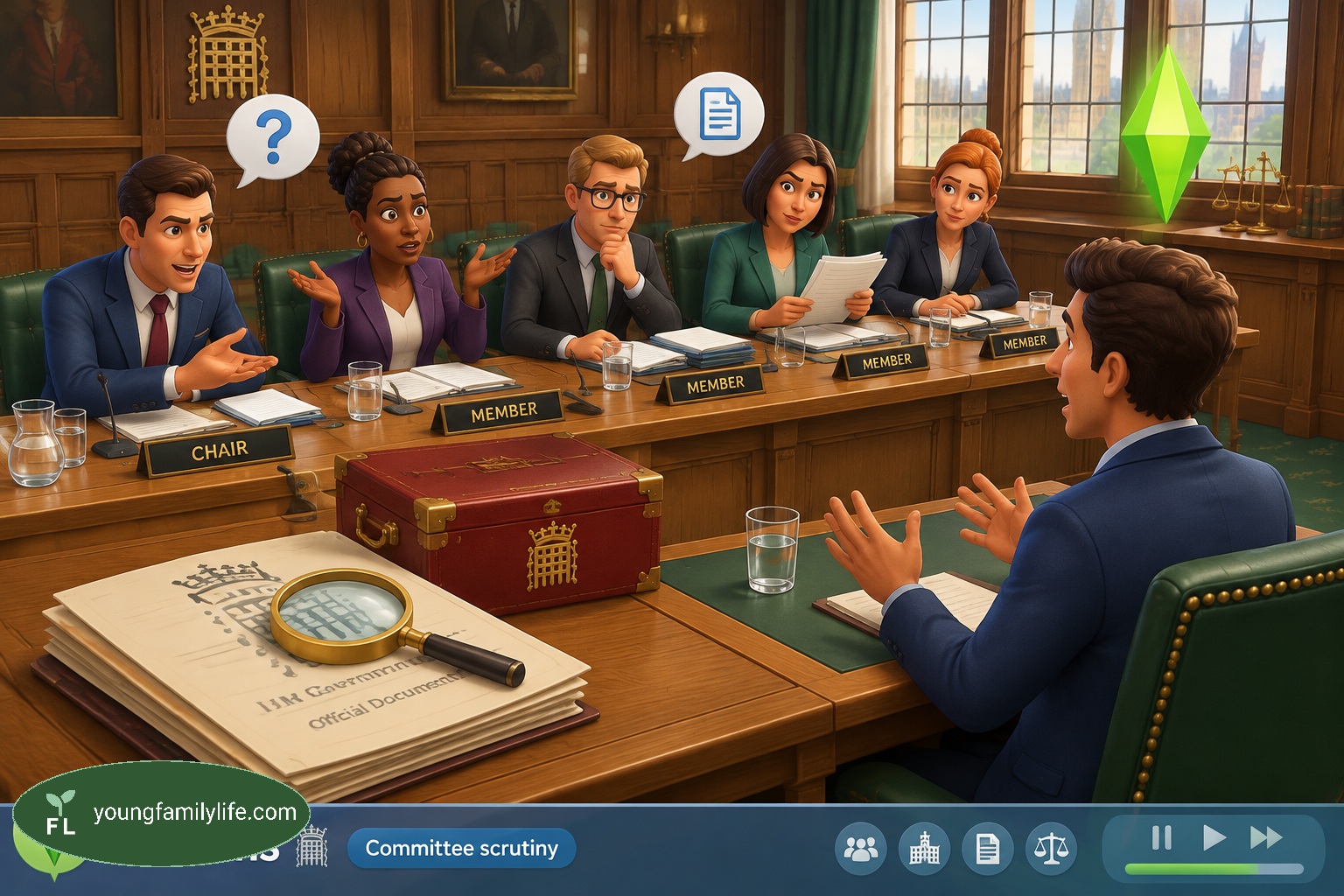
Much of the detailed scrutiny happens in select committees. Most government departments have one, made up of MPs from several parties, which looks at the department’s spending, policy and administration. Committees can call ministers, officials and outside witnesses, and ask for papers.
Since 2010 the chairs of the main committees have been elected by MPs in a secret ballot, and the members are elected by their own parties, not chosen by the party whips. That change was intended to give committees more independence. The chairs of the main committees also sit together as the Liaison Committee, which questions the Prime Minister a few times a year.
Committees can recommend, but they cannot order a government to act. By convention the government replies to each report, normally within two months. What they can do is put evidence on the record and draw public attention to it.
Following the Money
Two bodies concentrate on spending. The National Audit Office, headed by the Comptroller and Auditor General, audits the accounts of government departments and reports to Parliament on whether public money was spent properly and gave value for money. The Comptroller and Auditor General is an officer of the House of Commons, not a member of the government, and is appointed for a single fixed term of ten years, which is meant to keep the office independent. The National Audit Office as a body was set up by the Budget Responsibility and National Audit Act 2011.
The Public Accounts Committee then uses those reports to question the senior officials directly. By long-standing convention the committee is chaired by a member of the main opposition party. The most senior official in each department, the Permanent Secretary, is also its Accounting Officer, personally answerable to the committee for how the department spends money.
Checks Inside Government
Government also checks itself, though less visibly.
Officials. Civil servants advise ministers frankly before a decision. An Accounting Officer with serious concerns about a spending decision can ask for the minister’s instruction in writing, and that direction is reported to the National Audit Office.
Departmental boards. Each department has a board chaired by its Secretary of State and including non-executive directors from outside government. They are there to challenge how the department is run.
The Ministerial Code. The Prime Minister sets out the standards expected of ministers in the Ministerial Code. An Independent Adviser on Ministers’ Interests can look into alleged breaches. For years the adviser could investigate only when the Prime Minister asked. Changes in 2022 allowed the adviser to start an investigation after consulting the Prime Minister, but the Prime Minister still decides whether a minister has broken the Code and what follows.
Each of these sits within the executive branch. They help, but they do not give an outside check on the people at the top.
The Courts
Judges do not decide whether a policy is wise. They decide whether a minister or public body has acted within the law. People can ask a court for judicial review of a decision they believe was unlawful, unfair or beyond the powers Parliament gave.
The most widely noticed example in recent years was in 2019, when the Supreme Court ruled that the advice given to the Queen to suspend Parliament for five weeks was unlawful, because it prevented Parliament from doing its job without reasonable justification. The ruling built on a very old idea that the royal prerogative has limits, covered in the YFL piece In Other Words... How Parliament Took Over the Monarch’s Powers.
The courts have a clear limit as well. They cannot strike down an Act of Parliament, because Parliament is sovereign. They can interpret it, and in some cases declare it incompatible with human rights law, but the decision then goes back to Parliament.
The Ombudsman
An ordinary person who thinks a government department has treated them badly can complain to the Parliamentary and Health Service Ombudsman. The Ombudsman investigates complaints about maladministration, such as delay, error or poor handling, and can recommend that the department puts things right and sometimes pays compensation.
For complaints about most government departments, the usual route runs through a Member of Parliament, who has to refer the complaint. The Ombudsman can recommend but cannot enforce, so the weight of the finding depends on how the department and Parliament respond.
How the Pieces Fit
The checks are different in kind. Some are political, such as confidence votes, questions, committees and pressure from a Prime Minister’s own party. Some are financial, like the audit and the Public Accounts Committee. One is legal, in the courts, and one is administrative, in the Ombudsman. Others, such as departmental boards and the Ministerial Code, are inside government.
Many rely on convention, meaning habits that governments follow because breaking them would be costly, not because a court would force them. Pressure from a Prime Minister’s own party is one: it rests on party rules and political judgement, not on any law. That is typical of a constitution that is not written in one place. It works when those involved respect the habits, and it can be tested when they do not.
Voters are the final check. Every few years they can replace the government. The other checks mostly exist to give them, and Parliament, the information to make that decision.
Back to the Question
So who checks the government? Parliament does, through votes, questions and committees, and often most sharply a Prime Minister’s own party. Auditors and the Public Accounts Committee check the money. Courts check the law. An Ombudsman checks individual complaints, and the government’s own officials and boards check from the inside. Voters decide in the end. None of these has the complete answer, and together they are meant to cover for each other’s gaps.
Topics: #InOtherWords #Accountability #UKConstitution #Governance #Parliament #SelectCommittees #JudicialReview
Related YFL Content
Hey!, Want To Know... Why Did England Put King Charles I on Trial? — why the 1649 trial happened and what followed.
In Other Words... Who Is Actually in Charge of the United Kingdom? — the whole set of layers that these checks apply to.
In Other Words... What the Prime Minister Is, and Is Not — the office most of these checks are aimed at.
In Other Words... Who Employs the Civil Service? — Accounting Officers, written directions and the National Audit Office in more detail.
In Other Words... How Parliament Took Over the Monarch’s Powers — where the limits on royal power began.