An Office With No Job Description
The Prime Minister runs the UK government, yet no voter has ever put a cross next to the words “Prime Minister”. Voters choose an MP for their own constituency. The Prime Minister is whoever ends up leading the government afterwards.
The office was not designed. An Act of Parliament did not recognise it until 1937, when the Ministers of the Crown Act gave the post a salary in its own right, under the title Prime Minister and First Lord of the Treasury.
How Someone Becomes Prime Minister
The monarch invites the person best able to command the confidence of the House of Commons to form a government. That usually means the leader of the party with the most MPs. When one party has a majority, the choice is clear.
When no party has a majority, it is less clear. In 2010 two parties formed a coalition. In 2017 one party formed a minority government with the votes of a smaller party agreed in advance. Both times the person invited was the one thought most likely to keep the Commons’ support.
The Prime Minister does not need a general election to take office. Parties can change their leader at any time, and the UK has had several Prime Ministers who took over between elections when their party chose a new leader.
Where the Power Comes From
No single law hands the Prime Minister power. It comes from two sources working together. One is the support of a majority in the Commons. The other is the Prime Minister’s position as the monarch’s chief adviser, which means the old prerogative powers are used on the Prime Minister’s advice.
In practice that includes choosing who sits in the Cabinet, deciding what the Cabinet discusses, advising the monarch on when to call an election, and recommending senior appointments. The Prime Minister is also Minister for the Civil Service, which gives the office a say over how the civil service is run.
Sir Robert Walpole, who led the government from 1721 to 1742 and is usually counted as the first Prime Minister, set many of the early habits. Later holders copied what worked, and the habits hardened into conventions.
The Cabinet: First Among Equals
The Prime Minister chairs the Cabinet, the group of senior ministers who head the main departments. The traditional description of the role is “first among equals”. Ministers share responsibility for the government’s decisions and are expected to back them in public once they are made. That rule is called collective responsibility.
How equal the others are depends on the Prime Minister’s standing. A leader who is strong in the party and the Commons has a good deal of control. One who is weak has to bargain with senior ministers to keep the government together.
What the Prime Minister Cannot Do
A Prime Minister cannot make a law alone. A Bill has to pass the Commons and the Lords, and the monarch gives Royal Assent on ministers’ advice. Nor can a Prime Minister raise taxes alone, since Parliament has to approve them.
The courts can also set limits. In 2019 the Supreme Court ruled that a five-week suspension of Parliament, advised by the Prime Minister, was unlawful.
And the Prime Minister can be removed. That can happen when the governing party changes its leader, when the government loses the confidence of the Commons, or when the voters choose a different party at a general election.
Standards of conduct are a separate matter. The Ministerial Code sets them for ministers, and the Prime Minister has the final say on whether a minister has broken it. The independent adviser on ministers’ interests investigates only when the Prime Minister asks.
Strong or Weak, With the Same Office
A US president is elected nationally, serves a fixed term and stands outside Congress. A UK Prime Minister is in practice an MP, depends on the Commons day by day, and can be replaced without an election.
The office stays the same from one holder to the next. What changes is the room to act, which depends on the size of the majority and the standing in the party.
The Houses That Go With the Office
Two houses and a cat go with the job. Each was given or kept for the office, not for the person holding it, and each passes on when the Prime Minister changes.
Number 10: How a Street Became an Address
The street is named after Sir George Downing, who lived from about 1623 to 1684. He was a soldier, diplomat and government official, born in Dublin and raised partly in Massachusetts, where he was among the early graduates of Harvard College. He served Oliver Cromwell’s government, and after 1660 he changed sides and served Charles II, which won him a knighthood and a reputation as a turncoat. Samuel Pepys, the diarist, who had worked for him early in his career, thought poorly of him.
In the 1680s Downing built a short row of terraced houses off Whitehall. It was a property development, not a government project, and the houses were built quickly and cheaply.
The link to government came in 1732, when George II offered No. 10 to Walpole as a personal gift. By the usual account, Walpole accepted only on condition that the house go to the office of First Lord of the Treasury, not to him. He moved in in 1735. Since then the Prime Minister has normally held that post as well, which is why No. 10 is officially the residence of the First Lord of the Treasury and is in practice the Prime Minister’s house.
After Walpole, use of the house was patchy. Many later Prime Ministers lived in their own homes and used No. 10 for work. It became the settled home of the Prime Minister in the early twentieth century.
Chequers: The Country House
Chequers is the Prime Minister’s country house, in the Chiltern Hills in Buckinghamshire. The main building is a manor house from the sixteenth century, altered over the centuries since. One explanation of the name links it to the Exchequer, the medieval royal finance office.
It became government property through a gift. Sir Arthur Lee, a Conservative MP and army officer who had restored the house, and his wife Ruth gave it to the nation under the Chequers Estate Act 1917, so that Prime Ministers would have a place to rest away from London. David Lloyd George, Prime Minister from 1916 to 1922, was the first to use it, in 1921.
The house is held through a trust for the use of the Prime Minister of the day. During the Second World War, Winston Churchill, who led the wartime government from 1940 to 1945, is said to have avoided Chequers on moonlit nights because its long drive was easy to see from the air. He used another country house, Ditchley Park in Oxfordshire, instead.
Between them, the two houses show how the office gathered what it needed over time: a town house in 1735 and a country retreat in 1921.
The Chief Mouser: The Home Side of the House
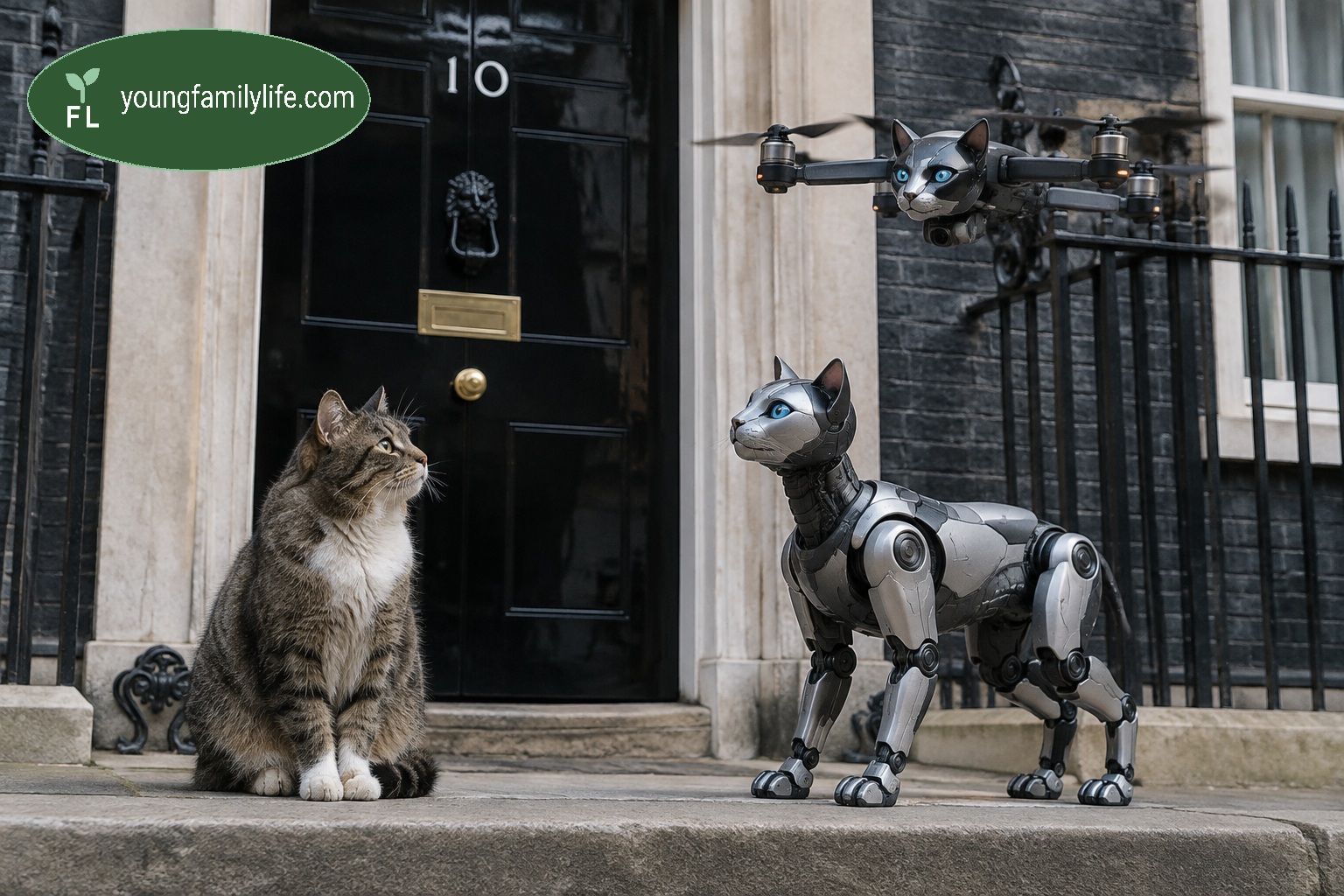
Most of what happens at No. 10 is government business, but it is also a home. Prime Ministers and their families have lived in flats within the building, and sometimes in the flat above No. 11 next door. And for a long time the house has kept a cat.
Cats have been kept in government buildings for centuries to deal with mice. The post at No. 10 carries the official title Chief Mouser to the Cabinet Office. Humphrey, a stray who settled there in 1989, held it until 1997 and served under three Prime Ministers. He was reportedly named after Sir Humphrey Appleby, the senior civil servant in the television comedy Yes Minister, following a ballot among staff. Larry, a rescue cat from Battersea, took up the post in 2011 and also served under several.
The cat belongs to the post, not to the Prime Minister of the day, and the post carries on when the Prime Minister changes.
Topics: #InOtherWords #UKConstitution #PrimeMinister #Cabinet #ExecutivePower #DowningStreet #Chequers #ChiefMouser #WestminsterSystem
Related YFL Content
In Other Words... Who Employs the Civil Service? — who hires, pays and answers for officials.
In Other Words... What Happened When the Prime Minister Was in Intensive Care — how government carried on in April 2020.
Hey!, Want To Know... When Did a Monarch Last Refuse to Sign a Law? — the monarch’s formal part in making laws.
In Other Words... Who Is Actually in Charge of the United Kingdom? — the whole set of layers, with the Prime Minister as one of them.
In Other Words... How Parliament Took Over the Monarch’s Powers — the history behind why ministers need Parliament’s support.
Bureaucratic Incentives and the Limits of New Public Management — why government can feel inefficient, and how incentives inside departments shape what officials do.