Who He Was
Thomas Cromwell was Henry VIII’s chief minister for most of the 1530s. He was born around 1485 in Putney, then a village outside London, the son of a blacksmith and brewer. He spent years abroad, reportedly as a soldier and a merchant, trained as a lawyer, and entered the service of Cardinal Wolsey, who was Henry’s chief minister until his fall in 1529. When Wolsey fell, Cromwell made himself useful to the king and rose through a series of senior posts, finishing as the Earl of Essex.
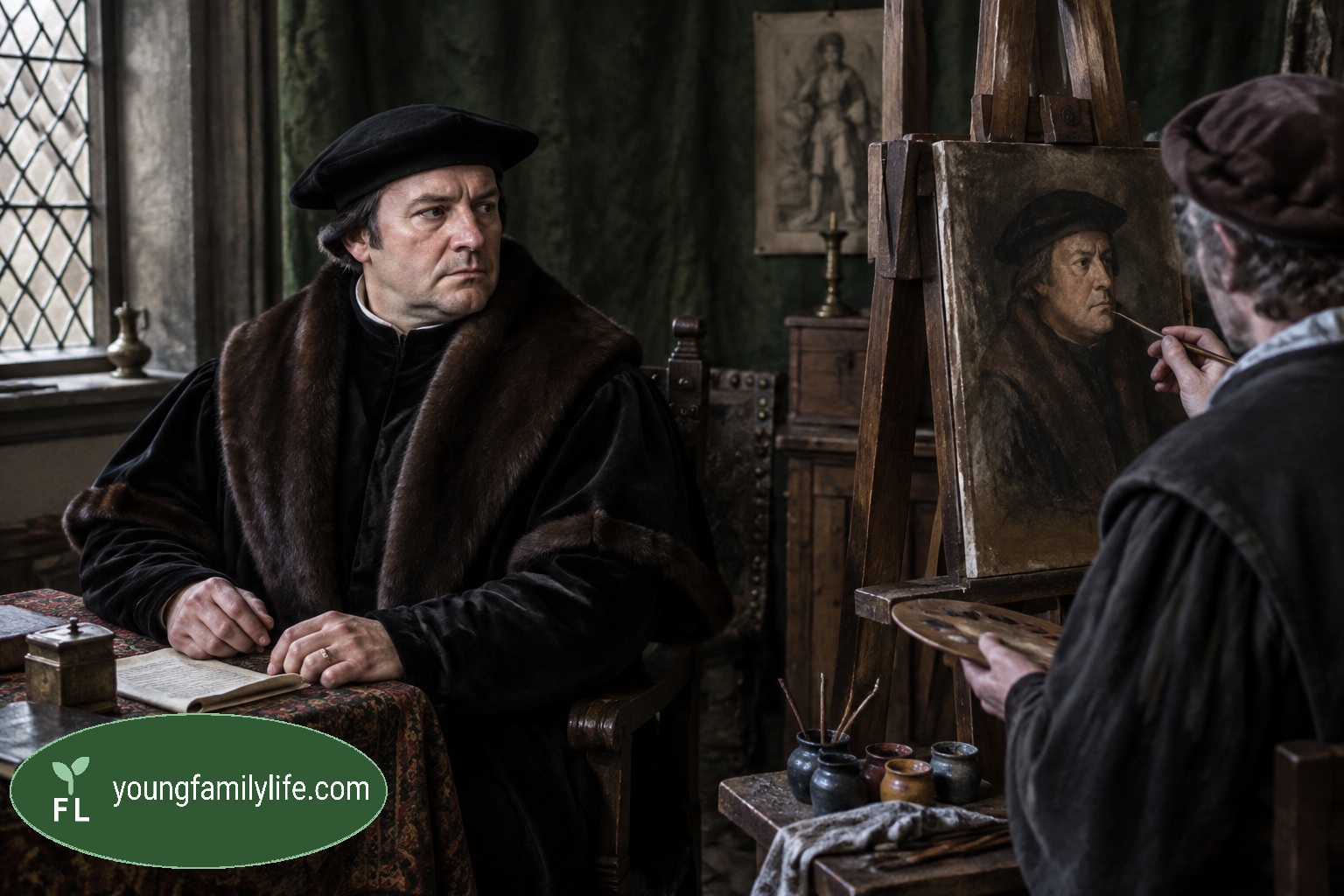
The best-known portrait of him was painted by the German artist Hans Holbein the Younger, around 1532 to 1533. Portrait sittings of this kind were one way powerful men of the period showed their position.
The Problem He Was Asked to Solve
Henry VIII, who reigned from 1509 to 1547, wanted to end his marriage to Catherine of Aragon, who had not given him a surviving son. Only the Pope could annul it, and the Pope refused. Henry’s problem was a legal and political one: how could an English king overrule the Pope?
Cromwell’s answer was to do it by law. If Parliament passed a statute, meaning a law made by the king together with the Lords and the Commons, it could declare that the Pope had no authority in England. The break with Rome would then be the law of the land, and not only the king’s wish.
The Laws That Made the Break
The Act in Restraint of Appeals, 1533. It ended the right to appeal from English courts to Rome, and stated that England was a complete realm with no higher authority than its king.
The Act of Supremacy, 1534. It declared Henry the Supreme Head of the Church of England, which put the Church under the Crown.
The dissolution of the monasteries, 1536 to 1540. A series of laws closed the monasteries and moved their land and wealth to the Crown, with Cromwell overseeing the work.
The Parliament that passed the first of these laws sat from 1529 to 1536, an unusually long run, and it is known as the Reformation Parliament.
What Changed in How Laws Were Made
Before this, a king could make major changes by royal command. Cromwell used a different route, and the lasting idea was that the highest law is the monarch acting together with Parliament. Parliament became central to the most important decisions of the day, which helped fix its role for the future.
The same tool could serve a strong king as well. In 1539 the Statute of Proclamations gave royal proclamations, which are announcements issued by the king alone, the force of law. It was repealed in 1547, after Henry’s death. A law that increases Parliament’s role and a law that increases the king’s power could come from the same hand, which is one reason historians still argue about what Cromwell intended.
Did He Reshape How Government Worked?
The twentieth-century historian G. R. Elton argued that Cromwell also reorganised government itself, moving it from the king’s household to permanent offices and departments. The idea was highly influential. Later historians have questioned how much was new and how much Cromwell personally planned, so it is best treated as a debated claim, not a settled fact.
How It Ended
In 1540 Cromwell lost the king’s favour, partly because Henry’s marriage to Anne of Cleves, which Cromwell had helped to arrange, went badly, and partly because he had enemies at court. He was arrested and executed in July 1540 on charges of treason and heresy. He was condemned by an Act of Attainder, a law declaring someone guilty without a trial. Cromwell had used that tool against others.
A Later Cromwell
The name returns in the next century. Oliver Cromwell, the army commander who led the country after the English Civil War, was a distant relative of Thomas Cromwell and was born about sixty years after Thomas died. Thomas’s nephew, Richard Williams, took the Cromwell surname while serving his uncle, and Oliver was Richard’s great-grandson.
In recent years Thomas Cromwell has been better known through Hilary Mantel’s novels, beginning with Wolf Hall (2009), and their television adaptation.
Reformer or Fixer?
Historians disagree about Cromwell. Some see a skilled administrator who gave England a modern state and a lasting idea of law-making. Others see a ruthless servant who did what the king wanted and fell when the king no longer needed him. Both views can draw on the same evidence, and the question remains open.
Topics: #HeyWantToKnow #ThomasCromwell #HenryVIII #Parliament #UKConstitution #Reformation #Statute
Further Reading
These sources go deeper into the topics covered here:
Biography and history:
- Diarmaid MacCulloch, Thomas Cromwell: A Life (2018) — a full modern biography
- Oxford Dictionary of National Biography, entry for Thomas Cromwell — a concise scholarly account
- G. R. Elton, The Tudor Revolution in Government (1953) — the influential, and debated, argument about Cromwell’s reform of government
Fiction inspired by the period:
- Hilary Mantel, Wolf Hall (2009) — a novel, not a history
How This Essay Reflects YFL Values
YFL treats readers as capable adults who can weigh evidence for themselves. This piece sets out what is known about Thomas Cromwell, where historians disagree, and what remains open, and leaves the conclusions to the reader.
Related YFL Essays and Resources
In Other Words... How Parliament Took Over the Monarch’s Powers — the longer story from the 1530s to 1689.
Hey!, Want To Know... Why Does the UK Have No Written Constitution? — Oliver Cromwell’s written constitution and why it did not last.
Hey!, Want To Know... When Did a Monarch Last Refuse to Sign a Law? — how a bill becomes law today.
Hey!, Want To Know... Why Did England Put King Charles I on Trial? — why the 1649 trial happened and what followed.
Holding State Power: The Crown, the Prime Minister and the Civil Service — the full Repositorium essay behind these pieces.