Music was here long before people were
Most people assume music is something humans came up with — like writing, or cooking, or football. But the evidence points in a different direction. The patterns that make music work — structured sound, mathematical relationships between notes, harmony — appear throughout the natural world, with no human involvement at all.
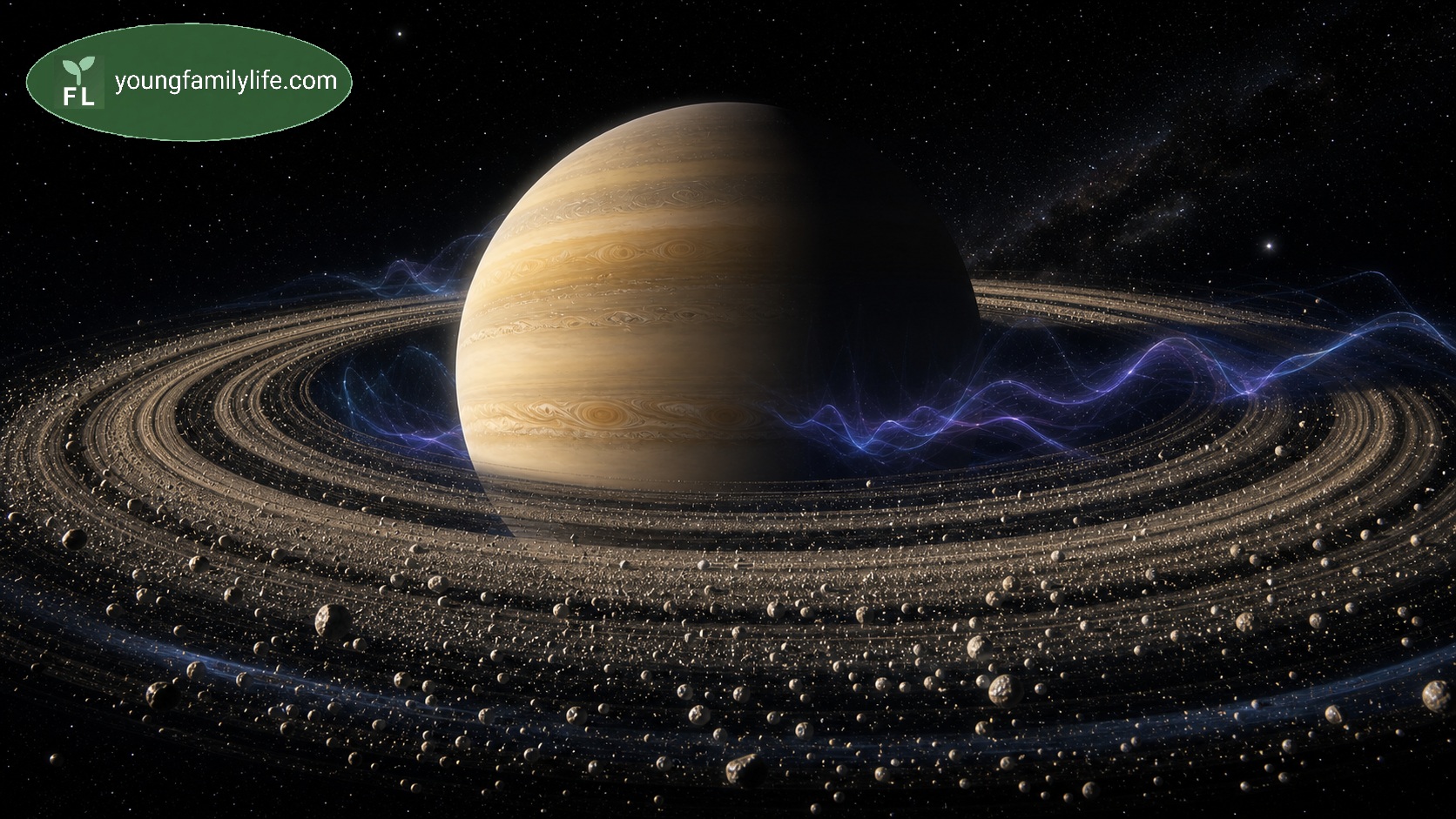
In 2002, NASA's Cassini spacecraft picked up radio signals coming from Saturn. The signals were produced by charged particles moving through the planet's magnetic field. Scientists converted them into audible sound — and what came out wasn't noise or static. It was something that sounded, to every human ear that heard it, unmistakably like music. Rising tones. Falling tones. Sounds moving in relationship to each other.
Saturn had been producing those signals for approximately 4.5 billion years. Long before the first human being existed. Long before anyone had ever thought about music at all.
The maths behind music isn't man-made
Around 2,500 years ago, the Greek philosopher Pythagoras noticed something while passing a blacksmith's workshop. The hammers striking the anvil produced sounds that either clashed horribly or fitted together beautifully — and when he investigated the weights of the hammers, he found they stood in simple mathematical ratios. Two to one. Three to two. Four to three. The same ratios that produce the musical intervals that human ears find pleasing.
Pythagoras concluded that harmony isn't a cultural preference. It's a property of mathematics — and mathematics runs through everything. The universe, in his view, is built on the same ratios that make music work. The music of the spheres, he called it.
It sounded like philosophy. It turns out to have been an accurate description of how physics works.
Researchers studying hermit thrushes — small North American songbirds — found that the birds consistently choose pitches drawn from the harmonic series: the same mathematical structure that underlies the human musical scale. The birds didn't learn this from people. They find the same ratios independently, because those ratios are built into the physics of vibrating air. The maths was always there. Both human musicians and hermit thrushes are working within it.
Animals don't just make sounds — some of them make music
Humpback whales sing. That isn't a loose use of the word. A humpback whale song has structure — shorter units that build into phrases, phrases that build into themes, themes that repeat across a song lasting up to thirty minutes. The songs spread across entire ocean basins as one whale learns from another, and they change and evolve over years. Researchers who study them describe the same features that musicologists use to analyse human composition.
Songbirds show the same arch-shaped melodies found in human music across cultures — rising phrases that peak and fall, brief pauses between phrases, small steps between adjacent notes. These aren't coincidences. They reflect the same physical constraints on how vocal systems produce and control sound, whether the vocal system belongs to a bird or a human being.
The clearest example is a double yellow-headed Amazon parrot called Tico, filmed by his owner as he plays guitar. As the music plays, Tico improvises freely alongside it — not copying what he hears, but creating new phrases that fit within the same key, following chord changes in real time. He isn't trained to do this. He hears the music, finds his place inside it, and sings.
The human ear doesn't create music — it completes it
Saturn's signals were real — structured, harmonic, mathematically organised — but they weren't music yet. Not until the scientists shifted the frequencies so that a human ear could receive them. At that moment, something that had existed as pure physics became something that could be heard, felt, and recognised.
The capacity to hear music — to register it not just as sound but as something meaningful — appears to be one of the most deeply built-in features of the human nervous system. It activates the same reward pathways as food and warmth. It persists in the brain long after other memories have gone. People with severe Alzheimer's disease, who can no longer recognise family members or hold a conversation, can still sing a song from their childhood all the way through.
Music isn't something humans invented and then found in nature. The structures that make music work — ratio, pattern, harmony — are properties of the physical world. What humans did was develop the ability to hear them, respond to them, and eventually to make them deliberately. The ear didn't create music. It recognised something that was already there.
Saturn had been singing for billions of years. It just needed a listener.
Topics: #InOtherWords #Music #Nature #Science #Cosmos #Saturn #Cassini #Pythagoras #HumpbackWhales #Birdsong #HarmonicSeries #Acoustics #WhyMusic #YoungFamilyLife #InformationWithoutInstruction
Related YFL Content
Music Has Fallen — a companion Young Thinking essay on how music's ecosystem has changed, and what that means for the musicians and listeners inside it.
In Other Words — full index — all IOW pieces across every topic, in plain language.
Repositorium Essays — the full essay library, all streams and depth levels.
Hey!, Want To Know — the most accessible entry point to any YFL topic, discovery-first.
Copyright Notice
© 2026 Steve Young and YoungFamilyLife Ltd. All rights reserved.
"In Other Words" is a copyrighted content format of YoungFamilyLife Ltd.
The information in this piece is based on established research and theory. Full academic sources, references, and evidential detail are available in the linked YoungFamilyLife essays.
This essay was developed collaboratively using AI assistance to research academic sources and refine content structure, while maintaining the author's original voice, insights, and "Information Without Instruction" philosophy. No part of this essay may be reproduced, distributed, or transmitted in any form or by any means, including photocopying, recording, or other electronic or mechanical methods, without the prior written permission of the copyright holders, except in the case of brief quotations embodied in critical reviews and certain other noncommercial uses permitted by copyright law.
For permission requests, contact: info@youngfamilylife.com