Who He Was
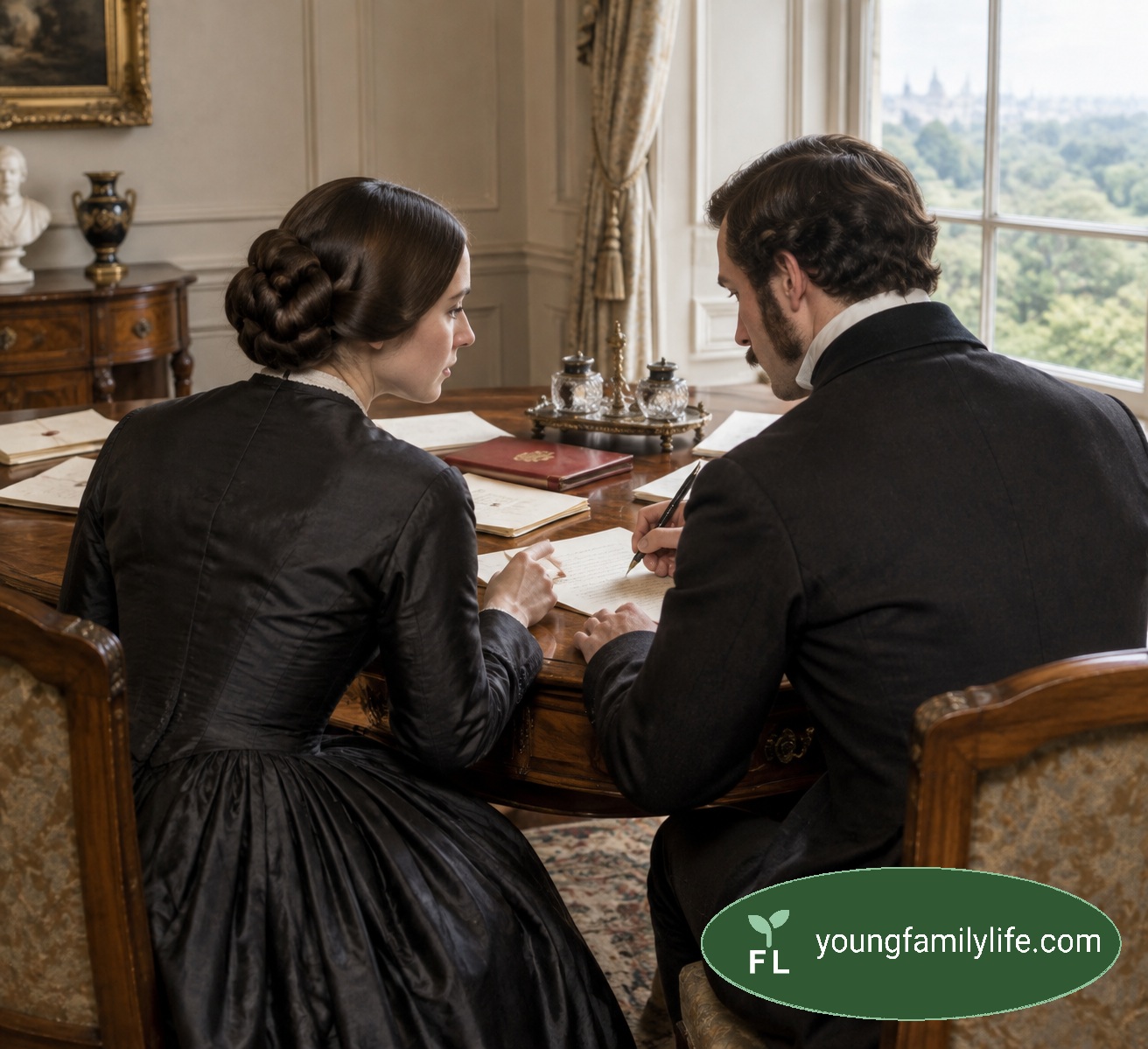
Prince Albert of Saxe-Coburg and Gotha, a small German state, was born in 1819. He married his cousin, Queen Victoria, on 10 February 1840. She had become queen in 1837 at the age of eighteen. Albert held no office in Britain and had no part in government. He was a foreigner with no job, married to the head of state.
The Problem He Was Married Into
In her first years as queen, Victoria was openly loyal to one party, the Whigs, and to their leader, Lord Melbourne, who was Prime Minister and her close adviser. The Tories, the other main party, felt shut out of the Queen’s circle.
In May 1839 the problem came to a head. Melbourne’s government weakened and he resigned. The Tory leader, Sir Robert Peel, was asked to form a government. Peel asked Victoria to replace some of the Whig ladies who served in her household with Tory ones, since they were close to her and would be reporting her views and conversations to the Whigs. Victoria refused. Peel declined to take office on those terms, and Melbourne returned to power. The episode is known as the Bedchamber Crisis, and it showed that a monarch who sided with one party could get in the way of the government Parliament had chosen.
How Albert Gained a Role
After the wedding, Victoria kept state business to herself. Albert was left to sit at the edge of it. Over the next few years this changed. Victoria came to trust him, and by the early 1840s he was reading government papers, sitting in on her meetings with ministers and writing memoranda (short written statements of a position) for her. In practice he became her private secretary, though he had no title for it.
He was guided by Baron Stockmar, a German doctor who had advised the royal family for years and who was also his mentor. Stockmar held that a monarch in a parliamentary system could do most good by staying out of party politics, and by advising, encouraging and warning ministers rather than choosing them.
What He Tried to Do
Make the monarch impartial. Albert worked to move the Crown away from the Whig side. The monarch would deal fairly with whichever party the House of Commons backed, and would stay above the quarrels between them. In 1841, when Peel and the Tories took over, the Court worked with them.
Make the monarch informed. The Queen and Albert read despatches (official reports and letters on government business) and insisted on being kept up to date. A monarch who knew the detail could ask better questions of ministers.
Make ministers answer to the monarch. In 1850, Victoria and Albert wrote down their objections to the way the Foreign Secretary, Lord Palmerston, handled his work. He often sent despatches abroad without showing them to the Queen first, or changed them after she had approved them. The memorandum set out that he must state clearly what he proposed, must not alter a policy once she had approved it, and must send her his despatches in time. Palmerston lost his post in December 1851, when the Prime Minister, Lord John Russell, dismissed him after he gave his own approval to a coup in France without consulting the Queen or the Cabinet. The dispute with the Crown had been part of the background.
Reform or Influence?
One view. Albert worked out the modern role of the monarch: neutral between parties, well informed, and limited to advising, encouraging and warning. Walter Bagehot, the journalist who wrote The English Constitution in 1867, described the monarch’s remaining rights in much the same terms: the right to be consulted, to encourage and to warn.
The other view. The Crown was still trying to shape policy. Victoria and Albert pressed their own views on foreign affairs, and some at the time were uneasy that an unelected German prince was doing so. In early 1854, during the build-up to the Crimean War, newspapers accused him of meddling in policy and favouring foreign interests, and ministers had to defend him in Parliament.
Historians still disagree about which of these was nearer the truth.
What Happened After
Parliament gave Albert the title Prince Consort in 1857. He died on 14 December 1861, aged 42, of an illness usually identified as typhoid fever. One of his last acts, while already ill, was to tone down a harsh draft despatch to the United States during a dispute over the seizure of two Confederate envoys from a British ship.
Victoria was devastated. She withdrew from public life for years, and was rarely seen in London. The absence of the monarch from public view fed a small republican movement in about 1870, which faded as she returned to public duties.
Does It Still Matter?
The monarch’s role today closely resembles the one Albert and Stockmar set out: no party, a regular flow of government papers, a weekly meeting with the Prime Minister, and a voice in private rather than in public. The monarch does not choose the government. The shape of that role came from practice, from what Victoria and Albert did in the 1840s and 1850s, rather than from any Act of Parliament.
Topics: #HeyWantToKnow #PrinceAlbert #QueenVictoria #Monarchy #UKConstitution #BedchamberCrisis #Parliament
Further Reading
These sources go deeper into the topics covered here:
History:
- Walter Bagehot, The English Constitution (1867) — the classic description of what the monarch does and does not do
- Robert Rhodes James, Albert, Prince Consort (1983) — a biography
- Stanley Weintraub, Albert: Uncrowned King (1997) — a biography
- Oxford Dictionary of National Biography, entries for Prince Albert, Baron Stockmar and Lord Palmerston
Primary sources:
- Queen Victoria’s journals — held by the Royal Archives and published in part
- Theodore Martin, The Life of His Royal Highness the Prince Consort (1875–80) — written with the Queen’s approval, and so a favourable account
How This Essay Reflects YFL Values
YFL treats readers as capable adults who can weigh evidence for themselves. This piece sets out what Albert did, how historians read it, and where they disagree, and leaves the conclusions to the reader.
Related YFL Essays and Resources
In Other Words... Who Is Actually in Charge of the United Kingdom? — the monarch’s formal roles among the layers of power.
In Other Words... Line Managers at the Top — the weekly meetings between the monarch and the Prime Minister.
Hey!, Want To Know... When Did a Monarch Last Refuse to Sign a Law? — the monarch’s formal role in making laws.
In Other Words... What the Prime Minister Is, and Is Not — how the office grew by convention.
Holding State Power: The Crown, the Prime Minister and the Civil Service — the full Repositorium essay behind these pieces.