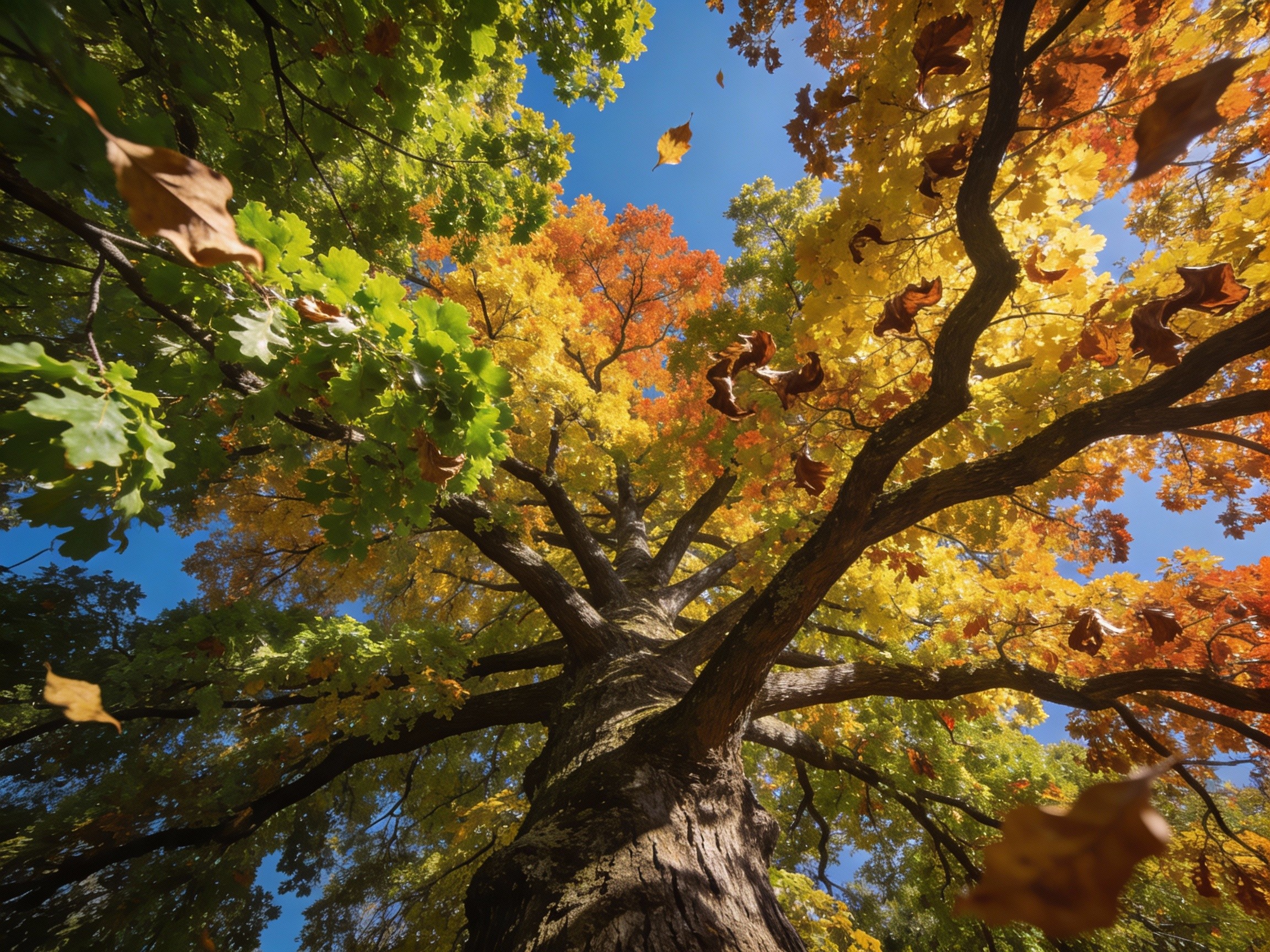
The Tree That Makes Decisions Without Thinking
Every October, something remarkable happens. Oak trees across the northern hemisphere of Earth begin dropping their leaves. Not randomly. Not all at once. In a sequence that starts at the tips of branches and works inward. The tree cannot see that days are getting shorter. It cannot feel that winter is coming. It has no brain to make a decision. And yet, at roughly the same time each year, the leaves come down.
How does a tree "know" anything?
The answer is chemicals. Not thoughts. Not instincts. Just molecules moving through wood and leaf, triggering changes that look—from the outside—like a decision. The oak tree runs on hormones. And understanding how a tree coordinates itself without a brain opens up a surprising window into how all living things work. Including people.
Wait—Trees Have Hormones?
Most people hear "hormones" and think of humans. Puberty. Stress. Mood swings. The word conjures up images of blood tests and glands and complicated medical charts.
But hormones are simpler than that. A hormone is just a chemical messenger. Something made in one part of a living thing that travels to another part and changes what happens there. That definition fits trees perfectly.
Plants were running on hormones long before animals existed. The first land plants appeared around 470 million years ago. They needed ways to coordinate roots and shoots, growth and rest, without any nervous system at all. Hormones were the solution. And they still are.
An oak tree produces at least seven different types of hormone. Each one does a different job. Together, they let a tree with no brain, no senses, and no ability to move respond to a changing world.
What Is a Hormone, Anyway?
A hormone is a chemical messenger. Nothing more complicated than that. A molecule made in one part of a living thing that travels to another part and causes something to happen there.
The living thing makes hormones from ingredients it already has. In plants, the raw materials are simple: sugars, amino acids from proteins, and fatty acids from fats. Enzymes—tiny molecular machines inside cells—assemble these ingredients into hormone molecules. Different hormones need different recipes. Auxin, for example, is built from an amino acid called tryptophan. Ethylene is built from another amino acid called methionine. Jasmonic acid comes from fatty acids. The tree does not import special chemicals. It builds what it needs from what it eats and absorbs.
Where are hormones made? In animals, there are dedicated glands—the thyroid, the adrenal glands, the pancreas. Plants do not have glands. Instead, hormones are made in whatever tissue needs to make them. Root tips produce cytokinins. Shoot tips produce auxin. Damaged leaves produce jasmonic acid. The production happens where the signal starts.
The real question is: what happens when a hormone arrives somewhere?
Every hormone has a matching receptor—a protein on or inside a cell that recognises that specific hormone and nothing else. Think of a lock and key. The hormone is the key. The receptor is the lock. When the hormone binds to its receptor, the receptor changes shape. That shape change triggers a chain of events inside the cell. Genes switch on or off. Enzymes activate or deactivate. The cell's behaviour changes.
This is why the same hormone can do different things in different places. A cell with one type of receptor responds one way. A cell with a different receptor—or no receptor at all—ignores the signal entirely. The message only matters if there is something there to read it.
So: hormones are chemical keys. Receptors are locks. And a tree full of hormones is a tree full of millions of tiny conversations—molecules meeting receptors, triggering changes, coordinating a living thing that has no idea any of it is happening.
The Chemical Toolkit
Here are the main players:
Auxin is the growth hormone. It controls which direction stems grow (up toward light) and which direction roots grow (down into soil). It also maintains what scientists call "apical dominance"—the main trunk stays in charge and side branches stay smaller. Remove the top of a tree, and auxin levels drop, and suddenly side branches start competing to become the new leader.
Ethylene is unusual—it's a gas. It triggers ripening in fruit and, crucially, leaf drop in autumn. When ethylene levels rise in the connection between leaf and branch, the cells there weaken and break apart. The leaf falls.
Abscisic acid—usually just called ABA—is the stress hormone. When water runs short, ABA tells the tiny pores on leaves to close up. This stops the tree losing water through evaporation. The tree cannot "feel" thirsty. But ABA responds to drought anyway.
Gibberellins promote growth and help break dormancy. They are part of why an acorn buried in autumn soil waits until spring to germinate. Conditions have to be right—and gibberellins are part of the chemical check.
Cytokinins stimulate cell division and keep leaves from ageing too quickly. They are made in the roots and travel upward, balancing the tree's growth between what's underground and what's above.
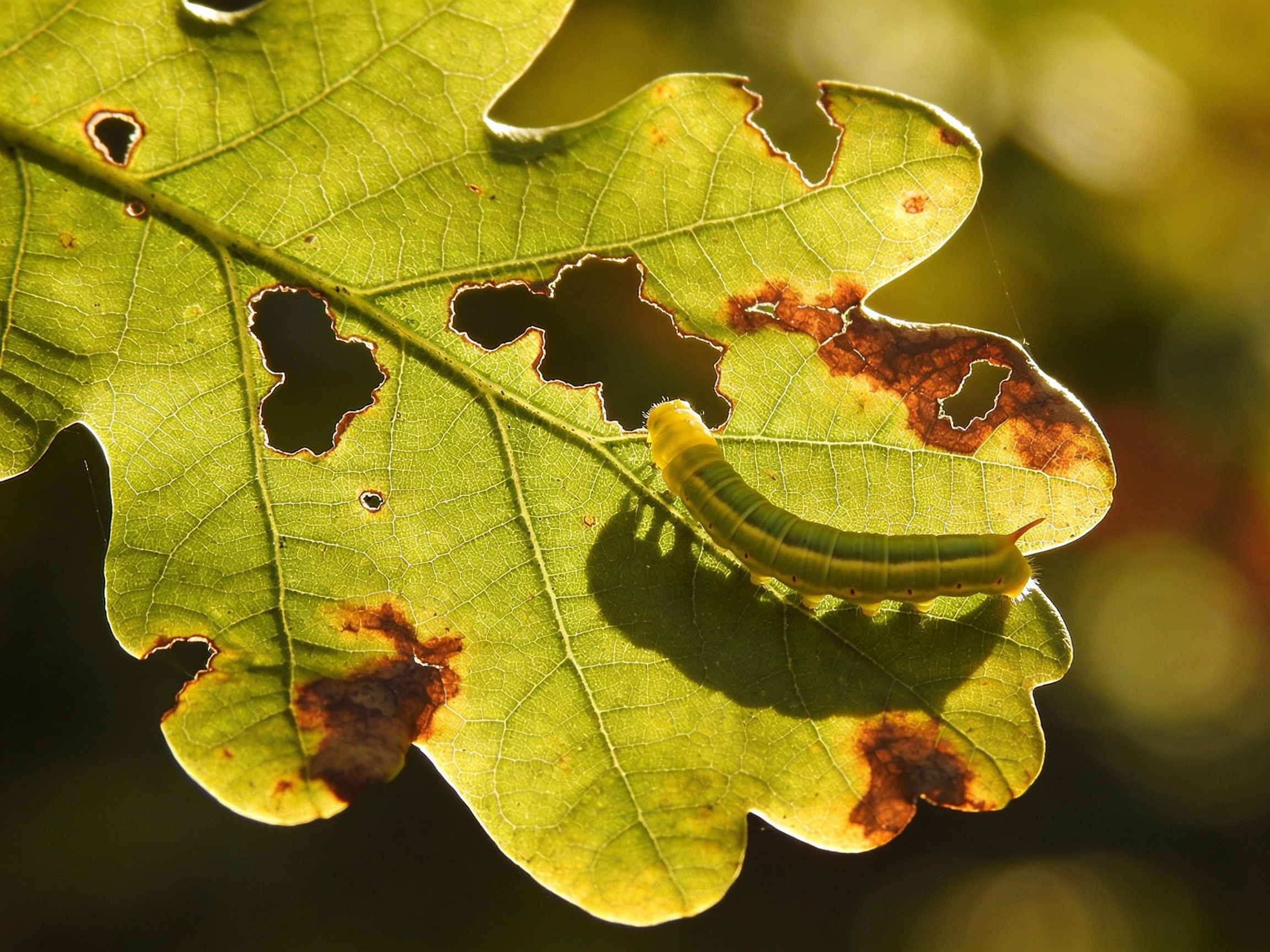
Jasmonic acid handles defence. When caterpillars start eating leaves, damaged cells release jasmonic acid, which triggers the production of tannins—bitter chemicals that make the leaves taste unpleasant. The tree cannot see the caterpillars. But it responds to the damage.
Salicylic acid manages disease resistance. When fungi or bacteria attack, salicylic acid coordinates the tree's immune response. This is the same molecule—found in willow bark—that led to the development of aspirin.
Seven chemical messengers. Each with a different role. None of them intelligent. But together, they let a tree navigate life without ever having a thought.
No Blood, No Problem
Here is where trees get really interesting. Humans move hormones around in blood. The heart pumps, blood flows, hormones travel. Simple enough.
Trees have no heart. No blood. No circulation in the way animals understand it.
So how do oak tree hormones get where they need to go?
Several ways. Some hormones travel through the phloem—tubes that carry sugars from leaves down to roots. Others move through the xylem—tubes that carry water from roots up to leaves. Some pass from cell to cell, handed along like a bucket in a chain. And ethylene, being a gas, simply drifts through air spaces inside the tree's tissues.
It is slower than blood. Much slower. A hormone signal in a human body can take effect in seconds. A hormone signal in an oak tree might take hours or days to spread. But speed is not everything. Trees live for centuries. They do not need to react in seconds. They need to react in seasons. And their hormone system is perfectly matched to that pace.
Reading the World Without Senses
An oak tree cannot see that autumn is coming. It has no eyes. But it can detect changes in daylight—not through vision, but through pigments in its leaves that react differently to red light and far-red light. As days shorten in autumn, the balance of these light types shifts. The pigments register this shift. And hormone production changes in response.
Temperature matters too. Cold nights trigger chemical changes. The tree does not "feel" cold. But certain chemical reactions slow down in lower temperatures, and this affects hormone production and breakdown.
Add these signals together and the tree has something that looks, from the outside, like awareness. It "knows" that days are getting shorter. It "knows" that nights are getting colder. It "knows" that winter is coming. But none of this involves knowing in the way a brain knows. It is chemistry responding to physics. Molecules reacting to conditions.
The result is the same. The tree prepares for winter without ever deciding to.
The Autumn Sequence
So what actually happens when an oak tree drops its leaves?
First, the days shorten. Light-sensitive pigments in the leaves register this change and trigger a slowdown in auxin production.
Auxin normally keeps leaves attached. It maintains the connection between leaf and branch. As auxin levels drop, that connection starts to weaken.
At the same time, ethylene production increases. Ethylene is the "goodbye" signal. It accelerates the breakdown of the connection zone—a layer of cells called the abscission zone. These cells were always there, waiting. Ethylene activates them.
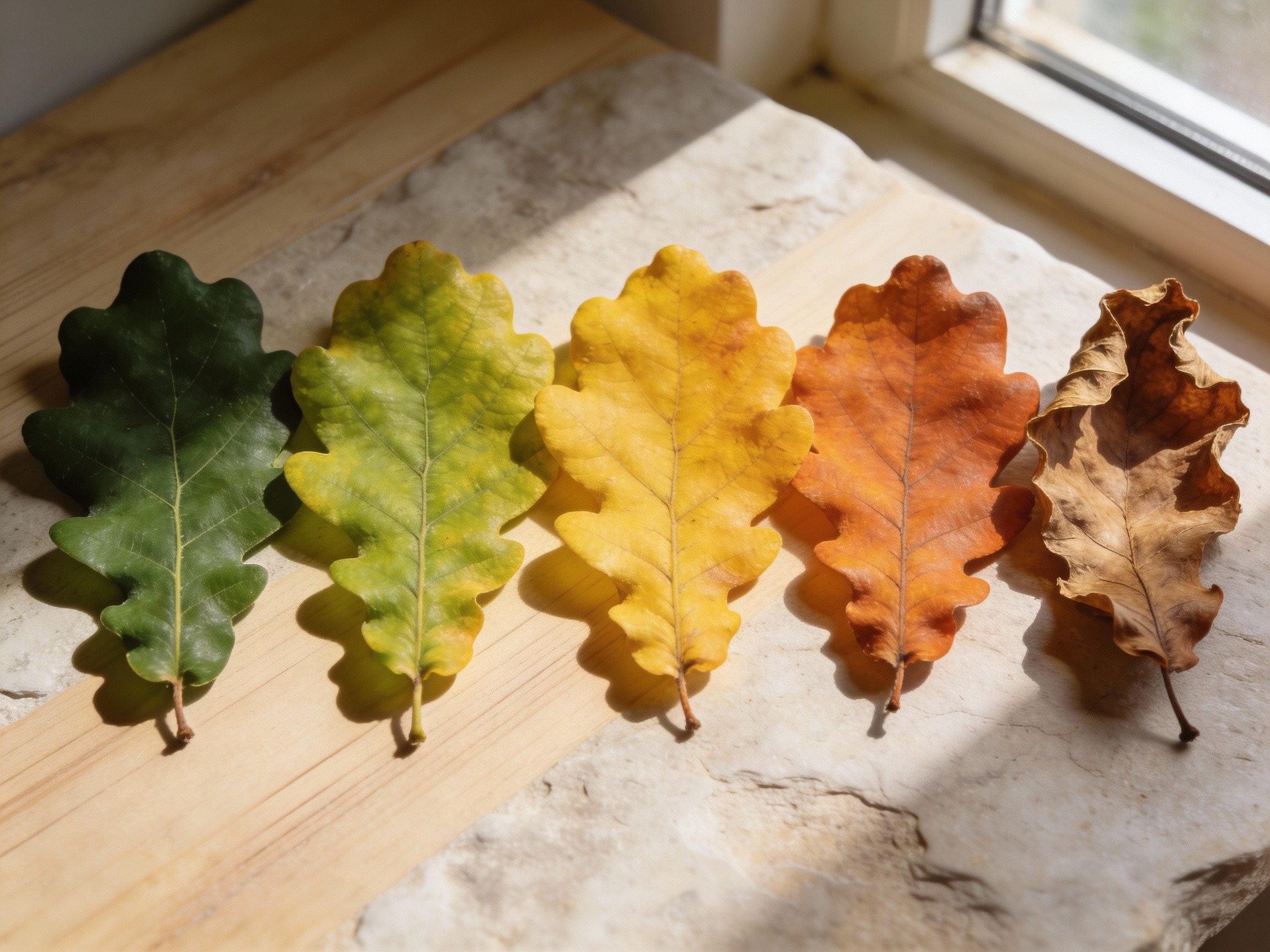
The tree also starts withdrawing resources from its leaves. The green chlorophyll breaks down. This is why leaves change colour—the green fades and reveals the yellows and oranges that were there all along, masked by chlorophyll. Meanwhile, sugars and nutrients travel back down into the trunk and roots for storage.
Finally, the abscission zone completes its work. The connection becomes so weak that wind or rain or simply gravity pulls the leaf free. The tree has sealed the wound before the leaf even falls. No infection gets in. No resources are lost.
All of this happens without a single decision. Just hormones rising and falling in response to changing conditions. The oak tree does not choose to drop its leaves. The chemistry makes it inevitable.
When Rain Stops Falling
Autumn leaf drop is dramatic and visible. But trees use hormones for quieter challenges too. When roots detect dry soil, they produce more ABA—the stress hormone. ABA travels up to the leaves and triggers the closure of stomata—tiny pores that normally let water vapour escape. The tree cannot feel thirsty. But ABA responds to drought anyway.
Closing stomata slows photosynthesis, so it is a trade-off. But losing water is a bigger risk than slowing growth. If drought continues, the tree may drop leaves early and enter a kind of survival mode. When rain returns, ABA levels drop, stomata reopen, and growth resumes. The crisis passes, and the tree never knew it was in one.
Fighting Back Without Fighting
A tree cannot run away from caterpillars. It cannot swat. But it can defend itself chemically. When a caterpillar bites into a leaf, damaged cells release jasmonic acid. This hormone spreads through the leaf and into neighbouring leaves, triggering the production of tannins—bitter chemicals that make leaves much less tasty. Undamaged leaves start producing tannins too. A caterpillar chewing on one branch causes leaves all over the tree to become less palatable.
Some research suggests trees can even warn their neighbours. Volatile chemicals released by a damaged tree may drift to nearby trees and trigger defensive responses before any caterpillars arrive. The evidence is still debated. But the possibility exists: trees communicating danger through chemical signals, without any intention or awareness at all.
No Central Control
Stand back and look at what the oak tree does. It grows toward light. It sends roots toward water. It drops leaves before winter. It closes pores during drought. It defends against attack. It times its acorns to germinate in spring. All of this happens without a brain, without a nervous system, without any central control at all.
The oak tree is a coordinated system made of millions of cells, each responding to local chemical signals. No single cell knows the plan. There is no plan. There is just chemistry responding to chemistry, and the result—from the outside—looks like intelligence. Biologists call this "distributed coordination." The whole tree behaves in ways none of its parts understand.
The Same Trick in Animals
Humans have nervous systems and brains and the ability to think. But running alongside all of that is something much older: hormones. Adrenaline floods the bloodstream during danger—muscles get more fuel, the heart beats faster, attention sharpens. None of this requires a decision. Cortisol rises during stress and changes how the brain forms memories. Oxytocin shapes trust. Melatonin sets the sleep cycle. Insulin controls whether cells can access fuel.
Animals have faster hormone delivery through blood circulation, and more complex responses. But the principle is identical to the oak tree: chemical messengers coordinating separate parts that cannot see each other, systems working together without any single part understanding the whole.
What This Means
The oak tree drops its leaves without deciding to. It closes its pores without feeling thirsty. It defends against attack without knowing it is under attack.
And humans? Humans regulate their own bodies constantly—heart rate, blood sugar, stress response, sleep cycles—without any conscious involvement at all.
This is because evolution does not replace what works. When animals developed nervous systems and brains, hormones did not disappear. The new system grew alongside the old one. Nerves handle fast, precise signals—"move that finger now." Hormones handle slower, broader coordination—"shift the whole body into stress mode." Both systems talk to each other constantly. Neither is in charge.
Evolution is sloppy and inventive, not neat and efficient. It does not design from scratch. It tinkers with what already exists. The result is layered, complicated, and sometimes redundant. But if it works, it stays. Animal bodies—including human bodies—are not elegantly engineered machines. They are accumulations of solutions that happened to survive.
So intelligence is not just what happens in brains. It is what happens when parts coordinate. When chemistry responds to chemistry. When old systems and new systems work together without any central plan.
The oak tree has no thoughts. But it has something that works just as well: a hormone system that lets millions of cells act as one living thing, responding to a world they cannot see. Every autumn, the leaves come down. Not because the tree decides. Because the chemistry makes it so.
Topics: #plantbiology #hormones #oaktrees #distributedcoordination #chemicalmessengers #evolution #neuroscience #ArchitectureOfIntelligence
Further Reading
These links dig deeper into the topics covered here:
Plant Hormones:
- Wikipedia: Plant Hormone - Overview of the main plant hormones and their functions
https://en.wikipedia.org/wiki/Plant_hormone - Nature Education: Auxin and Plant Development - Deeper look at the main growth hormone
https://www.nature.com/scitable/topicpage/auxin-and-cell-elongation-14023932/
Trees and Seasons:
- Woodland Trust: Why Do Leaves Change Colour and Fall? - Accessible explanation of autumn leaf processes
https://www.woodlandtrust.org.uk/blog/2019/10/why-do-leaves-change-colour/ - Royal Horticultural Society: How Plants Cope with Drought - Practical guide to plant stress responses
https://www.rhs.org.uk/science/plant-health-in-gardens/drought - New Scientist: Do Trees Communicate? - Overview of chemical signalling between plants
https://www.newscientist.com/article-topic/plant-communication/
How This Essay Reflects YFL Values
This essay explains how hormones work in oak trees and in people. It shows how chemicals moving through a body can make complicated things happen without anyone being in charge. Oak trees drop leaves. People handle stress. Both use the same trick—chemical messages that coordinate millions of cells. The essay presents the evidence and lets readers decide what it means for them.
Related YFL Essays
The Architecture of Intelligence: From Termite Colonies to Human Brains - Explores distributed coordination across different systems—termite colonies, human societies, and brains—showing how intelligence emerges without central control
Living Emergence - Examines how complex behaviours develop from simple interactions, connecting to how hormones create coordinated responses without conscious planning
When Your Brain Has a Mind of Its Own - Details how stress hormones like cortisol reshape brain function and behaviour, showing the hormone-brain conversation in action
Play—the Brain's Natural Learning Environment - Explores how learning happens through cycles of arousal and recovery—processes regulated by the same hormone systems described in this essay
Copyright Notice
© 2025 Steve Young and YoungFamilyLife Ltd. All rights reserved.
"Hey!, Want To Know" is a copyrighted content format of YoungFamilyLife Ltd.
This essay was developed collaboratively using AI assistance to research academic sources and refine content structure, while maintaining the author's original voice, insights, and "Information Without Instruction" philosophy. No part of this essay may be reproduced, distributed, or transmitted in any form or by any means, including photocopying, recording, or other electronic or mechanical methods, without the prior written permission of the copyright holders, except in the case of brief quotations embodied in critical reviews and certain other noncommercial uses permitted by copyright law.
For permission requests, contact: info@youngfamilylife.com