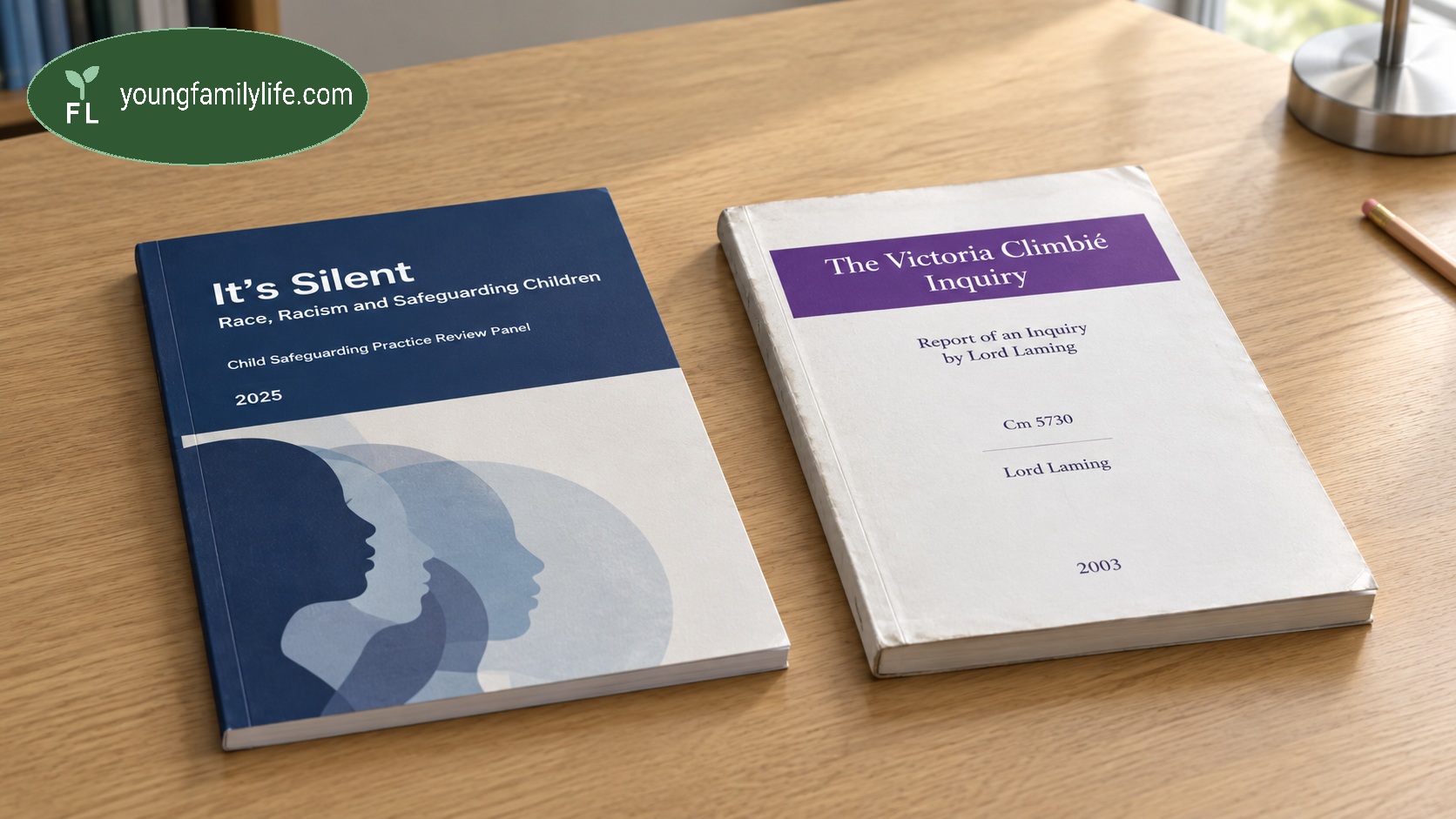
Race and racism have not been analysed with the same consistency as other risk factors in UK child protection practice, in serious case and safeguarding reviews, despite three independent confirmations of this pattern across more than two decades. "Silence," the term most often used to describe this pattern — including by the reviewing body that named its own 2025 report after the word — is imprecise. A more exact term is available: the licensing of discourse, which names what the evidence actually shows.
Poverty has been named consistently in UK child protection reviews for at least two decades — as a contributing factor, a risk marker, a thing reviewers are trained and expected to ask about. Race is not treated the same way, in one specific and narrower sense that needs stating precisely before it can be defended.
Race has not gone undiscussed in British public life over the same period — the opposite is true. Race and racism have arguably never been more prominent in British political and institutional discourse than since 2020, when the international reaction to George Floyd's murder produced an unusually direct wave of British reckoning with institutional racism, workplace DEI policy, and anti-racism training commitments across public bodies, safeguarding services included. Reading the pattern above as though it contradicted that abundance would be a straightforward misreading. The pattern is narrower, and better named as something other than silence: the licensing of discourse — the observation that a society or institution can permit, and even actively encourage, one register of speech about race while a different, more specific register remains effectively unlicensed, rarely attempted, and treated as a departure from professional norms when it is. Abundant public and political speech about racism as a structural, systemic reality is one register, and it has become broadly licensed in Britain, in many institutional settings actively encouraged. Naming racism as something that may have shaped a specific professional's judgement, in a specific case, closely enough to matter for what happened to a specific child, is a different register — and it is this second register, not speech about race in general, that has stayed unlicensed across the whole period under examination here.
The distinction is not new, even if its application to this specific case-review pattern is. Sara Ahmed's peer-reviewed analysis of institutional anti-racism statements argues that such statements are typically nonperformative: they do not, in themselves, commit the institution that issues them to the action they name, and the appearance of having spoken can function to substitute for, rather than produce, real accountability (Ahmed, 2006). A separate and independently replicated body of psychological research gives the mechanism a more precise name still. Moral licensing — first demonstrated, in its founding study, specifically in relation to racial prejudice — shows that establishing moral credentials on one occasion measurably increases a person's willingness to act or judge in a biased way on a subsequent, unrelated occasion, without the individual feeling or appearing prejudiced to themselves (Monin and Miller, 2001). A direct follow-up study found the same effect in precisely this register: participants who had endorsed Barack Obama for president, a visible, low-cost anti-racist credential, were subsequently more likely to favour White candidates over Black candidates in an unrelated hiring judgement (Effron, Cameron and Monin, 2009). Broadcast regulation supplies a further, more mundane reason the same asymmetry holds structurally, not just psychologically: Ofcom's fairness principles require that individuals or organisations facing an allegation of wrongdoing normally be given a right of reply, a due-process bar that a general claim about systemic racism does not have to clear, because no single named party is being accused. None of these three sources examined UK child protection reviews specifically. Together, though, they describe exactly the asymmetry visible in one specific institutional record: broad, structural anti-racism speech carries low cost and is widely licensed; naming bias in one named professional's one specific judgement carries real cost, faces real procedural friction, and stays rare.
The gap between how licensed each register is, is the more precise finding than "silence" alone captures. The 2025 Panel's own title, "It's Silent," reads more accurately once that distinction is in view: not a claim that Britain has stopped talking about race, but that its safeguarding reviews specifically have stayed outside the one register of that conversation — individual case analysis — where it would matter most for the next child.
The same asymmetry has a further, more visible consequence in current public discourse, and it is worth naming directly rather than leaving it as an implication. A vocal minority of white Britons, amplified particularly on social media, now frames itself in the language of ethnic-minority grievance — as a group whose disadvantage goes unacknowledged precisely because attention to racial disadvantage has been directed elsewhere. This is not a new phenomenon, and it is not confined to social media. Ware's peer-reviewed analysis of the BBC's 2008 "White Season" documents an almost identical framing being offered by the series' own commissioning editor, who wrote that "many of the white working class see themselves as an oppressed ethnic minority too, and lower down the ladder than other groups on the hierarchy of victimhood" (Ware, 2008; Klein, 2008). Recent polling gives the current version of this sentiment a rough scale: an Ipsos poll of 1,200 British adults in 2025 found 36 per cent of respondents believe workplace DEI initiatives have "gone too far," rising to 38 per cent among white respondents against 23 per cent among those from minority ethnic backgrounds (Ipsos, 2025).
That grievance is not equivalent, in scale or material consequence, to the disproportionate presence of Black and mixed-heritage children in serious case reviews, or to disclosures from Asian girls going unheard, whatever any single high-profile case might seem to suggest in isolation. Scheler's account of ressentiment, drawn on directly in Ware's analysis, offers a useful caution here rather than a dismissal: grievance of this kind is often structured less by a desire for a specific remedy than by the grievance itself, and "improvements in the conditions criticised cause no satisfaction" because satisfaction was never quite the point (Scheler, in Bershady, 1992). The grievance is, instead, a predictable by-product of the exact asymmetry described above. When one register of race-discourse is heavily licensed and amplified — structural, political, general — while a harder register stays restricted, a vacuum opens that something will fill. A reactive claim to minority status, borrowing the vocabulary built to protect people who face measurably different material outcomes, is one of the things that fills it. Naming that consequence is part of describing the licensing asymmetry accurately, not a concession that the two claims carry equal weight.
That gap is not a minor omission. What follows traces its three confirmations in order — Lord Laming's Climbié Inquiry in 2003, Bernard and Harris's content analysis in 2019, and the Child Safeguarding Practice Review Panel's report in 2025 — before turning to what the pattern implies about how institutions learn.
2003: what Climbié's Inquiry saw, and didn't fully resolve
Victoria Climbié died in London in February 2000, having been seen by numerous social workers, police officers, and health professionals in the months before her death. Lord Laming's inquiry, reporting in 2003, found catastrophic multi-agency failures across every service that had contact with her. Among the inquiry's findings was a specific, uncomfortable observation: some professionals appeared to read signs that would otherwise have prompted serious concern as culturally unremarkable, deferring to an assumed cultural norm rather than treating what they saw as a warning (Laming, 2003; Chand, 2003).
This is not the same claim as straightforward racism, and treating it as though it were would flatten something more specific and, in some ways, harder to correct. The professionals involved were not, on the available evidence, acting out of hostility toward Victoria because of her race. They were, on this reading, doing something closer to the opposite: extending a kind of deference intended as respect for cultural difference, and in doing so, allowing behaviour that should have triggered concern regardless of a family's background to pass without challenge. Cultural relativism and institutional racism are not the same failure. But both can produce the identical outcome — a child's danger going unnamed — and Climbié's case is where UK safeguarding first had to reckon, in public and in enormous detail, with the fact that respecting difference and protecting a child are not automatically the same instinct.
2019: the sixteen-year gap, measured
Bernard and Harris's 2019 content analysis of serious case reviews gave this observation its first systematic confirmation. Their study set out to establish what questions, if any, serious case reviews concerning Black children actually asked about race, ethnicity and culture — and found that race received, in their own words, limited attention, or was virtually absent, despite the number of high-profile Black child deaths that had by then driven two decades of safeguarding reform (Bernard and Harris, 2019).
The finding is worth sitting with for what it implies about the review process itself, not only about any individual case. A serious case review exists specifically to extract lessons from a child's death or serious harm, and to feed those lessons back into practice. If race was, on Bernard and Harris's analysis, not being asked about across the reviews they examined, that is not evidence that race was irrelevant to those children's experiences. It is evidence that the lesson-learning machinery itself was not designed, or was not consistently used, to ask the question in the first place. Sixteen years after Climbié's Inquiry had already surfaced cultural relativism as a specific mechanism by which risk could be missed, the system's own review process had still not built race in as a standing question.
2025: the same finding, now with numbers and a name
The Child Safeguarding Practice Review Panel's March 2025 report goes further than either of the findings before it, in one specific respect: it names the silence itself, in its own title, as the finding. "It's Silent": Race, Racism and Safeguarding Children examined 54 sample reviews — 40 rapid reviews and 14 Local Child Safeguarding Practice Reviews, covering incidents between January 2022 and March 2024 — relating to 53 children from Black, Asian and Mixed Heritage backgrounds. Twenty-seven of those children died (Child Safeguarding Practice Review Panel, 2025). The sample itself was composed of 15 Black children, 25 of mixed heritage, and 14 Asian children, and the Panel's own account of what it found is direct: reviews were silent about the presence of racial bias in professionals' decision-making, and about the role racism might have played in how services responded to these families and children.
The report resists being smoothed into a single narrative, and it is worth resisting that smoothing here too. Black and mixed-heritage children's overrepresentation in the Panel's own safeguarding-review data, and Asian children's underrepresentation in it, is one finding — stated by the Panel qualitatively, against its own review database, rather than as a direct comparison with England's general child population, since the sample itself was purposively selected rather than drawn in a way that would support that wider comparison. A different and separate finding concerns several reviews in which girls of Asian or mixed-Asian heritage had disclosed sexual abuse, and where those disclosures appeared to have been dismissed as untrue or not carefully followed up. These are not the same failure. One is a pattern of over-representation and, the Panel suggests, insufficient scrutiny of why that over-representation exists. The other is a pattern of disclosures not being believed or acted on. Both sit inside the same twenty-two-year pattern, but they are different silences, about different things, and treating them as interchangeable would lose exactly the specificity the Panel's own report was trying to establish.
Twenty-two years after Climbié's Inquiry first surfaced the mechanism, and six years after Bernard and Harris measured its persistence directly, an independent national panel used the word "silent" as its own report's title. That is not a subtle finding stated cautiously. It is an institution naming its own failure to learn, in public, about a question it had already been asked twice before.
What twenty-two years of repetition suggests about institutional learning
Working Together to Safeguard Children's 2026 edition, published in March 2026, is the live policy response to this specific finding: it now requires practitioners not merely to hold awareness of racism and disproportionality, but to actively identify and challenge them, backed by strengthened multi-agency requirements to share data specifically capable of revealing disproportionality patterns (Department for Education, 2026). Whether this changes what the next content analysis or the next Panel report finds is not yet known.
What twenty-two years of repetition does support is a genuine, open question about why this particular gap persisted for as long as it did, rather than a single confident diagnosis. Several explanations are plausible, and none of them need to be mutually exclusive. Naming racism as a general, structural problem carries a kind of institutional safety that naming it in one specific case does not: it locates the issue in a system everyone can agree needs improving, rather than in a specific team's specific reading of a specific family, which risks reading as an accusation against a named colleague rather than a lesson for the service. Review templates may simply never have prompted reviewers to ask the case-specific version of the question, so that its absence reflects a missing structure rather than active avoidance. High turnover in a field already discussed in Capacity on Both Sides of the Door for its resourcing pressures means that whatever a reviewer does conclude about race in one case may never accumulate into the kind of institutional memory that changes the next template. And professional discomfort may run in exactly the direction this asymmetry would predict: comfortable citing racism as a national issue in a training slide, considerably less comfortable writing, in a document that will be read by a bereaved family and the press, that a named professional's judgement may have been shaped by an assumption about this specific child's race. Which explanation carries the most weight is left deliberately unresolved here. Twenty-two years of the same finding, confirmed three separate times by three different kinds of institutional authority, is not a pattern that needs solving before it can be treated as real. It needs to stop being possible to look away from.
What this means for practice
Building the Working Alliance Based on Confidence That Can Be Earned's account of the Social GRACES framework already names the two failure modes traced in more detail above: the cultural relativism that may have let Victoria Climbié's case go unchallenged, and the racial bias the 2025 Panel's report found operating in the opposite direction elsewhere. That essay treats the framework, used as its originators intended — revisited across the life of a case, not completed once and filed — as one of the better tools available for holding both failure modes in view at once. The twenty-two-year record above is what makes that claim more than a hopeful gesture. A tool for holding race in view is only worth as much as the twenty-two-year record of a system that mostly hasn't used it, and knowing that record is what turns "use the GRACES framework properly" from a training slide into a specific, historically grounded caution.
The confidence measure that essay builds its whole argument around asks whether a family has genuine grounds to believe a service will help them meet their children's needs. A system that has spent two decades licensing one register of speech about race while leaving the other effectively unlicensed cannot be assumed to extend that confidence-earning practice evenly across racial lines, however carefully it earns it elsewhere. That is not a claim that every case involving a Black, Asian, or mixed-heritage family has been handled badly. It is a claim about what a documented, repeatedly-confirmed asymmetry in what a system permits itself to say should make a practitioner unwilling to assume.
References
Ahmed, S. (2006) 'The nonperformativity of antiracism.' Meridians: feminism, race, transnationalism, 7(1), pp. 104–126.
Bernard, C. and Harris, P. (2019) 'Serious case reviews: the lived experience of Black children.' Child and Family Social Work, 24(2), pp. 256–263.
Bershady, H. (ed.) (1992) Max Scheler: On Feeling, Knowing, and Valuing. Chicago: University of Chicago Press.
Chand, A. (2003) '"Race" and the Laming Report on Victoria Climbié: Lessons for inter-professional policy and practice.' Journal of Integrated Care, 11(4), pp. 28–37.
Child Safeguarding Practice Review Panel (2025) "It's Silent": Race, Racism and Safeguarding Children. London: Child Safeguarding Practice Review Panel.
Department for Education (2026) Working Together to Safeguard Children 2026. London: DfE.
Effron, D.A., Cameron, J.S. and Monin, B. (2009) 'Endorsing Obama licenses favoring Whites.' Journal of Experimental Social Psychology, 45(3), pp. 590–593.
Ipsos (2025) DEI in UK Workplaces: Public Attitudes Poll.
Klein, R. (2008) 'White and working class ... the one ethnic group the BBC has ignored.' Daily Mail, 29 February.
Laming, Lord (2003) The Victoria Climbié Inquiry: Report of an Inquiry by Lord Laming, Cm 5730. London: The Stationery Office.
Monin, B. and Miller, D.T. (2001) 'Moral credentials and the expression of prejudice.' Journal of Personality and Social Psychology, 81(1), pp. 33–43.
Ofcom fairness principles (Broadcasting Code, Section 7; BBC Editorial Guidelines 6.2.3).
Ware, V. (2008) 'Towards a sociology of resentment: a debate on class and whiteness.' Sociological Research Online, 13(5)9.
Topics: #Race #Safeguarding #ChildProtection #InstitutionalRacism #SerialCaseReviews #DEI #SocialWork #PublicDiscourse