Structural poverty and individual moral failing are routinely treated in British public life as though they were the same explanation for the same set of facts.
The public argument over the government's 2026 breakfast clubs initiative is a paradigm case of exactly this happening in real time. Put crudely, one side says the state is filling a genuine structural gap in family life; the other says parents are being let off a basic duty that was always theirs.
Child protection cases, though, are where that same conflation shows up most starkly and does the most damage. This essay traces that pattern from a specific 1994 case to the present, and argues that "class-coded moral judgement" names it more precisely than "stigma" alone does. The "class" doing the coding here is not a loose or merely descriptive label — Britain's Quiet Caste That Resists Meritocracy makes the case, on its own separate evidence, that class in Britain functions as a persistent boundary individual achievement does not reliably dissolve; this essay borrows that weight rather than re-arguing it. Stigma names a social consequence — being looked down on. Class-coded moral judgement names the cognitive move that produces it: treating a structural condition, such as poverty, as though it were evidence of a person's character.
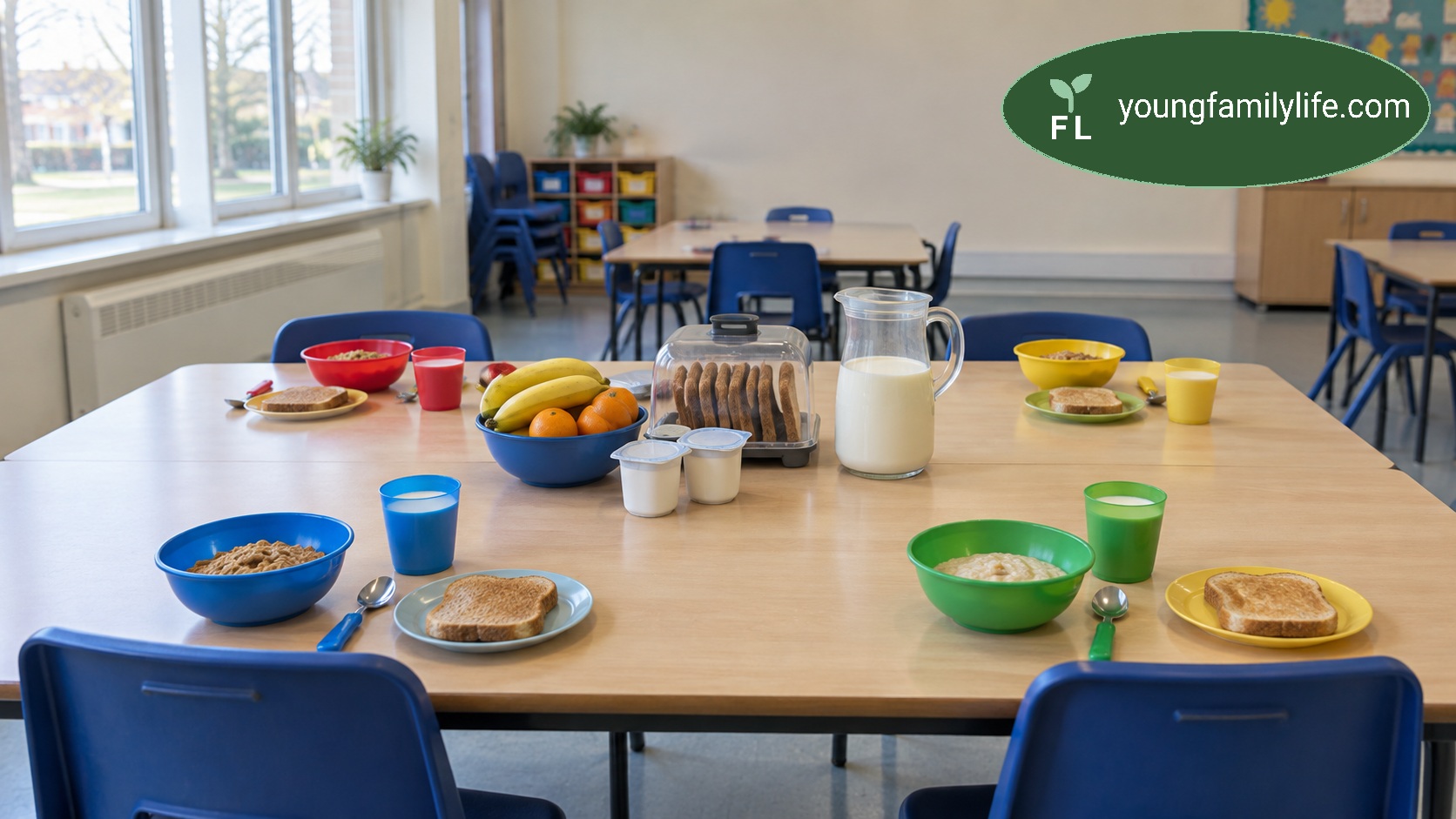
The same move is visible well outside child protection, in live policy debate rather than closed casework. That debate has two stated, structural functions on one side: letting a parent work standard full-time hours rather than the part-time or flexible patterns that otherwise become the only option once wraparound childcare and a school-hours job stop lining up, and the plainer purpose of making sure no child starts the school day hungry regardless of what happened at home that morning.
Criticism of the policy has taken a different shape. Rather than disputing whether it achieves either function, it argues that feeding a child is a parent's basic responsibility — a Maslow-level obligation — and that a school taking it on is a moral failure being quietly outsourced, not a structural gap being sensibly filled. The disagreement, in other words, is not really about breakfast clubs. It is about whether needing one is evidence of what kind of parent you are, which is the identical move this essay traces through Ruth Neave's case thirty years earlier, now aimed at a policy rather than a family already in crisis.
What moralising poverty actually does
The move has a specific shape. A structural condition — insufficient money, unstable housing, no spare time, no one to call for help — gets read as an inferred trait: chaotic, feckless, unfit. The inference travels in one direction only. A parent who is poor and struggling is asked to explain their struggling; a parent with resources who reaches the same crisis point is far more often read as unlucky. Neither reading is really an assessment of what the parent did. Both are assessments of what their poverty is assumed to say about who they are.
This is not a claim that structural conditions never combine with individual conduct, or that context excuses everything a parent does. It is a claim about a specific error: skipping the structural explanation entirely and treating the individual one as though it were the complete and sufficient account. Two cases, one real and thirty-two years old, one fictional and recent, show what that error looks like in practice.
The 1990s "underclass" discourse and Ruth Neave
Rikki Neave was six years old when he was murdered in woodland near his home in Peterborough in November 1994, his body left posed in a clearing a short walk from the estate where he lived. His mother, Ruth Neave, was tried for his murder in 1996 and cleared by the jury. She was convicted, on her own admission, of child cruelty, and served seven years. The actual killer — a local boy, thirteen years old at the time, with no family connection to the Neaves — was not convicted until 2022, following advances in forensic evidence that reopened a case police and press had treated as settled for over two decades.
The killer's own circumstances are worth a brief, factual note here, since they do real work in separating what Ruth Neave was actually guilty of from what she was assumed to be guilty of. He had recently moved from foster care into a children's home a short distance from Rikki's estate. The 2022 trial established that he had described a premeditated "morbid fantasy" to his own mother three days before the killing, and that he stripped and posed Rikki's body afterward for his own sexual gratification — the court's account of a calculated, sexually motivated act by another child, unconnected to anything in Rikki's own household. This essay draws no causal line between the killer's own circumstances and what he did; that would overreach what is actually known. But it is worth noting, without pressing the point further, that the child responsible for Rikki's death was, at that exact moment, also a child inside the state's own care system — a detail that does not excuse what Ruth Neave was convicted of, but that sits oddly with a public narrative that treated only her household as the site of institutional failure.
Ruth Neave was not an unseen family. She was in frequent, documented contact with social services before Rikki's death. No conventional serious case review exists for this case, but the Department of Health's Social Services Inspectorate conducted a formal inspection of Cambridgeshire's child protection services in 1997, commissioned directly following Rikki's death, finding serious deficiencies and issuing forty recommendations, with a 1998 follow-up assessing how many had actually been implemented (Social Services Inspectorate, 1997). That inspection is the institutional side of this story, and it is worth holding separate from the press and public response, which ran on a different track entirely.
That response took shape inside a specific and, at the time, very current discourse. The American social scientist Charles Murray had brought the term "underclass" into mainstream British debate with The Emerging British Underclass in 1990, arguing that a certain kind of poverty was not simply a shortage of money but a marker of a "type" of person, characterised by attitudes toward parenting, work and crime rather than by circumstance (Murray, 1990). He returned to the argument in Underclass: The Crisis Deepens, published in September 1994 — two months before Rikki Neave's death (Murray, 1994). Whether or not any individual journalist covering the case had Murray's essays specifically in mind, the vocabulary his work had put into wide circulation — chaos, dysfunction, a class of person rather than a set of pressures — was already live in British public discourse at the exact moment reporters needed a frame for Ruth Neave.
According to a 2017 report by Dominic Ponsford, John Elworthy — the local editor who later fought successfully to have the case reopened — described exactly this framing at work: television cameras allowed into Ruth Neave's home in 1994 filmed what he was reported as calling a "sparse and seemingly chaotic home," an image that stood, in his reported account, at odds with the "relatively normal domestic scene" that still photographs taken around the same time actually showed (Ponsford, 2017, reporting Elworthy's remarks). Elworthy was reported as judging bluntly that the media were, in his words, "force fed the accepted wisdom" that Ruth Neave was guilty of murder, an assumption that held for years and shaped how her home, her parenting, and her credibility were all read from that point on. The neglect conviction that followed was real. The murder was not hers, established only twenty-six years later. The framing that made the second fact feel almost unnecessary to establish — that this was, self-evidently, the kind of home a killing would come from — is the class-coded moral judgement this essay is naming.
Peter Connelly and the individualisation of blame
Peter Connelly's case, discussed in Capacity on Both Sides of the Door for what it shows about professional capacity, produced a press and political response that is worth treating as its own separate case study in moralising, distinct from the practice failures the case itself involved. The Sun's "Justice for Baby P" campaign ran under the front-page headline "Blood on their hands," named individual frontline social workers directly, and delivered over a million signatures demanding their dismissal (Press Gazette, 2011; Community Care, 2011). Sharon Shoesmith, the director of children's services, was sacked at a live press conference by the then education secretary, Ed Balls, within weeks of a rapid Ofsted-led review — before Haringey's own full serious case review had been made public (Channel 4 News, 2008).
What that response did, structurally, was individualise a failure that the case's own serious case review had located substantially in resourcing and caseload capacity — the same mechanism examined in detail in Capacity on Both Sides of the Door. Naming individual, low-paid frontline workers as the story's villains is not simply an emotional public reaction to a child's death. It is a way of protecting a different story — about funding, staffing, and political choices made well above any individual social worker's pay grade — from the scrutiny a genuinely structural account would have demanded. A family's poverty gets moralised into a parent's character; a system's underfunding gets moralised into a named worker's failure. The mechanism converting structural conditions into individual blame is the same mechanism in both directions, aimed at different targets.
What the fictional Copkdens show by contrast
The Copkdens, a fictional family from YFL's Midkwell case-study material, show the same mechanism working in reverse. The fictional Martin, an IT consultant, and the fictional Sophie, a teacher, reach a genuine crisis — a suicide attempt, discovered by one of their own children — and close their case successfully within eight months, drawing on private therapy, grandparental financial support, and the kind of stable professional life that makes taking time off to attend appointments straightforward rather than costly. Their crisis is real. It is also, by virtue of who they are, read by default as misfortune rather than culpable failure — a family that "did the right thing" by engaging quickly, rather than a family whose engagement had to overcome anything to happen at all.
The question worth asking directly is what would have happened to the identical crisis — the same suicide attempt, discovered the same way, by the same kind of frightened child — in a family without private therapy to draw on, without grandparents able to help financially, without an employer likely to accommodate a sudden run of appointments. Bywaters' inverse intervention law, examined in Building the Working Alliance Based on Confidence That Can Be Earned, describes exactly this asymmetry at the structural level: families with fewer resources are more likely to be investigated and less likely to receive the kind of support that resolves a crisis quietly. The fictional Copkdens' resourced version of this crisis was never at meaningful risk of being read as evidence of who they are as parents. An unresourced family's identical crisis routinely is.
The point for practice
None of the ideas already established across this suite and elsewhere at YoungFamilyLife — the inverse intervention law, professional capacity as a distinct variable from willingness, confidence as something a service has to earn (per Building the Working Alliance Based on Confidence That Can Be Earned's own measure), and person-in-environment theory's insistence, set out in When Personal Conviction Meets Professional Neutrality in Social Care, that a family's circumstances are part of the picture rather than separate from it — resolves the pattern this essay has traced on its own. What they do, together, is make the pattern identifiable rather than instinctive. Person-in-environment theory in particular already establishes, as training, that explaining a family's situation by individual choice alone, without asking what housing policy, service provision, or economic conditions contributed, is an incomplete answer rather than a neutral one. The moralising this essay describes is that incomplete answer, arrived at reflexively rather than deliberately, applied more readily to a poor family than a resourced one facing the same crisis.
Learning to notice this pattern in real time — in supervision, in a case conference, in one's own instinctive first read of a family walking through the door — is itself a professional skill, not a matter of personal politics. It is closer to the reflective practice already required of every registered social worker than to a position on any contested political question. Ruth Neave's home was, by the surviving photographic evidence, relatively ordinary. It was read, at the time and for years afterward, as self-evidently chaotic, because chaos was the story her poverty was already assumed to be telling. Recognising that assumption operating — in a live case, not only in a thirty-year-old one — is the practical skill this essay has been describing throughout.
The breakfast clubs debate points at something wider than any single policy, worth naming directly. Responsibility for meeting a child's basic needs does not sit still. Parents, schools, government and wider society each hold a piece of it, and each can point, with some justification, at one of the others: a parent under-resourced by low pay and inflexible hours; a school already asked to take on far more than teaching; a government weighing one spending decision against every other; a society that votes for both lower taxes and better-supported children without reconciling the two. The Victoria Sponge Problem: Why Schools Can't Be Everything examines this same diffusion from a different angle entirely — not who is at moral fault, but who has the resourced capacity to act, once breakfast clubs, safeguarding, mental health triage and a dozen other functions have all been quietly added to a school's original, narrower purpose. The two essays are not describing the same problem. They are describing two different failure modes of the same unresolved question — who is actually responsible. Moralising is what fills that gap. Sometimes it is a slow drift: the question goes unanswered long enough that blaming the nearest visible party starts to feel like an answer. More often, once press and social media take hold of a case, it is immediate — a public that wants someone to blame right away, punished visibly, so that everyone else can look away from the harder truth that responsibility was never held by one party alone.
References
Channel 4 News (2008) 'Shoesmith sacked over Baby P.' 8 December 2008, [online].
Community Care (2011) 'How the media covered the Baby P case: a case study in child protection.' [online].
Crown Prosecution Service (2022) 'Killer of Rikki Neave guilty of murder.' [online].
Murray, C. (1990) The Emerging British Underclass. London: IEA Health and Welfare Unit.
Murray, C. (1994) Underclass: The Crisis Deepens. London: IEA Health and Welfare Unit.
Ponsford, D. (2017) 'Editor hits out at "unhealthy" police-media relations at time of unsolved murder.' HoldTheFrontPage, 8 August.
Press Gazette (2011) 'Sun editor Rebekah Wade defends Baby P campaign.' [online].
Social Services Inspectorate (1997) Cambridgeshire Social Services: Inspection of Child Protection Services. London: Department of Health.
Topics: #Poverty #SocialJustice #ChildProtection #ClassCodedJudgement #Safeguarding #Underclass #SocialWork #StructuralInequality