What the term means
“Parenting style” is a term professionals use often. It can sound like something a parent might be tested on and marked against — which is the wrong way to think about it.
Parenting style just means the general way a parent tends to respond to their child, day to day. It's not a fixed personality type, and it's not a rulebook.
The two ingredients
Most descriptions of parenting style come down to two things, in different amounts:
- Warmth — how much love, comfort, and attention a child gets from a parent.
- Structure — how much guidance and clear boundaries a parent gives around behaviour.
Every parent has some mix of both. Parenting style is simply the pattern that mix tends to settle into, most of the time.
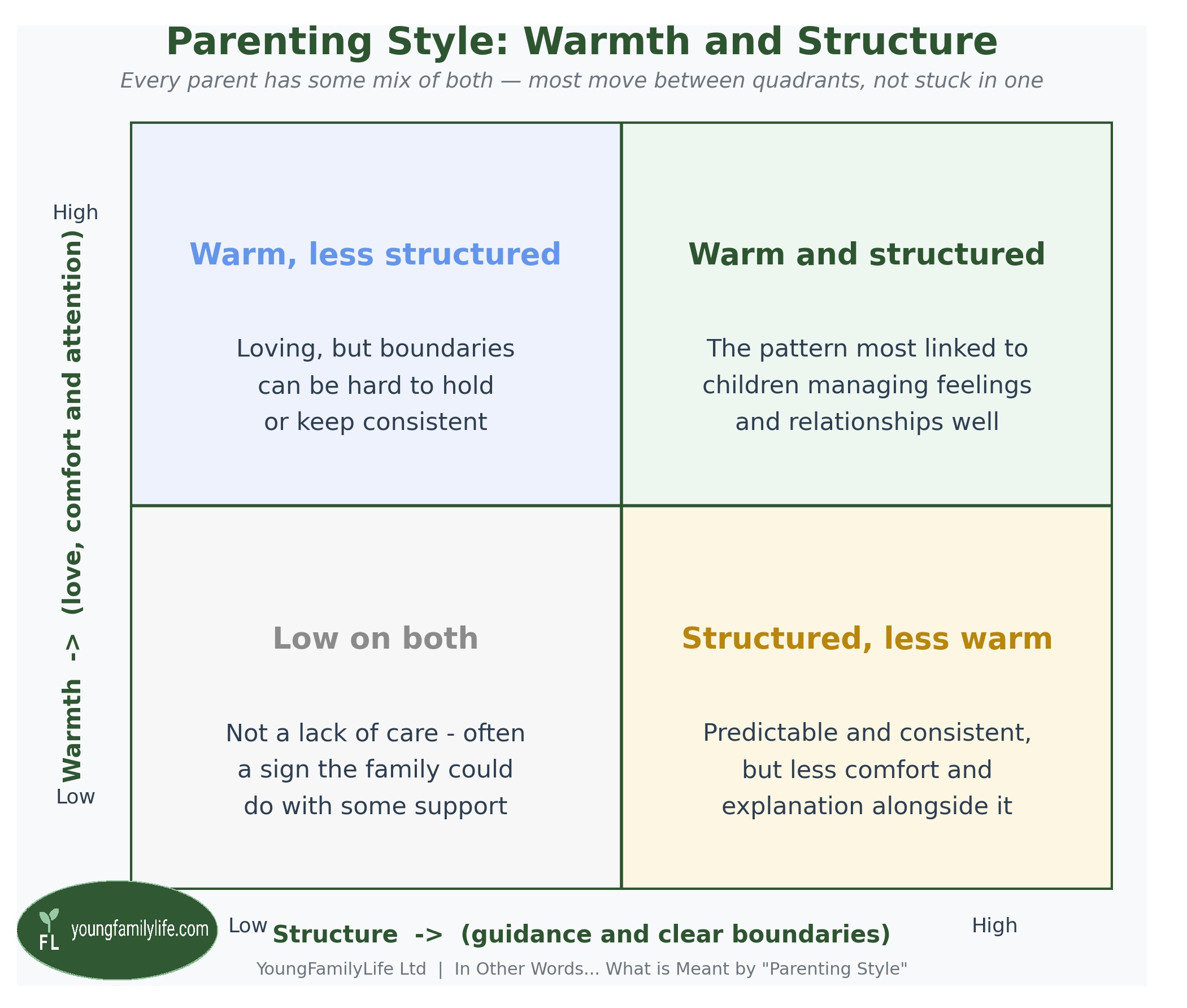
The diagram below shows how these two ingredients combine into four broad patterns — most parents move between more than one of these, rather than sitting fixed in a single quadrant.
When both are high
Research points to one pattern that tends to work best: plenty of warmth, alongside clear structure.
In practice, this looks like:
- Explaining the reason behind a boundary, not just enforcing it.
- Staying calm and close when a child is upset, while still holding the boundary.
- Being consistent enough that a child knows roughly what to expect.
- Naming a child's feelings, even when their behaviour isn't acceptable.
Children raised this way tend to grow up better able to manage their feelings and relationships. But it's a tendency, not a guarantee — and no parent gets this right every day.
What it looks like when one is missing
The other three quadrants in the diagram above look like this in everyday life.
A parent can be warm without much structure — loving, but boundaries that are hard to hold or keep consistent. Children can find this caring, but sometimes confusing, because they're not always sure what's expected of them.
A parent can be structured without much warmth — clear rules, consistently enforced, but less explanation and comfort alongside them. Children can find this predictable, but sometimes distant.
And a parent can be low on both — not through a lack of care, but often because they're overwhelmed, unsupported, or dealing with their own difficulties. This isn't a judgement on the parent. It's usually a sign the family could do with some support.
It can differ from child to child
Parenting style isn't always the same across a whole family. A parent can be warm and structured with one child, and find that mix harder with another — because children are different, and what works for one doesn't always work for a sibling.
Age matters too. A teenager may need firmer boundaries — clear limits, held consistently — while still getting plenty of warmth and understanding alongside them. A younger child may need comfort and reassurance first, a hug before a reminder of the rule, so they feel safe enough to take the boundary on board.
Neither is a different “style” as such — it's the same warmth and structure, adjusted to fit the child in front of you.
Why this matters
None of this describes who a parent is, fixed for life. Parents move between these patterns depending on the day, the child, and what else is going on in their lives.
A parent who's warm and consistent on a good day might be short on patience during a hard week. That's ordinary — not a failure.
Not a competition
Parenting style isn't a test to pass, and there's no single right way that fits every child or every family. Culture, a child's own temperament, and what a family has to work with all shape what “warm” and “structured” actually look like in practice.
The point isn't to score parents against an ideal. It's simply a way for parents to notice their own patterns — and adjust them, gently, over time.
Topics: #InOtherWords #ParentingStyle #FamilyClimate #Parenting #Warmth #Boundaries #ChildDevelopment #EmotionalWarmth #Consistency #RaisingChildren #FamilyLife #Attachment
Related YFL Content
Family Climate — the Warmth and Governance framework this piece is built on, with the full research and evidence behind it.
Hey!, Want To Know: what soft parenting can do for children? — the warmth side of this piece, approached through lived experience.
Hey!, Want To Know: what strict parenting can do for children? — the structure side of this piece, in the same lived-experience style.
Hey!, Want To Know: Why Do Household Rules Matter? — why consistency, not strictness, is what actually builds structure.
In Other Words... A Parent's Introduction to Circle of Security — the attachment framework behind why warmth and boundaries work together, not against each other.
In Other Words... What Happens When a Family is Referred to Children's Services — how professionals think about a child's world when a concern is raised.