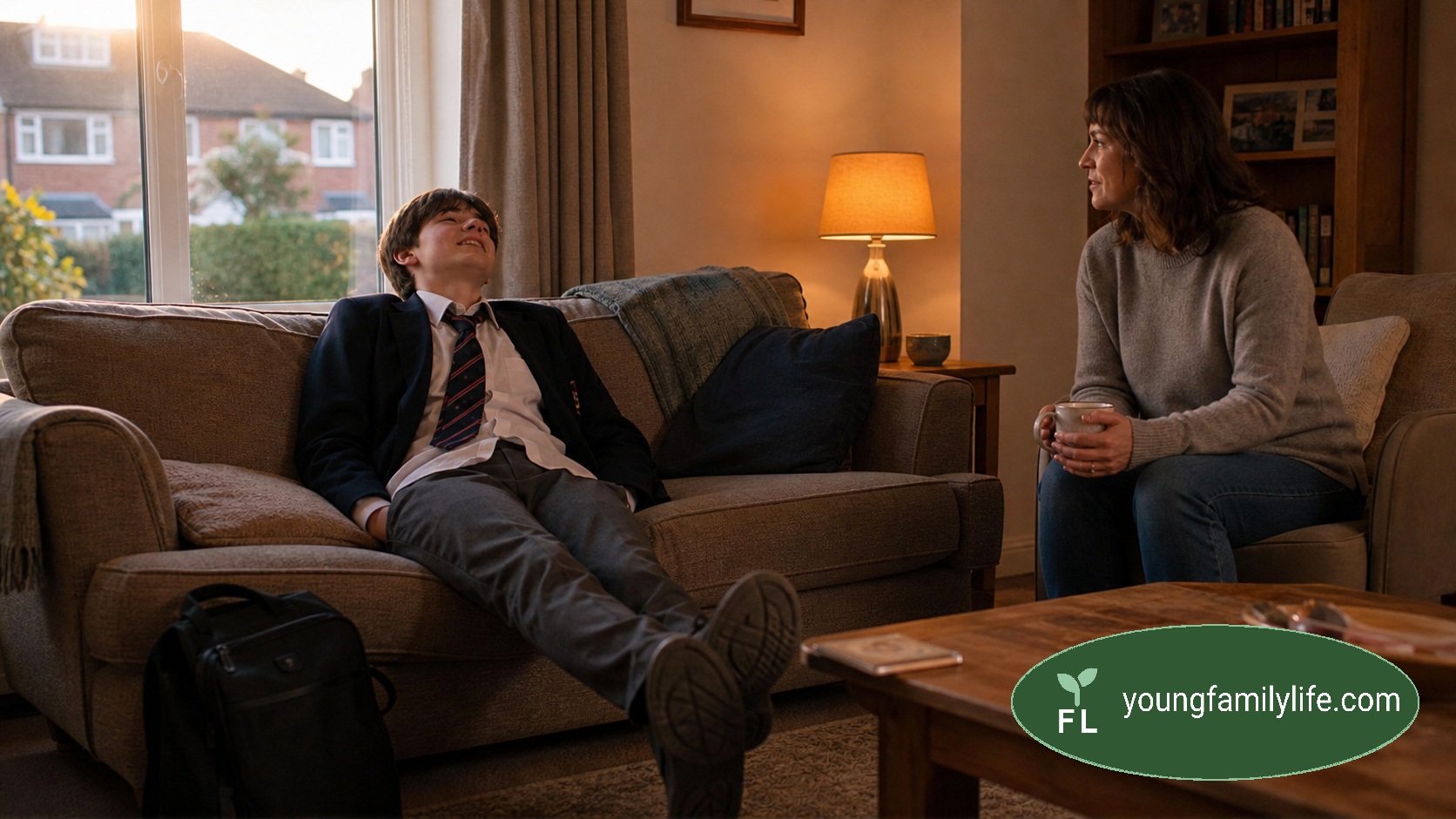
A chemical moment
Most conversations about teenagers who seem distant, disengaged, or dismissive focus on behaviour or relationships. What sits underneath those conversations — and what this piece is concerned with — is chemistry.
The adolescent body does not experience a parent's return, or the transition from school to home, as a neutral event. It responds through a system of hormones — chemical messengers that travel through the bloodstream and alter how the brain and body function. Three of those hormones are particularly relevant to what happens at the front door in the teenage years: cortisol, oxytocin, and dopamine. Understanding what each of them is doing reframes the behaviour in ways that the language of attitude and respect alone cannot account for.
What puberty is actually doing
Before the three hormones can be understood in the adolescent context, it helps to be clear about what puberty is doing to the brain — because puberty is not primarily a physical or emotional event. It is a hormonal one, and the hormones involved act directly on the brain itself.
The surge of oestrogen and testosterone that defines puberty does not simply drive physical changes in the body. It acts on the brain's dopamine and serotonin circuits — the systems that govern what feels rewarding, what feels threatening, and how intensely the brain responds to social signals. The result is a brain that has been chemically reconfigured. It is not simply an older version of the child's brain. It has different sensitivities, different priorities, and different responses to the same situations.
This is why the three hormones described in this piece behave differently in an adolescent than they would in a younger child or an adult. The underlying chemical system has been reset by puberty. The front door is the same front door. The brain behind the teenager's eyes is operating on a different set of instructions.
Cortisol: what accumulates across the day
Cortisol is the body's main stress hormone. It is produced by the adrenal glands when the brain detects demand or threat, and it prepares the body to respond — raising alertness, increasing energy availability, sharpening focus. In short bursts, it is useful. When it accumulates over a sustained period, its effects on behaviour become significant.
For most children, the school day is a cortisol event. Six or seven hours of social performance — managing friendships, navigating peer dynamics, meeting academic demands, regulating impulses — involves ongoing low-level stress-response activation. Research shows that cortisol levels are often higher at the end of the school day than at the beginning, and that they peak in the period immediately after school rather than declining.
In adolescence, this picture is more intense. The puberty-driven sensitivity to peer signals means that the social environment of school — where peer approval and rejection are constantly in play — carries a higher cortisol cost for a teenager than for a younger child. The same corridor, the same lunchtime dynamics, register as higher-stakes. The accumulated cortisol load at the end of a teenager's school day is not simply the product of tiredness. It is the output of a stress-response system that puberty has made more finely tuned to exactly the kinds of social threat the school environment contains.
What research on attachment has found is that the presence of a trusted caregiver produces what is called cortisol buffering — the proximity of a reliable attachment figure helps the body's stress chemistry begin to settle. Home, and the parent, are part of the resolution process. The apparent indifference or moodiness of the returning teenager is not, in most cases, directed at the parent. It is the stress chemistry of the day finding its way out.
Oxytocin: the chemistry of being received
Oxytocin is released in response to warm physical contact, sustained eye contact, and moments of genuine attunement between people. It is associated with bonding, trust, and the feeling of safety in the presence of another person. In the context of reunion — a parent returning home, a teenager coming back from school — oxytocin is the hormone that underpins the reconnection.
Research on attachment relationships shows that consistent, sensitive caregiving over time builds up what might be called an oxytocin baseline: a biological readiness to respond to the caregiver with trust and calm. Securely attached children show more efficient recovery from stress in the presence of their caregiver, partly because of this well-established oxytocin response.
In adolescence, the oxytocin system doesn't disappear — but it operates within a brain that puberty has reorganised around peer relationships. The teenager still needs the safe haven the parent provides. The need is simply less visibly expressed, because the adolescent developmental task is to demonstrate independence rather than reliance. What looks like a teenager who no longer needs comfort or connection may be a teenager whose oxytocin system is working exactly as it always has — but whose puberty-driven brain is simultaneously working to conceal it.
The quality of the reunion matters here. A parent who returns and immediately communicates their own hurt or disappointment — because the teenager hasn't greeted them as expected — may unintentionally create conditions that delay the oxytocin response rather than triggering it. A reunion that is warm and accepting is more likely to activate the biological reconnection that both parent and teenager need after a day apart. This is not a prescription. It is a description of what the research shows about how the chemistry works.
Dopamine: what the screen is competing with
Dopamine is the brain's reward and anticipation signal. It is released in response to pleasurable stimuli, but — crucially — its biggest release comes not at the moment of reward, but in anticipation of it. Dopamine is what drives motivated behaviour: the reaching toward something the brain has learned to associate with reward.
Digital screens — particularly social media, games, and video content — are built to generate sustained dopamine responses through unpredictable reward patterns. The same mechanism makes slot machines compelling. The child or teenager absorbed in a screen when a parent comes home is not simply distracted. Their dopamine system is in active, sustained engagement with a reward cycle that a parent's arrival is unlikely to interrupt in real time.
This is not a comment on the quality of the parent-child relationship. A parent's return generates its own dopamine response — but it is less immediate, less intense, and less precisely timed than the signal the screen is producing. The child who doesn't look up is not choosing the screen over the parent in any meaningful emotional sense. Their reward chemistry is simply running a different programme at that moment.
How this looks differently in boys and girls
Oestrogen and testosterone do not produce identical outcomes in the adolescent brain. While both sexes experience the same fundamental reorganisation — peer sensitivity up, parental responsiveness down — the way that reorganisation expresses itself at the front door tends to differ.
In boys, testosterone amplifies dopamine sensitivity in ways that lean toward risk-seeking, novelty, and status within peer hierarchies. The male adolescent brain is particularly responsive to competition and dominance — which means a perceived challenge from a parent can escalate more quickly than it would with a younger child. Testosterone also amplifies the cortisol response to social threat. A comment that a younger child might receive as mild correction can land, in a teenage boy, as a status challenge — triggering a cortisol spike disproportionate to what the parent intended. The disengagement at the front door in adolescent boys tends to be blunt: the monosyllable, the grunt, the physical withdrawal. The emotional surface is often flat, even when the cortisol load underneath it is not.
In girls, oestrogen interacts more directly with the oxytocin system, producing heightened sensitivity to relational dynamics and the emotional texture of relationships. The female adolescent brain is more finely attuned to tone of voice, facial expression, and interpersonal nuance. This means the disengagement at the front door in adolescent girls often has a more volatile relational quality — the sensitivity to what the parent said, or how they said it, or what they didn't say. The pull toward peer relationships as the primary source of emotional regulation is also stronger, and the cortisol load from social media tends to be higher in adolescent girls on average, partly because the relational content of social media — who said what, who excluded whom, who responded and who didn't — maps directly onto the oestrogen-amplified sensitivity to social connection and exclusion.
What both sexes share is the core architecture: the puberty-driven reset of the brain's reward and threat systems, the elevated cortisol load of the school day, and the continued — if less visible — need for the parent as a safe haven. The differences are in expression and degree, not in the underlying biology. A parent of both a teenage son and a teenage daughter may find themselves experiencing quite different versions of the same developmental process.
It is also worth resisting the picture this section might inadvertently paint — of a teenager who is uniformly withdrawn, dismissive, or difficult to reach. That is one expression of adolescence. It is not the only one. Some teenagers move toward the parent rather than away — becoming more emotionally present, more demanding of attention, more clingy than they were in childhood. This can be particularly true for adolescents whose experience of the peer world feels more threatening than rewarding, or whose attachment history has left them seeking reassurance rather than independence. The same puberty-driven neurochemistry that pushes one teenager toward peer relationships and away from family can, in another, amplify the need for parental availability precisely because the peer world feels overwhelming. Both are adolescent responses to the same biological transition.
Why the peer world takes over
The adolescent brain becomes significantly more sensitive to peer signals than it was in childhood — and considerably less responsive to parental ones. Peer approval activates the adolescent reward system more powerfully than parental approval. The risk of peer rejection registers as a more acute threat than any parental disappointment. This is not a phase or an attitude. It is the predictable output of the neurochemical reorganisation puberty has produced — and one that affects both boys and girls, whatever form its expression takes.
The teenager who barely looks up when a parent arrives is operating a brain that is, at this developmental moment, chemically oriented toward the peer world. The parent's return registers. It simply does not register as urgently as the peer world does — and that asymmetry is biological, not personal.
When the chemistry goes wrong
For most children, the hormone system described above is working as it should. The cortisol rises with the demands of the day, the presence of the caregiver brings it back down, oxytocin does its reconnecting work, and the dopamine of the screen is a normal competing signal in a healthy balance.
Where the picture changes is under sustained stress. Children who have experienced chronic early adversity — persistent household instability, neglect, or prolonged anxiety — can develop what researchers describe as HPA axis dysregulation: the cortisol system becomes chronically over-activated, or in some cases paradoxically blunted, losing some of its normal sensitivity. A child in this state may present as persistently flat or emotionally unavailable — not because they don't care, but because their stress-response chemistry has been operating under sustained load for so long that its signalling is compromised.
The oxytocin system can also be affected in children who have not experienced consistent, attuned care. The warm reunion that triggers reconnection in one child may produce a muted response in another, not through absence of feeling, but through a system that has not been reliably calibrated by early relational experience.
These are the circumstances in which the ordinary developmental explanations — age, stage, school day — are not sufficient on their own. A teenager who is persistently and pervasively emotionally unavailable may be signalling a chemistry that has been under pressure for longer than the current day. And it is worth noting that what chronic stress looks like will differ between boys and girls: a teenage boy under sustained stress may appear flat, withdrawn, and difficult to reach; a teenage girl under the same pressure may present as emotionally volatile, relationally preoccupied, or persistently anxious about friendships. Both are expressions of a hormone system under load.
The parent at the door is also in transition
This piece has focused on the teenager's chemistry. But the front door is not a meeting between a chemically complex teenager and a neutral adult. The parent at the door is carrying their own biology into the moment.
For many parents of teenagers, the years of adolescence coincide with a period of considerable personal pressure. Career demands often peak in the same decade that children enter secondary school. Caring responsibilities for ageing parents can begin in the same years. And for many mothers, the perimenopausal transition — with its own hormonal reorganisation affecting mood, sleep, energy, and emotional regulation — runs alongside, and sometimes directly into, a teenager's puberty.
Oestrogen fluctuation in perimenopause affects the same serotonin and dopamine circuits that puberty is reshaping in the teenager. A mother whose own hormonal system is in flux may find her emotional responses less predictable, her tolerance for friction lower, and her need for calm greater — at exactly the point in family life when the teenager is least equipped to provide any of those things. Two hormone systems in the same household, both in transition, neither fully transparent to the other.
Research on family systems consistently shows that the quality of the parent-child relationship in adolescence is shaped by both sides of the relationship — not by the teenager's development alone. Understanding the teenager's hormone system is one part of a picture that also includes the parent's own. Parents who understand both sides of that chemical meeting are better placed to navigate it with clarity rather than confusion. What they do with that understanding is, as always, entirely their own.
Topics: #InOtherWords #Cortisol #Oxytocin #Dopamine #AdolescentBrain #Puberty #HormoneSystem #TeenBehaviour #Attachment #CortisolBuffering #FamilyLife #YoungFamilyLife #InformationWithoutInstruction
Related YFL Content
In Other Words: what the sting of being ignored is actually about — the companion IOW on the adult's own experience: what the social pain system is, where it comes from, and what the internal working model brings to the moment at the door
Hey!, Want To Know: How an Oak Tree Knows When to Drop Its Leaves — an accessible introduction to how hormones work as chemical messengers across living systems — the foundation for understanding the three hormones described here
Hey!, Want To Know: why your child can be so moody after school? — the cortisol picture and the after-school decompression pattern: how the school day's chemistry comes home, across all ages
Learning to Survive — How the Human Brain Navigates Opportunity and Danger — the stress-response framework and the biology of a brain built to detect threat, from birth through adolescence
Copyright Notice
© 2026 Steve Young and YoungFamilyLife Ltd. All rights reserved.
All original content on YoungFamilyLife — including essays, articles, frameworks, and other written material — is the intellectual property of Steve Young and YoungFamilyLife Ltd, unless credited to another source. Content is developed collaboratively using AI assistance to research sources and refine structure, while all intellectual authorship, original insight, and professional expertise remain those of the author.
No part of this website may be reproduced, distributed, or transmitted in any form without prior written permission, except brief quotations for noncommercial use.
For permission requests, contact: info@youngfamilylife.com