A Target, Not a Plan
In September 1999, Tony Blair told the Labour Party conference he wanted half of young adults going into higher education. It was framed as opportunity — a way to open professions that had always been closed to people whose parents had never been near a university. Nobody stood up that day and said "let's turn universities into businesses." That's not how it was sold, and it's probably not how it was meant.
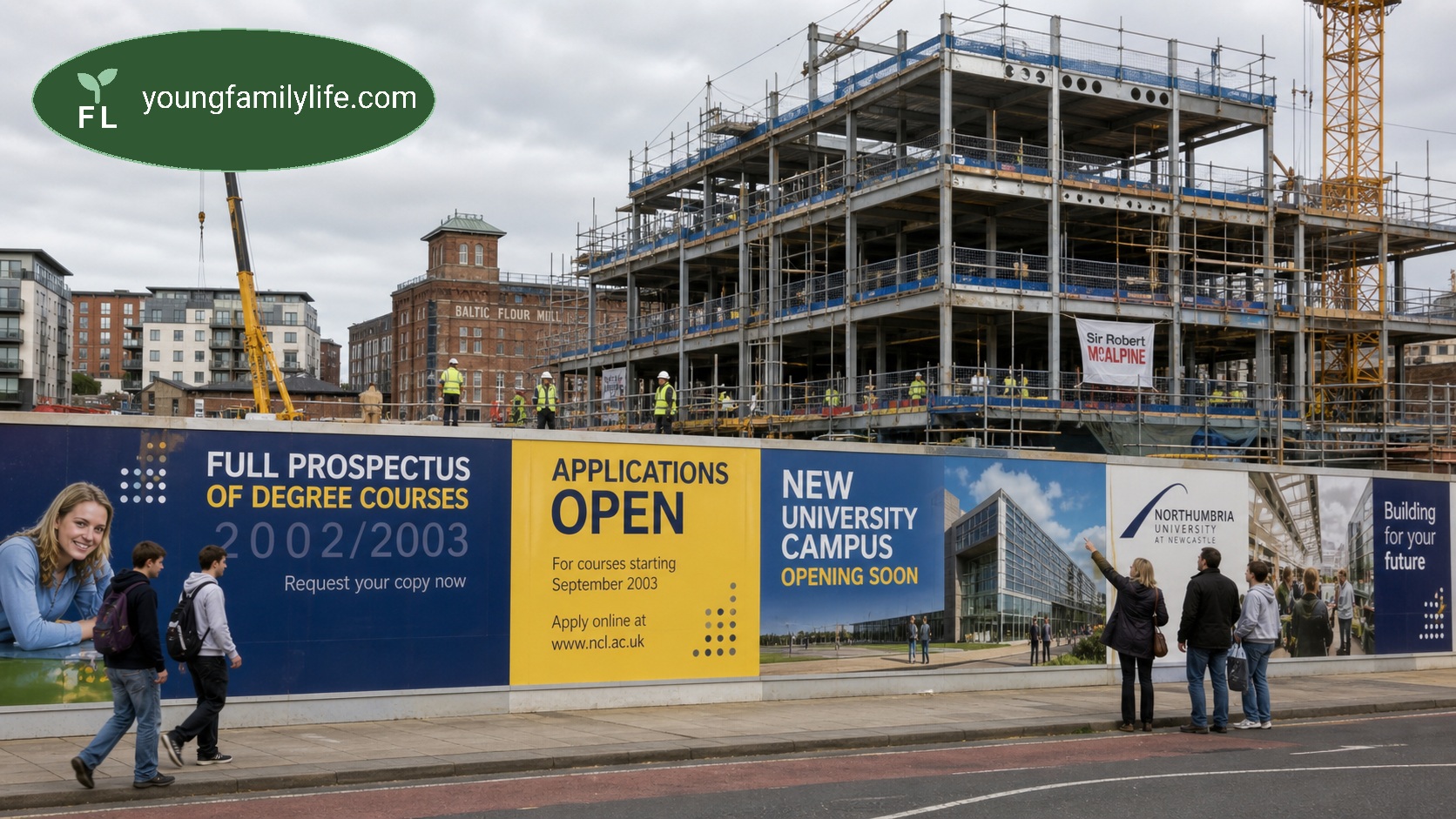
But a target like that needs paying for, and the funding model built to pay for it — tuition fees, introduced the year before and raised sharply over the following decade — quietly changed the relationship between student and university from something closer to admission into a shared project, into something closer to a purchase. Once a student is paying, "value for money" becomes a fair question to ask. And once universities are competing for fee-paying customers, they start behaving like something competing for customers.
The Debt Nobody Talks About
There's the debt everyone does talk about — the tuition loans graduates carry for years afterwards. But there's a second debt sitting underneath that one, and it belongs to the institutions, not the students. Universities took on a structural obligation in 1999 that they are still, twenty-five years later, working out how to repay: the promise that expanding access wouldn't just mean more people getting a degree, but more people getting what a degree was actually supposed to give them — real opportunity, real preparation, real value.
That debt has been serviced unevenly. Course closures over the past few years have landed hardest on subjects that don't recruit well — languages, philosophy, and similar departments — regardless of how good the teaching inside them was. Decisions about what to teach, who to hire, and which research to fund have quietly re-anchored around what will recruit and what will keep the institution solvent, rather than only around what's true or worth knowing. None of this makes any individual vice-chancellor or course leader a villain; someone trying to keep a real institution solvent, with real jobs at stake, is not obviously behaving badly by taking recruitment seriously. But the debt from 1999 is still being paid down in the coin of exactly the things the expansion was never supposed to cost — intellectual rigour, subject diversity, the willingness to teach something because it matters rather than because it sells.
Now There's a Second Bill Coming Due
Generative AI has arrived at the worst possible moment for a sector already stretched by that first debt. For decades, a degree tested whether a student had genuinely learned a body of knowledge — the exam, the essay, the coursework, all built around the assumption that fluent, correct answers could only come from someone who'd done the work. AI can now produce fluent, correct answers in seconds, for almost anyone, regardless of what they've learned. The test that used to prove learning has quietly stopped proving it.
A sector already reshaped by a 1999 debt it hasn't finished repaying is now being asked to redesign, at real cost, how it tests and teaches — moving toward closer, more expensive, harder-to-scale forms of assessment that actually observe judgement rather than simply mark a finished document. That's not a small ask for institutions already running deficits. But avoiding it isn't really an option either: a degree whose grades don't mean what they used to is a debt of its own, quietly accumulating, paid eventually by every graduate who discovers their qualification doesn't open the door it once did.
Whose Bill Is It, Really?
It would be easy to conclude this is entirely universities' problem to solve, and that would be a mistake. Employers benefited from the 1999 expansion too — a larger, more qualified applicant pool — without always holding up their side of an older, unwritten arrangement: that businesses would finish training graduates on the job, the way they used to. That informal system has quietly weakened as well, for reasons that go beyond AI. If universities owe a debt from 1999, industry owes one alongside it, and neither bill gets settled by the other side simply waiting for a cheque.
Topics: #InOtherWords #HigherEducation #UniversityFunding #Marketisation #AIAndEducation
Related YFL Content
Academia and the Marketplace — The fuller account of the 1999 expansion’s financial consequences and what they’ve displaced.
Britain’s Quiet Caste That Resists Meritocracy — Whether the glass ceiling the 1999 expansion aimed to remove has closed, or simply migrated.
Why University, Of All Things — The longer history behind why knowledge institutions have always been shaped by the power sustaining them — long before 1999.
In Other Words... Why Higher Education Matters Across the Animal Kingdom — What a bush full of sparrows can teach a university about itself.
The Feedback Paradox — On what happens to honest listening inside an institution once its survival depends on keeping people satisfied rather than telling them the truth.