The Bird That Won't Shut Up
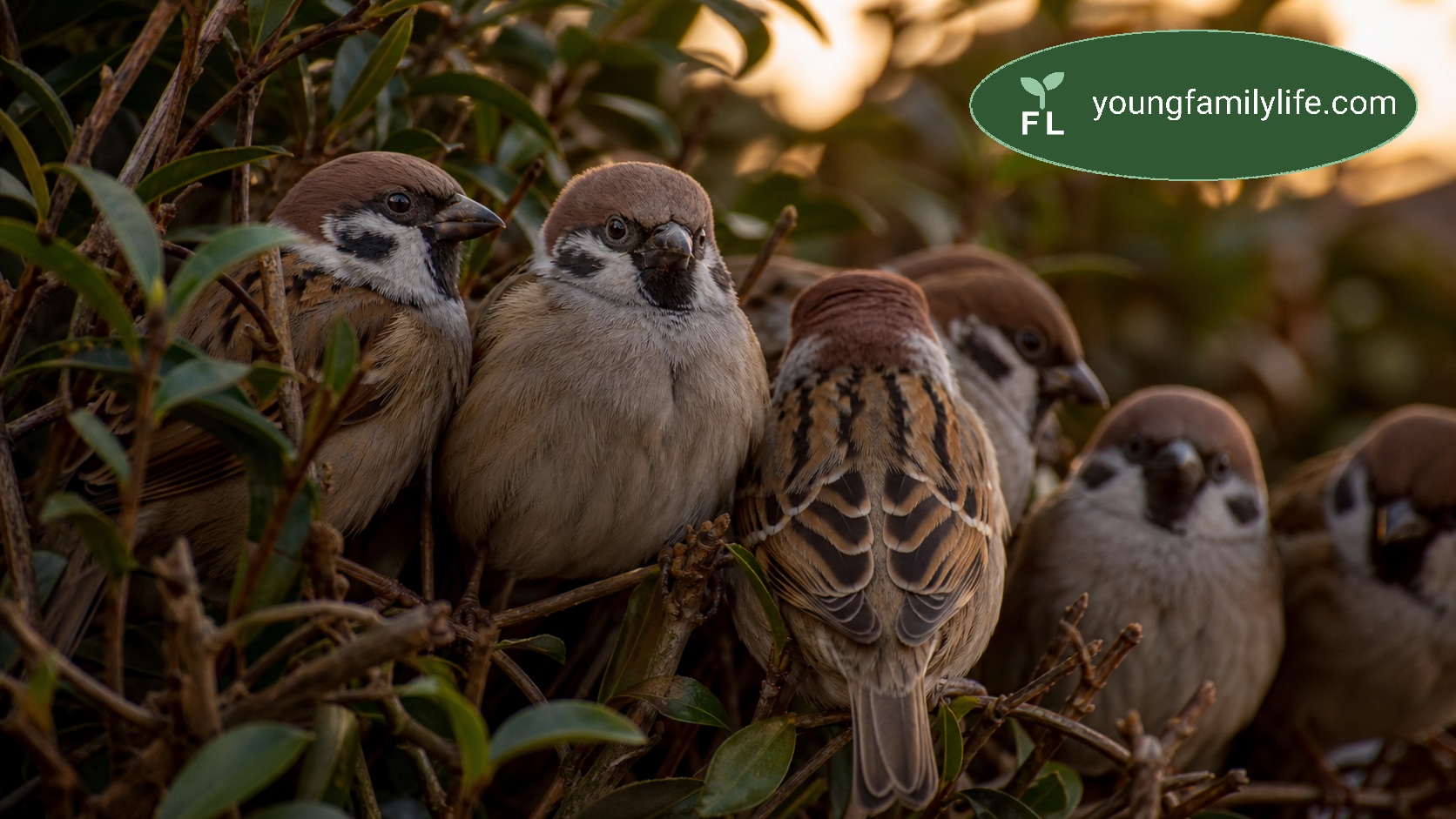
Anyone who's ever sat near a hedge full of house sparrows knows the sound. It's not birdsong, not really — it's more like a pub after work. A constant, cheerful chatter, on and on, going nowhere in particular.
Scientists who study this have a name for it: social song. The sparrows aren't doing it to find a mate. They're not doing it to warn each other about a cat. They do that stuff too, with completely different sounds. This is something else. After they've eaten, they gather together in the thick part of the bush — somewhere safe, somewhere comfortable — and they just... talk. For the pleasure of it.
That's not a guess. It's been studied and written down. Sparrows carve out time, specifically, to sit together and natter.
It's Not Just Sparrows
Guinea pigs do it too, and scientists who study them have actually mapped out the different sounds a guinea pig makes and what each one is for. There's a sharp "danger" call. There's a completely different sound they make when they fancy a mate. And then there's a soft little noise — "chutting" — that they make just pottering about calmly near each other, not warning about anything, not trying to impress anyone. Three different sounds, three different jobs, and one of them exists purely for keeping in gentle touch.
Whales are the most impressive example. Sperm whales make clicking sounds for two completely different reasons. Deep underwater, hunting, they click to find their prey — that's echolocation, essentially sonar. But at the surface, when they're socialising with other whales, they make a different pattern of clicks entirely, called a "coda." Scientists have found these codas work almost like an accent or a family name — different whale families have their own distinct versions, passed down and learned, not just automatic. And whales only do this chatting-click when they're together, socialising. Never while hunting alone. Same animal, same basic tool — clicking — but one version for catching dinner, and a completely separate version just for staying close to friends and family.
Humans Do the Exact Same Thing, Just Bigger
It gets more interesting for people. A scientist called Robin Dunbar spent years looking at why humans, out of every animal on Earth, ended up with such enormous brains for something as trivial-sounding as gossip. His answer: it isn't trivial at all.
Other primates — chimps, gorillas — bond with each other by grooming, picking through each other's fur for hours a day. It feels nice, and it keeps the group together. But humans live in much bigger groups than any other primate. There aren't enough hours in the day to groom everyone you'd need to stay close to. So, Dunbar argued, humans evolved something more efficient: talking. Gossip does the same job grooming does for chimps, except one conversation can bond a whole group at once instead of just two individuals at a time.
In other words: the "pointless" chat humans do constantly isn't pointless. It's the thing that made large human societies possible in the first place.
Which Brings Us to University
Now consider human civilisation.
Somewhere in deep prehistory, long before anyone wrote anything down, that same pull — gathering to talk, to share what's known, just for the pleasure and usefulness of it — was already there, doing its quiet work in bands of early humans the same way it does in a bush full of sparrows. Nobody can pin an exact date on when that turned into something more deliberate. The evidence that far back is thin, pieced together from fragments, and stays that way. But somewhere in the run-up to written history, in more than one part of the world, the informal instinct to gather and talk started hardening into something more organised: a place, a role, a habit of returning to sit together and work things out on purpose.
By the time real institutions show up in the historical record, the same basic idea has surfaced more than once, in more than one place. Ancient Greece built one. So, separately and as far as anyone can tell with no contact at all, did ancient China, at almost the same moment. India built one too, and so did the Jewish communities of ancient Babylon, and so did the Islamic world, twice over — though in most of those cases, the idea seems to have travelled and been rebuilt rather than invented again from nothing, carried along the same trade routes and conquests that carried everything else. Whichever way it happened — independently rediscovered, or picked up and reshaped by whoever received it — the same underlying pull kept resurfacing, over and over, for thousands of years, everywhere humans had the numbers and the settled life to support it.
The official story is always about knowledge — training lawyers, training doctors, training priests. And that's true, as far as it goes. But underneath the official story, there might be something much older and much simpler going on: the same pull that gets a bush full of sparrows chattering after dinner, running all the way back through prehistory and into whatever the earliest human bands were doing around a fire long before anyone thought to build anything. University might just be the biggest, most elaborate, most recent expression of an instinct considerably older than civilisation itself.
Why This Matters, Beyond the Trivia
It's not just a nice comparison. It changes how you might think about what a university actually is. Every one of those ancient institutions was also captured — sooner or later — by whoever was in charge at the time: emperors, caliphs, kings, popes, all of them found ways to bend these gathering-places to serve their own power. That's the less comfortable half of the story.
But the gathering itself, the actual pull toward sitting together and talking, seems to run deeper than any of the people who tried to control it. It was there before the politics moved in, and it's probably still there, underneath, at every university today — the same instinct that fills a bush with sparrows after feeding time, just with better furniture.
Topics: #InOtherWords #WhyHigherEducation #AnimalBehaviour #HistoryOfUniversities #Nature #WhyUniversity
Related YFL Content
Why...? Independent Enquiry series — Browse the full Why...? Independent Enquiry series in the essay library — geology, music, memory, promises, and more.
AI and Higher Education — What happens to this very old institution now that AI can do the ‘knowledge transmission’ part in seconds.
Why Old? — of all things? — Another Independent Enquiry essay tracing a universal biological rule — this time, why everything ages — across nature and human life.
Why Memory? — of all things? — Sea slugs, slime moulds, and H.M. — another Independent Enquiry essay asking why an everyday capacity works the way it does.
In Other Words... why people in groups can become monsters — Dunbar's number turns up here too, this time explaining how the same social-bonding instinct behind a bush full of sparrows can curdle in a crowd.
The Social Brain and the Lonely Child — the same wiring for connection, seen from the other side: what happens to a child when that pull towards gathering has nowhere to land.