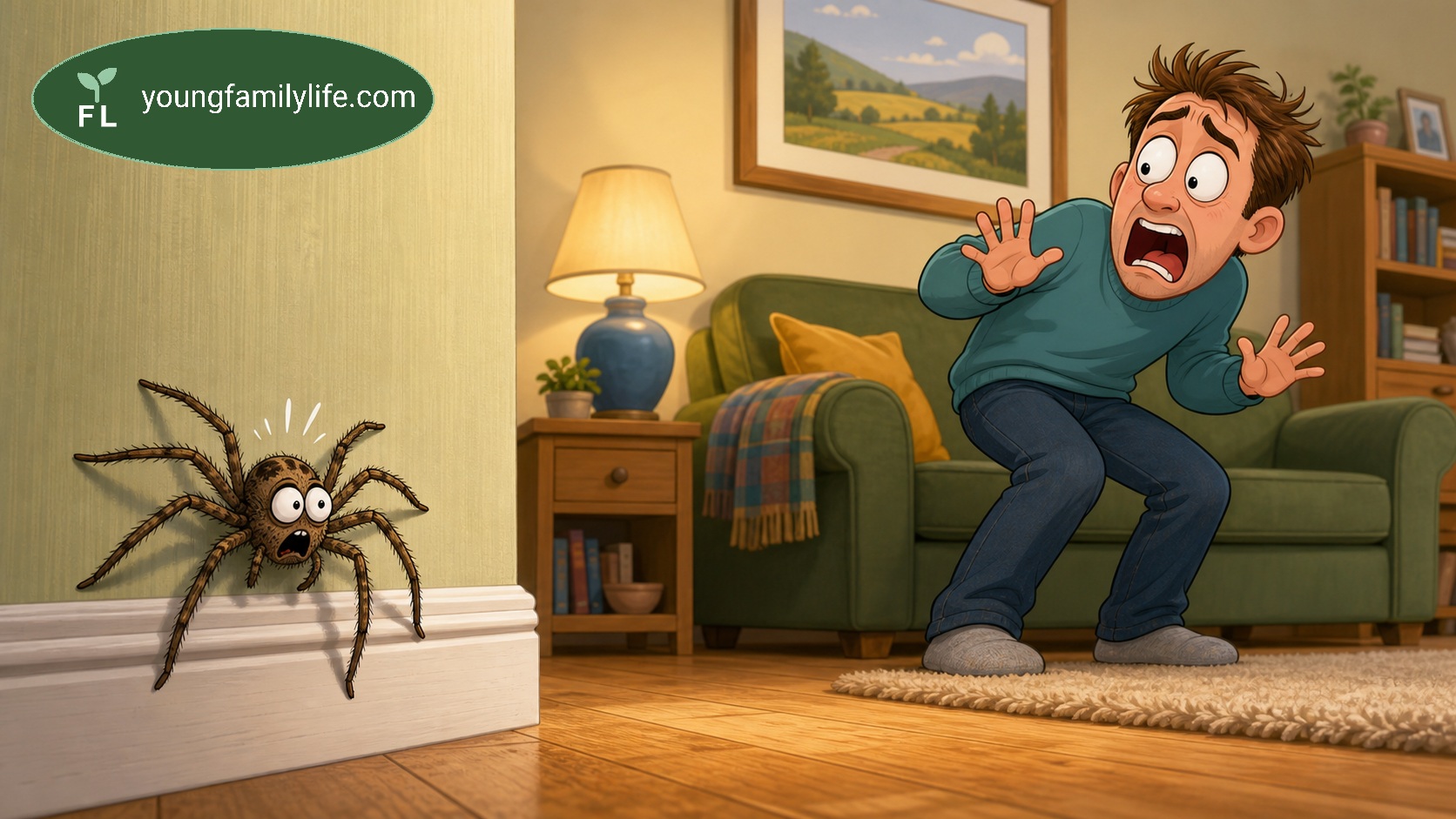
The Fear That Doesn't Match the Danger
Ask a room full of people what scares them most, and "spiders" comes up more than almost anything else. Now ask how many of them have ever actually met a spider that could kill them. Outside Australia and a few other places, the honest answer is almost nobody. Meanwhile, cars kill far more people every year than every dangerous animal on Earth put together — and almost nobody is scared of cars. Something odd is going on here. This mismatch isn't a mistake in how fear works. It's a clue about how old that fear really is.
Not every fear is like this, though. Being scared of heights matches a real danger that's still around today — falling really can hurt or kill you, right now, in this century. So some fears match today's world perfectly. Others are running on something much older.
Some Fears Come Built In
In 1971, a psychologist called Martin Seligman had an idea he called "preparedness." His idea was that people aren't born ready to learn to fear just anything equally (Seligman, 1971). Instead, evolution seems to have set certain fears up in advance — things like snakes, spiders, heights, and sudden anger from someone else. People learn to fear these things faster, with barely any bad experience needed, and find them much harder to un-learn, compared with newer dangers.
Later scientists explored this idea further and called it a "fear system" built into the brain (Öhman & Mineka, 2001). Their research showed that fears linked to old, ancient dangers are learned faster and stick around longer than fears linked to modern dangers that are just as risky. In short: our brains haven't caught up with cars, plug sockets, or sugary food yet. We're still running on very old settings, in a very new world.
You Don't Even Have to Go Through It Yourself
One of the best examples of this comes from a set of experiments with monkeys, led by a scientist called Susan Mineka. Baby monkeys who had never seen a snake before were shown a video of another monkey looking terrified of a toy snake — and just from watching, they became scared of snakes too. But when the same terrified reaction was aimed at a flower instead of a snake, the watching monkeys felt nothing. The scared monkey looked exactly as frightened either way — but the fear only passed on when it was pointed at a snake (Cook & Mineka, 1989, 1990).
That's a big deal. It shows that fear can spread just from watching someone else react — but only for the "right" kind of old danger. Nobody has to be hurt themselves. They just need to see someone they trust look afraid of the right thing, even once. The same is probably true for human babies. A baby watching a parent look alarmed at a height, a spider, or a sudden movement isn't learning "that exact thing is dangerous." They're switching on a very old fear setting that's been sitting there ready, just waiting for someone else's scared face to flip it on.
So Why Spiders, Exactly?
For most of human history, snakes were a real and common danger — often deadly. Spiders were far less of a threat overall, and in many places barely a threat at all. Yet today, fear of spiders is just as common as fear of snakes, even in countries with no dangerous spiders whatsoever. Scientists don't fully agree on exactly why spiders cause such strong fear (Mineka & Öhman, 2002) — it's still an open question. One likely reason: the old built-in fear wasn't really about snakes specifically. It was set up for anything small, fast, and moving unpredictably. Spiders fit that pattern closely enough to set off the same old alarm as a snake, even where there's no real danger at all.
In a way, this makes spider fear one of the oldest inherited fears there is — not passed down through one family's story, but through the whole history of the human species, and switched on by nothing more than a single frightened look on someone's face.
When This Fear Is Actually Helpful
This fear response is supposed to be there. Too little of it, and real danger — an actual fall, an actual dangerous bite where those exist — doesn't get taken seriously enough. Too much of it, and the fear itself becomes the problem: sweaty hands and shaky legs at the exact moment on a ladder when a steady grip matters most.
So when a fear or a panic reaction seems way bigger than the situation calls for, it might not really belong to that moment at all — it might be a very old setting, switched on by something that hasn't been a real danger for thousands of years. Knowing where a fear comes from doesn't make it vanish. But it changes the question from "why is this person overreacting" to "what is this old fear actually trying to protect against, and when did it first get switched on."
Topics: #HWTK #HeyWantToKnow #EvolutionaryPsychology #FearAndPhobia #ChildDevelopment #Parenting #BrainScience
Further Reading
These links dig deeper into the topics covered here:
The Original Research:
- Seligman, M. E. P. (1971). Phobias and preparedness. Behavior Therapy, 2(3), 307–320. — the original paper proposing that fear is more easily learned for some categories of stimulus than others.
- Cook, M., & Mineka, S. (1989). Observational conditioning of fear to fear-relevant versus fear-irrelevant stimuli in rhesus monkeys. Journal of Abnormal Psychology, 98(4), 448–459. — the study showing monkeys acquired snake fear from watching another monkey react, but not flower fear from an identical reaction.
Going Deeper:
- Öhman, A., & Mineka, S. (2001). Fears, phobias, and preparedness: Toward an evolved module of fear and fear learning. Psychological Review, 108(3), 483–522. — a fuller account of the "fear module" built on Seligman's original theory.
- Mineka, S., & Öhman, A. (2002). Phobias and preparedness: The selective, automatic, and encapsulated nature of fear. Biological Psychiatry, 52(10), 927–937. — discusses why some ancestral threats, such as spiders, remain widely feared despite low real-world risk in most regions today.
Related YFL Essays and Resources
Learning to Survive — How the Human Brain Navigates Opportunity and Danger — the fuller account of how threat responses develop and fire across childhood, including the six-response framework this piece's "ancient software" idea sits alongside.
The Nervous System We Were Given — what shapes how parents parent, including the blocking signal under stress and where hardness and softness in a family's response to fear may come from.
Beyond Words — how continuous, often unconscious body signals shape relationships more powerfully than words, including exactly the kind of caregiver signal this piece argues a fear can be caught from.