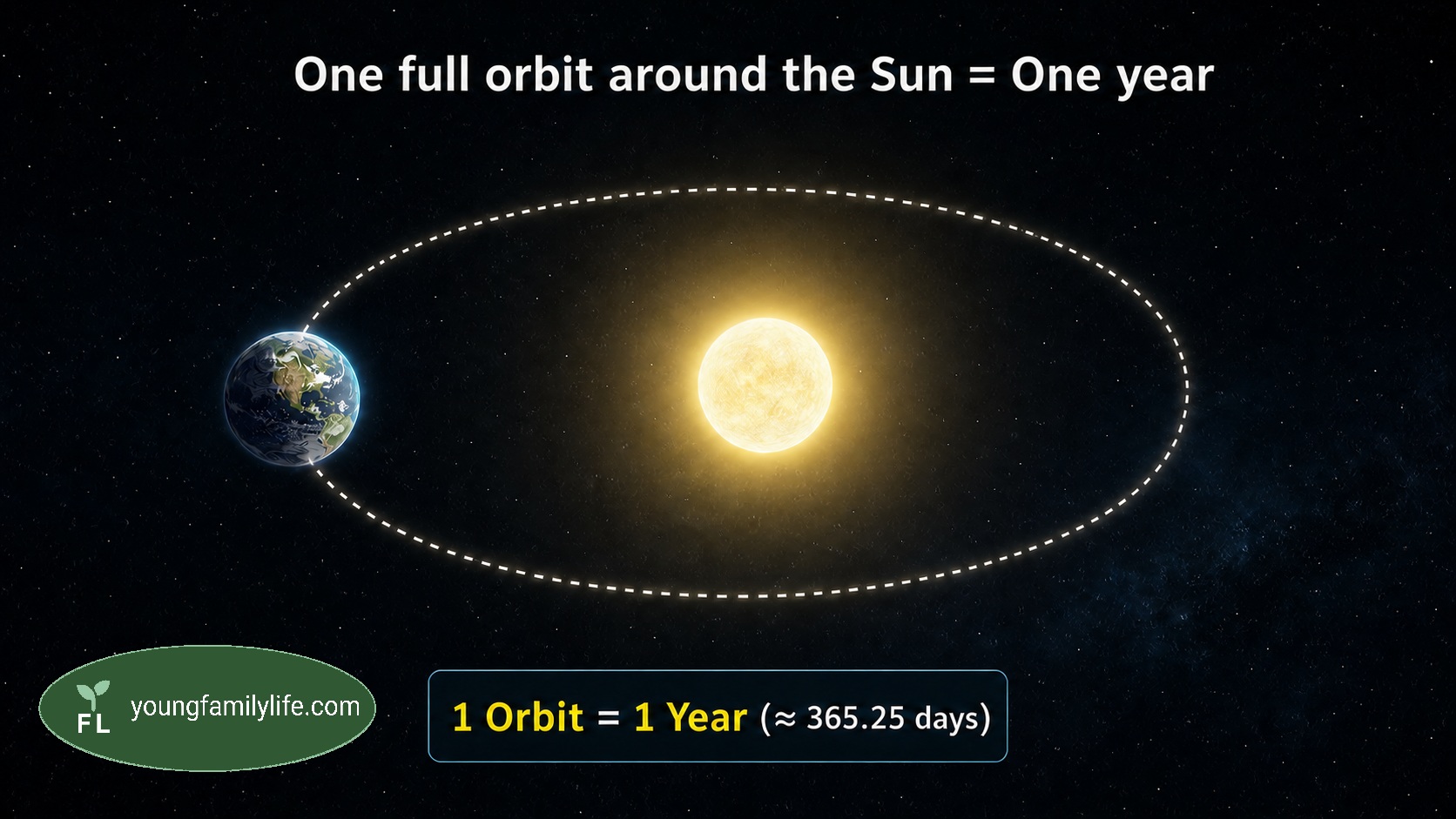
A year is usually just a date circled on a calendar. It's also something more literal: the time it takes the Earth, and everything and everyone on it, to travel one full circuit around the sun — something like 940 million kilometres, carrying all of us with it whether we notice or not. YoungFamilyLife has been going for exactly one of those circuits now.
The first essay I published on this site (since we were all last here) was written for a parenting course called Foundation Years. In August 2025 it wasn't a Young Thinking piece or a founding document or anything I'd have called significant. It was course material. Foundation Years was going to run in Bungay, and the essay — later called Dance of Reciprocity — was the theory underneath one of the sessions.
The course never ran. Looking back, there were two separate reasons, and I didn't fully separate them at the time. The first was timing: I started promoting it about six weeks before the start date, which turned out to be nowhere near enough. Parents need to arrange childcare, clear diaries, commit money — six weeks doesn't give most people room to do that. The second reason was harder to admit, and mattered more. I had limited credentials that anyone locally could actually see, and no local profile to speak of. Twenty years of frontline safeguarding work doesn't show up anywhere a parent in Bungay could check it. I was, to anyone deciding whether to trust me with their evenings and their children, essentially unknown.
What I did next is, I think, closer to the platform's real starting point than the incorporation certificate from June 2025. I cancelled the course. And I kept writing the material that was meant to support it.
Becoming checkable
The two problems needed different fixes, but only one of them was something I could act on immediately. The timing problem was a scheduling error, fixable next time round with a longer lead-in. The credibility problem was structural, and marketing harder wasn't going to solve it — what was missing wasn't reach, it was substance anyone could actually go and check. So YoungFamilyLife became the tool for addressing that: a public, free, extensive record of the thinking behind the practice, built specifically so that by the time I next put a course in front of parents, there would be something to look at first.
So Foundation Years stopped being a course I was trying to sell and became a body of work I kept building anyway. Dance of Reciprocity stayed up doing what it had always been meant to do, just without a booking form underneath it.
I didn't have a content strategy in August 2025. I had a cancelled course, a professional life still running in parallel, and twenty years of Family Safeguarding and Early Help, a counselling degree, and a systemic training background I thought was worth putting somewhere people could actually reach it — no paywall, no sales page in the way.
A year of following that
I've already written, at the hundred-essay mark, about the "follow my nose" method that's governed most of this, the fear behind it, and the five founding philosophies. I won't repeat that here. What's changed in the second hundred is scale: four content streams instead of one, six Lounges organising the whole library by who you are rather than what format you want, a working search function, a proper site architecture that didn't exist when Dance of Reciprocity first went up. And running through all of it, the same collaboration that built that first essay.
Horse and rider
Every piece here, from Dance of Reciprocity onward, has been built the way the site's own copyright notice has always described it: developed collaboratively using AI to research and structure, with the authorship, insight, and professional judgement remaining mine. I call it horse and rider. The horse is fast and tireless and knows the academic literature better than I do alone — it can hold a citation discipline across a seven-thousand-word essay that I'd lose the thread of on my own. But it hasn't sat in a family's front room during a referral. It doesn't carry twenty years of watching what happens when a child stops trusting an adult. It doesn't know what a tired parent needs to hear at eleven at night rather than what a textbook would say. I do. The connections, the judgement about what matters, the ethos of the thing — that's the rider's job, and it always has been.
That was true when nobody was watching and there was no argument to have an opinion in. It's still true now that the argument exists.
What the argument looks like from here
Somewhere in the last year, "was this made with AI" became a question worth asking about almost anything, mostly using categories too blunt to be much use.
Facebook has started flagging a number of my posts with an "AI info" label. I looked into what actually triggers it, and it's worth knowing: the label runs largely on metadata detected in images — a photo touched by a generative tool, sometimes for something as small as a background fill — not on the writing itself. So what's probably being flagged is the picture above the essay, not the essay. Either way, the label can't tell the difference between AI inventing an idea from nothing and AI holding a citation to account while a person decides what the idea should be in the first place. It just knows a tool was involved somewhere.
Reddit runs a rougher version of the same thing, enforced by people rather than a badge — downvotes and removals standing in for the label Facebook shows automatically. Some of the communities I post in are currently dismissive of AI-touched writing on principle, occasionally calling it inauthentic aping. I understand the instinct. A lot of what gets called AI content genuinely is mass-produced and nobody-home, built for volume rather than for having anything to say.
I'm not arguing with either of those reactions. I've got a year of actually doing the thing being debated in the abstract — nearly two hundred pieces, built the same way throughout, aimed at helping real families and practitioners with real problems — and I intend to keep publishing it wherever it fits, on the belief that the people who'll find it useful will find it regardless of what label sits next to it. My guess is that Reddit in particular loosens its current dogma as AI-assisted writing stops being a hypothetical and starts being something people read every day without noticing. I could be wrong about the timeline.
Where this points next
Both times, the response to a discouraging signal was the same: keep building the thing that would eventually settle the argument, rather than arguing about it directly. Nobody booked the course, so I built a public record instead. Two platforms are currently unsure what to make of AI-collaborative writing, so I'm publishing exactly that, at the same standard, until the record does the talking there too.
The analytics tell me something I didn't expect a year ago: readers across the UK and, further than I'd have guessed, across the world. That's the wider credibility problem largely solved. What's still thin is the local one — the profile in Bungay itself, the town the whole thing was originally meant to serve. August is where I start correcting that, with a significant upgrade to the YFL Bungay guide among other local developments. I want to be honest about the motive, because it isn't purely strategic: I love this town. I want YFL to work as a direct, practical resource for the people who live here, and I want Bungay itself to be recognised as a genuinely strong first choice for anyone deciding where to raise a family. The guide is where those two things meet.
Foundation Years hasn't gone anywhere. It's still in the portfolio, still waiting for the credibility this year was meant to build. I don't know yet when I'll run it. But there's a body of work behind it now that didn't exist when I first tried — and from August, a stronger case for Bungay itself alongside it.
Whenever it does run, it will carry the same ethos as everything else on this site: Information Without Instruction. Scientifically grounded material, offered as a springboard rather than a script — something parents and practitioners can use to inform their own decisions and their own adaptations, not a set of instructions to follow. That was true of Dance of Reciprocity a year ago, whether I had the words for it then or not. It will be true of whatever comes after this essay.
The Earth hasn't just come back round to where it started when I first published something here, though. It only looks that way if you stop at the orbit around the sun. The sun itself is moving, carrying the whole solar system round the centre of the Milky Way at roughly 450,000 miles an hour. The Milky Way is moving too, and so is the Local Group of galaxies it belongs to. Whether any of that counts as "movement" in an absolute sense is actually an open question in physics — general relativity doesn't give you a fixed point to measure from, and there's genuine debate over whether the universe's own expansion is movement at all or something stranger than that. The one reference point cosmologists do use, the cosmic microwave background left over from the early universe, gives a rough popular estimate: in the 365 and a quarter days since I first published something here, the Earth has covered something in the region of 7 billion miles. Nothing has stayed still in the meantime, including the ground I'm standing on to say so.
Topics: #YoungThinking #FirstBirthday #FoundationYears #HorseAndRider #AIAuthorship #InformationWithoutInstruction #YoungFamilyLife #FollowMyNose #Bungay