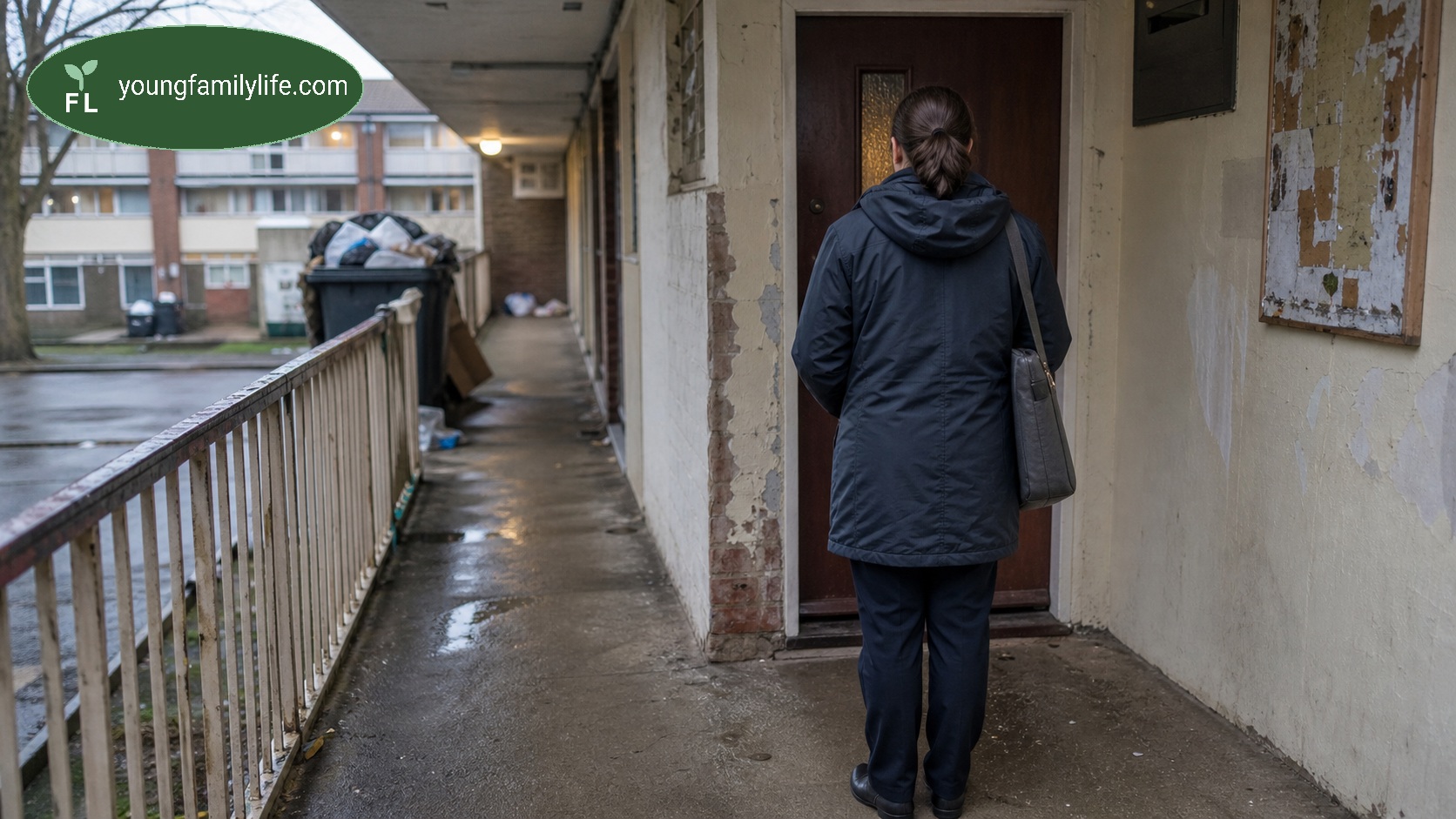
In February 2026, the trade union UNISON went looking for an answer to a question that sounds, on the face of it, straightforward: are social workers safer on a joint visit than on a solo one? Over five weeks, from 4 February to 1 March, the union surveyed almost 1,800 practitioners working across children's and adults' services (UNISON, 2026). The prompt for asking wasn't a single dramatic incident. It was a quieter, structural shift that UNISON's members had apparently been noticing for some time — a steady drift toward more solo working. A quarter of respondents said they were now carrying out more visits alone than they had a year earlier; only 7% said they were doing fewer (UNISON, 2026). Something about the shape of the job was changing, and UNISON wanted to know what it was costing the people doing it.
What the survey found was, in its own terms, unambiguous:
- Half of respondents said they had been verbally abused during a solo home visit in the previous twelve months, compared with 40% on joint visits (UNISON, 2026).
- Solo visits were also where the more serious categories of harm concentrated: 13% reported online harassment linked to a solo visit, against 7% for joint visits, with smaller but real proportions reporting physical abuse (UNISON, 2026).
- One in six of those who received threats said the abuse was racially motivated; a similar proportion said it was sexist (UNISON, 2026).
- Child protection work was the single most common type of case handled on a solo basis, cited by 41% of respondents — ahead of mental health, adult safeguarding, and family support (CYP Now, 2026).
- The consequences, where they occurred, were not trivial: of those who had experienced abuse, 61% needed between one and three days off work to recover, and 17% needed more than a month (UNISON, 2026).
UNISON was clear, too, about what it wanted done with this. The report closed not with a call for more research but with a six-point charter aimed squarely at employers (UNISON, 2026):
- A written policy on violence, aggression and lone working
- Active encouragement to report every incident
- Ongoing collection and monitoring of incident data
- Thorough risk assessments for staff in vulnerable situations
- Training in de-escalation
- Access to independent counselling for those affected
The union's own framing made the underlying argument explicit — without changes to staffing levels and to how the public views social work, the risks to both staff wellbeing and service quality would continue to grow (UNISON, 2026). This was not, in other words, a study designed to measure how much violence exists in children's social care. It was a lever, built to move councils toward signing an existing charter, using the testimony of currently-serving staff as its evidence. Nowhere in the survey's own account of itself is there a claim to have produced a population estimate; the ambition was narrower and more practical than that: get employers to act.
That distinction matters, because almost everything written about violence against social workers in the UK since — including, at times, YFL's own coverage of the subject — treats the UNISON figures as though they answered a different question: not "what should employers do" but "how much of this is actually happening." They cannot bear that weight, and it isn't a criticism of UNISON to say so, because they were never built to.
What the evidence can and can't support
UNISON's survey wasn't built to measure prevalence — it was built to move employers, and reads accordingly: an opt-in sample with no disclosed response rate, categories that bundle a raised voice in with a credible threat (UNISON, 2026), and self-report data that workplace-violence research elsewhere shows rarely matches formal incident logs closely, subject to the same recall and telescoping effects found in that wider literature (Arnetz et al., 2015). A further complication cuts the other way: contrary to a common desensitisation assumption, at least one peer-reviewed study has found social workers rate violence as more severe than lay controls, not less (Dahl et al., 2025) — so under-reporting in this profession isn't simply explained by staff having stopped registering harm as harm. None of this is a criticism of UNISON; it just means "50%" is advocacy testimony, not epidemiology, and shouldn't be asked to do a job it was never built for.
The cost that nobody is counting
The cost side is thinner still. No UK dataset links violence, sector, and days lost together: HSE's days-lost figures are broken down by illness type, not cause (HSE, 2025); its dedicated violence data is broken down by occupation, not sector — and shows "health and social care associate professionals" at 2.7% victimisation, more than double the all-occupation average, though that classification generally means care workers rather than qualified social workers (HSE, 2025). The two datasets never meet. Work-related road incidents are explicitly excluded from RIDDOR entirely (IOSH, various dates), so a crash between visits and an assault at the door don't even sit in the same regulatory universe. The best comparators abroad — US BLS, Safe Work Australia — link cause to sector to severity in ways the UK doesn't, and still can't isolate "child protection worker" from the wider health-and-social-care bucket (US Bureau of Labor Statistics, 2024; Safe Work Australia, 2025).
Insurers hold the sharpest data of anyone — claims, cost, frequency, by sector — and publish none of it, for the ordinary commercial reason that it's pricing intelligence, not any reluctance to engage with the issue. Worth noting, too, that commissioned providers don't remove this exposure from the statutory sector — poor risk management in a commissioned service becomes a contract-management and litigation concern for the commissioning council. That the sector with the clearest self-interest in measuring this properly also holds the thinnest published evidence isn't obviously explained by a lack of incentive.
The honest conclusion
The absence of a rigorous, population-representative evidence base is itself a finding — not a caveat to bury in a footnote. Practitioners' lived experience is well-attested qualitatively; the quantitative claims in circulation are advocacy figures, not epidemiology, and treating them as interchangeable does a disservice to both the workforce and the public record. It does not appear that anything resembling a genuinely rigorous answer exists. Not in the UK, and not, in the specific form this question needs, anywhere else either — though, as later sections show, better instruments for asking the question do exist elsewhere; what's missing internationally is the specific answer, not every tool that could help find one.
The UK's Response: A Patchwork, Not a System
If the evidence base is thin, it is worth asking a related but separate question: whatever the true scale of the risk, how well is it actually being managed in the UK? The answer, on the evidence available, is: unevenly, and without any single guiding system.
At national level, the Local Government Association's Standards for Employers of Social Workers states that employers "should" have robust violence, aggression and lone-working policies (Local Government Association, 2025). This is a stated expectation rather than a specified system — it mandates no particular risk-assessment tool, alert device, escalation protocol, or shared incident taxonomy. The Health and Safety Executive's own lone-worker guidance is generic across every sector, listing delivery drivers, health workers, engineers, security staff and home workers in the same breath as anyone conducting a safeguarding visit, with nothing tailored to the specific circumstances of a child protection visit (HSE, 2025c).
In practice, each of England's 153 local authorities has developed its own lone-working policy independently. Sampled council policies show a broadly similar shape — risk assessment, buddy systems, check-in procedures, panic alarms — but no shared national system, no shared incident taxonomy, and no interoperability between one authority's data and the next (sampled council lone-working policies, various). This mirrors, on the prevention side, the same fragmentation already visible on the recording side: a 2014 Freedom of Information investigation found local authorities recording violent incidents in wildly inconsistent ways, meaning even the data that does exist within councils is not comparable council to council (Community Care, 2014).
A cleaner structural gap sits alongside this. Emergency workers — police, paramedics, NHS-facing staff, firefighters, prison officers — are protected by a specific statutory offence, the Assaults on Emergency Workers (Offences) Act 2018, carrying tougher sentencing for assaults committed against them in the course of their duties (UK Government, 2018). The British Association of Social Workers has campaigned since at least 2021 to have social workers included, without success to date (BASW & SWU, 2021).
This is a genuinely contested question rather than a straightforward oversight: the government's stated reasons for exclusion are substantive. The 2018 Act was framed specifically around unplanned, immediate-response work — officers responding to an emergency, not practitioners attending a scheduled visit (UK Government, 2018). The government's 2021 response to a public petition on the issue noted directly that opinion within the social care sector itself was divided: some believed extending the Act would offer greater protection, while others felt that doing so risked further dividing social workers from the vulnerable children, families and adults they are there to support (UK Government, 2021). That second objection was not merely a government talking point — an open letter from practitioners within the profession explicitly called for the campaign to be withdrawn, arguing that pursuing harsher criminal penalties sits awkwardly against social work's own relationship-based, therapeutic ethical framing, and noting that there is no clear evidence the 2018 Act has reduced assaults on the emergency workers it already covers (Open letter, social work practitioners, 2021/22). Scotland already offers a narrower version of this protection, under the Emergency Workers (Scotland) Act 2005, but only for social workers enforcing child protection orders or carrying out mental health assessments — not the wider safeguarding workforce carrying out routine visits (Scottish Parliament, 2005). That narrower scope arguably supports the "unplanned enforcement moment" distinction as the real dividing line, rather than occupation as such. The question of legislative protection, in other words, remains open on genuinely contested grounds, not simply blocked by inertia.
That same patchwork extends to the technology used to implement whatever safety policy an individual employer has chosen to adopt. English councils have converged, largely through commercial vendors rather than any shared national standard, on GPS-based lone-worker apps that are session-triggered — tracking activates only when a worker manually starts a "lone working session" or presses a panic button, a design choice vendors are candid about having made specifically in response to workforce privacy concerns (UK lone-worker technology vendors, various). The UK's British Safety Council has warned that this class of technology risks being perceived by staff as a tool for performance management rather than safety — and that this perception, once it takes hold, can increase stress and managerial distrust rather than reduce either (British Safety Council, 2024). The underlying issue is structural, not a matter of any single employer's intention: once location and movement data exist at all, there is no technical wall separating a "safety" feed from a "productivity" feed. No UK social-work-specific union document appears to engage with this question directly; UNISON's own violence-at-work material, discussed above, does not appear to address monitoring technology at all (UNISON, 2026).
Hybrid working has sharpened this further, seemingly by accident rather than deliberate policy design. That same generic HSE definition, already noted above, includes people working "at home" (HSE, 2025c). A tool built to answer "is this person safe on someone else's doorstep" is, by the HSE's own definition, equally applicable to that same practitioner working from their own home — a materially different question that does not appear to have been asked as one.
Much of this evidence base is also strikingly old. The 2018 Act dates from a spike in assaults recorded years before the pandemic; the FOI investigation into inconsistent local authority recording is from 2014; the LGA's Standards for Employers has its roots in work done between 2009 and 2012, with only a light-touch update rather than a rebuild since. None of this is a criticism of any single source — it simply means the framework this essay has been describing predates a period that plausibly should have forced a rethink.
That period is COVID-19. The pandemic pushed proportionally more contact into solo, unsupervised settings almost overnight: peer-reviewed research into English social work practice during the first wave found services becoming "more siloed," with practitioners describing having lost the informal habit of calling on a colleague for a risky visit (Kingstone et al., 2021). Later research tracking early-career social workers across the following years found lone working and the blurring of home and work boundaries continuing well into the recovery period, and explicitly called for the post-pandemic consequences of these changes to be evaluated (British Journal of Social Work, 2025b). If there was ever a moment that should have forced a systematic UK-wide look at lone working, solo visits, and the safety of community-based practice, the pandemic supplied it — a sudden, involuntary, nationwide experiment in exactly the working pattern this essay is concerned with. This essay has found no evidence that moment produced any lasting change to the patchwork described above. The LGA standard, the council-by-council policies, and the absence of a shared incident taxonomy all look, on the evidence gathered here, essentially the same shape they were before 2020. A genuinely unusual opportunity to learn something at scale appears to have passed without the sector taking it.
Elsewhere, a Different Kind of Answer
Three countries — the Netherlands, Norway, and the United States — have each built something recognisably different from the UK's patchwork, and from each other. The differences are not cosmetic; they represent three distinct theories of where responsibility for this risk should sit.
The Netherlands has made it a condition of employment, sector-wide. Since 1 July 2024, every Dutch youth-care organisation — jeugdzorg, the direct equivalent of England's children's social care — has been contractually required to operate an "aggression policy," built on four pillars fixed in the sector's collective labour agreement, the CAO Jeugdzorg (Jeugdzorg Werkt!, 2024). This is a term of the industry-wide employment contract governing the sector's entire workforce, covering the full cycle from risk inventory and prevention through team-level protocols, incident response, and aftercare for affected staff (Jeugdzorg Werkt!, 2024). A dedicated sector body, Jeugdzorg Werkt! — itself the joint platform of the CAO's negotiating parties, both employer associations and unions, rather than a vendor with a product to sell — supplies shared tools and training so that individual organisations are not each reinventing the same policy from first principles. An early promotional account from one pilot organisation claimed staff felt safer as a result, but a single-organisation case study reported in a trade publication is exactly the kind of evidence this essay has elsewhere treated with caution, and it is not relied on here. The more credible evidence comes from the Netherlands' independent, government-linked sector labour-market survey (the AZW Monitor), which found the proportion of jeugdzorg staff reporting client-directed aggression fell from 74.9% in 2023 to 64.7% in 2024 — the largest year-on-year drop of any care sector measured, coinciding with the CAO mandate's rollout (AZW Info, 2025). That is not proof the policy caused the fall on its own, but it is a genuinely independent, sector-wide, measured data point of exactly the kind absent from the UK's evidence base — one real before-and-after figure rather than a single organisation's testimonial. Notably, the underlying approach is procedural and cultural in emphasis — built around risk assessment, team protocol, and organisational aftercare, not around a piece of safety technology.
Norway has made it a properly funded research question. The Oslo Workplace Aggression Survey is a longitudinal study running across the roughly 1,500 employees of Oslo Municipality's child welfare service, collecting data across multiple waves and linking what staff self-report to their actual sickness-absence records held in the municipal registry (Nielsen et al., 2020). This is precisely the linkage the UK's evidence base lacks entirely — a means of checking self-reported experience against an independent, objective record. The study is explicitly designed to inform law and policy, not simply to describe a problem for a campaign.
The United States shows what happens when reform arrives only after tragedy. There is no federal system in the American model — instead, state-level legislation, typically triggered by a specific, named case. New Jersey's Human Services Police Force already provided an escort service to caseworkers before a serious 2014 incident — the near-fatal stabbing of caseworker Leah Coleman at a Camden office by a service user, Taisha Edwards — but the state's subsequent removal and partial reinstatement of that dedicated police presence, alongside newly installed armed security officers and metal detectors, illustrates exactly the reactive, one-incident-at-a-time pattern this section is describing (CBS News, 2014). Other states describe comparable patterns of their own: worker-safety measures in West Virginia and Kentucky reportedly followed their own cases, and the toll behind this wider legislative trend is said to include:
- A Kansas mental health social worker stabbed to death during a routine home visit, 2004
- A Texas caseworker mauled by a client's dog during a home inspection, 2013
- A Vermont social worker shot at her office, 2015
- An Illinois social worker fatally assaulted during a protective-custody removal, 2018
These are drawn from secondary reporting rather than sources this essay has independently confirmed, and are offered here as illustrative of the pattern rather than as individually verified fact. At federal level, the Administration for Children and Families publishes a national Child Welfare Worker Safety Guide (Administration for Children and Families, n.d.), and the National Association of Social Workers has maintained its own Guidelines for Social Worker Safety in the Workplace since 2013 (NASW, 2013) — but the state-by-state pattern beneath these national documents tells its own story. This model is not a template to aspire to, but a demonstration of what protection looks like when it is legislated one tragedy at a time, rather than built proactively.
Set side by side, these are not three points on a single scale from worse to better. They are three different theories of whose job this is. The Dutch model treats worker safety as something the sector is contractually bound to guarantee, collectively, in advance. The Norwegian model treats it as an evidential question, worth funding properly before deciding what to do about it. The American model treats it, in practice, as something legislated locally and specifically, once a name and a story attach to the risk. Against this, the UK's general expectation implemented independently by 153 separate authorities reads less like a fourth model and more like the absence of one. It is not that the UK has chosen badly between these approaches; it has not, in any systematic sense, chosen at all.
The Risk of Managing Risk
This essay has argued, repeatedly, that the UK under-measures and under-manages this risk — and that argument still stands. But more risk training, more incident monitoring, and more explicit risk-awareness are not straightforwardly good things with no cost of their own, because the psychology of risk perception does not work that way.
The underlying mechanism is well established, if not in this specific professional context. Heightened attention to threat cues tends to produce more of what it is looking for: a mind primed to scan for danger detects more potential danger, which sustains and often increases the underlying anxiety, in a self-reinforcing loop documented across the general anxiety and hypervigilance literature. This is not a phenomenon unique to social work, and it is worth being honest that no study located in the course of this research has tested it directly against lone-working or risk-awareness training for safeguarding staff specifically — that particular application appears not to have been studied at all, which is itself one more small instance of the evidence gap running through this whole essay. But the underlying mechanism is not exotic, and the extension is a reasonable one to draw, not a stretch: a training session structured mainly around listing, spotting, and managing danger signs on a home visit risks teaching a worker to notice threat more readily on every subsequent visit, including the many where none exists.
This is not a novel insight so much as a familiar one wearing different clothes. It is the same logic underlying solution-focused practice's founding argument — that sustained, close attention to a problem tends to enlarge the problem in the practitioner's field of view, and that this is often true regardless of whether the underlying reality has changed at all. The comparison holds well: a training day built around the felt effects of generational trauma can leave a cohort more attuned to spotting trauma responses everywhere afterwards, whether or not that attunement is accurate in any given case. Risk-awareness training runs the same structural risk. A worker who arrives at a routine visit carrying a heightened, recently-trained alertness to danger signs may communicate that alertness to the family without ever intending to or being aware they are doing so — in guardedness, in physical positioning, in the tone of a routine question — and a family that already has reason to feel watched and judged, for the reasons explored in the next section, is well placed to notice it. The anxiety a training course installs to protect the worker can, in this way, become a variable in the very encounter it was meant to make safer.
None of this is an argument against training, risk assessment, or awareness — the earlier sections of this essay have already made the case that the UK does too little of these things in any systematic way, not too much. It is an argument for a particular kind of care in how they are delivered: the same distinction that runs through solution-focused practice more broadly, between building a worker's capacity to notice and respond to genuine warning signs, and immersing that worker in an extended catalogue of everything that could go wrong. The first equips. The second risks manufacturing the very unease it was designed to manage, and passing that unease on, unnoticed, into the relationship the worker was sent to build.
Honesty at the point of entry, not just at the point of delivery
Whether anyone is honest about the job's inherent risk before a person commits to it at all is a different question from how risk-awareness training is delivered once someone is already doing the job. Professions that routinely expose staff to confrontation and danger — policing, the armed forces, and to a lesser extent the emergency services — generally build that exposure into selection itself: candidates are given a realistic preview of what the work actually involves, sometimes tested against it directly, before they are accepted onto a course or into a role. The logic is straightforward. A workforce that walks in with eyes open is better placed to develop genuine resilience than one that discovers the reality only once qualified and already in post.
Nothing resembling this appears to exist for social work in the UK. Social Work England's own curriculum standards require course providers to teach students how to assess risk to the children and families they will work with — safeguarding frameworks, signs of harm, structured assessment — but set no equivalent requirement to prepare students for risk to themselves as frontline workers (Social Work England, various dates). Where personal safety features at all in the material reviewed for this essay, it appears at placement level as administrative guidance — alarm loans, incident-reporting procedures (sampled university placement safety guidance, e.g. Sheffield Hallam University) — the same generic, locally-written pattern already found at employer level, simply appearing one stage earlier in the pipeline. It reads as risk management attached after the fact, not an honest occupational preview built into how the profession selects and trains people from the outset.
This essay has not found evidence that this honesty — at course entry, in selection, or in the transition into employment — is being meaningfully addressed anywhere in the UK. That is a claim about what this research turned up, not a claim to have exhaustively audited every course and every employer; but the pattern is consistent with everything else this essay has found: UNISON's charter is addressed to employers already managing staff who are already qualified, not to the point at which someone decides whether this is a job they are prepared to do. If the sector, its regulator, and its union are to take this risk seriously, the case for lighting that particular corner — honestly, before someone signs up, not only after they are already exposed — seems at least as strong as the case for better data and better lone-working technology, and considerably cheaper to act on.
The View From the Other Side of the Door
Everything above has been written from one side of the threshold. The risk this essay has been trying to measure is not simply "the public" behaving unpredictably toward safeguarding staff — a meaningful proportion of it arises from an encounter between two people who often have good reason to be wary of each other, and the stakes on the client's side of that door are part of what raises the tension.
Qualitative research into how parents experience child protection involvement is consistent on this point: power is central to how the relationship is felt. Parents who experience power being used with them tend to work with the intervention; those who experience it as being used over them tend to respond with open opposition or "playing the game" — visibly cooperating while privately disengaged (Parental Experience of Child Protection Intervention, 2000–01; Saar-Heiman, 2023). Fear of family separation is the theme that recurs most consistently across this research, and it does not require a parent to be wrong about the risk they are being assessed for — a family under real and substantiated investigation can still, correctly, perceive the professional in front of them as someone who holds the power to remove their child. Where that power has in fact been exercised, parents' own accounts describe something close to prolonged, unrecognised grief, often compounded by the isolation that stigma and fear of judgement bring (separation and psychosocial challenges of parents with children in foster care, 2025). For some families this is not a novel encounter at all but the latest in a relationship with the state spanning generations, where a professional at the door can trigger the same defensive or frightened response the family's own relational patterns produce internally — a dynamic explored in more depth in From Zebras to Ravens (Young, 2026).
This fear is not manufactured from nothing. The profession sits in a genuine structural bind, long recognised as "damned if they do and damned if they do not" (Cambridge Law Journal, 2011): cast as heavy-handed for intervening, negligent for not intervening soon enough, with high-profile cases like Baby P and Sara Sharif drawing coverage wildly disproportionate to their frequency (Community Care, 2017; BASW, 2024).
That coverage shapes how families arrive at the door as much as it shapes how the profession sees itself — and it has produced a countermeasure of its own: parents covertly recording meetings, "exposure" websites naming individual social workers, and a 2024 parliamentary petition for body-worn cameras, framed explicitly as holding the worker accountable rather than protecting them (UK Parliament petition, 2024). A good deal of this recording appears to happen without the deliberate intent a "covert recording" framing implies. Indoor security cameras and smart doorbells have become commonplace enough in ordinary homes that many visits are likely captured simply because the household's cameras were already running, not because a family set out specifically to record the encounter — anecdotal rather than formally surveyed, but consistent with how routine this technology has become. The law has already had to catch up with exactly this blurred line: a 2023 UK court found a homeowner's smart doorbell breached data protection law partly because it could record audio from people who had no way of knowing the device existed or was listening (Fairhurst v Woodard, 2023) — the same always-on ambiguity that now sits, unremarked, in the hallway of any home a safeguarding visit takes place in. It is a striking mirror of the lone-worker technology discussed earlier — there, employers reach for a device to protect the worker from the family; here, families reach for one, deliberately or simply by leaving it running, to protect themselves from the worker. Neither side, on this evidence, fully trusts the encounter without an independent record of it.
None of this excuses violence, and a parent's fear, however justified, never licenses an assault on the person standing in front of them. But it does mean the risk this essay has been measuring is, in a meaningful proportion of cases, the predictable output of an encounter between a professional who holds real coercive power and a family with real reason to fear how it might be used. Measuring the cost of that encounter is only half the task; understanding why it is shaped the way it is requires looking at both people standing at the door.
The Addressable Gap
Almost nothing described in this essay requires inventing something new — including the relational and power dynamics just discussed. The components already exist, scattered across the research this essay has gathered — the gap is that nowhere in the UK do they appear to have been assembled into one coherent approach.
The technology already exists in a form that does not have to produce the hypervigilance problem described earlier. Session-triggered lone-worker apps, of the kind already in use across English councils, activate only when a worker chooses to start a monitoring session or presses an alert — a genuinely different design to always-on surveillance, and one vendors have already built specifically to avoid the trust problem this essay has flagged. The technology, in other words, does not need to be more advanced. It needs to be paired with the organisational commitment the Netherlands has already demonstrated is possible: a single, sector-wide policy covering prevention, protocol, and aftercare together, rather than each council licensing a device and calling that lone-working safety addressed.
The training already exists in a form that avoids the catalogue-of-danger problem, too, and — usefully, given the power dynamic just described — in a form that speaks directly to it. Research from elsewhere in child and family social work — Forrester and colleagues' work on the relational and motivational skills that actually predict better outcomes for families (Forrester et al., 2018) — describes exactly the kind of training that builds capacity without manufacturing threat-scanning: curious, non-judgemental, present-focused engagement, the same Adult-to-Adult orientation that solution-focused practice already teaches, and the same orientation that treats a family's fear as something to be met rather than defended against. None of this is exotic or unproven. It is simply not what most risk-awareness training, built around listing hazards, currently looks like.
What is missing is not the technology or the training model individually, but the will to combine them into a single, honest offer to the workforce: here is what the job actually involves, here is a genuine tool for when it goes wrong, and here is training that equips you to do the relational work well without teaching you to fear every doorstep. Norway's Oslo Workplace Aggression Survey suggests a further, low-cost piece of the same puzzle — building in the evidential check between self-report and sickness-absence record that would let any employer actually see whether their combination of technology, training, and honesty at entry was working, rather than assuming it. Nothing here demands a breakthrough. It demands assembling what is already known to work, and applying it with more honesty than has so far been shown.
An Unlit Corner, Not an Unfixable One
This essay set out to answer a question that turned out to have no reliable answer: how much risk do UK safeguarding staff actually face, and what does it cost them. What it found instead was the shape of the darkness rather than the thing itself — an evidence base built from advocacy surveys rather than population data, a cost that no official dataset in the UK or abroad has ever fully priced, and a protective response assembled from 153 separate local improvisations rather than any single, chosen system.
None of that is the same as finding nothing. Genuinely useful pieces turned up throughout — HSE's occupational violence data, thin as it is, still says something real; the Netherlands and Norway show that this can be organised with far more coherence than the UK currently manages; the research on relational skill in this work already exists and already works. The recurring finding was not an absence of knowledge but a failure to assemble what is already known into anything resembling a system — for measuring the risk honestly, for preparing people for it honestly, and for protecting them once they are in the role.
There is also a risk in over-correcting: a workforce trained too heavily to see danger everywhere carries its own cost, one that lands on the very relationships this work depends on. And the families on the other side of that relationship are not simply the source of the risk being measured — many are afraid for reasons the evidence supports, shaped by the same power the profession genuinely holds and the same public narrative neither professionals nor families actually control.
What connects every part of this essay is the word in its subtitle. Unlit is not the same as unfixable. A landscape that has never been properly measured is not a landscape that cannot be. The tools to look — better data, honest training, technology already built with the right design, an evidential model already running in Oslo — exist, most of them already, somewhere. What has been missing is not capability but the will to point the torch, and to keep it pointed once the first uncomfortable thing is seen.
References
Administration for Children and Families / National Child Welfare Workforce Institute (n.d.). The Child Welfare Worker Safety Guide. childwelfare.gov.
Arnetz, J. E., Hamblin, L., Ager, J., Luborsky, M., Upfal, M. J., Russell, J. & Essenmacher, L. (2015). 'Underreporting of Workplace Violence: Comparison of Self-Report and Actual Documentation of Hospital Incidents.' Workplace Health & Safety, 63(5), 200-210. (Found: of staff self-reporting an incident, 88% had not formally documented it electronically, though over 45% had reported informally, e.g. to a supervisor — the range cited in this essay reflects this and related studies, e.g. Bensley et al. 1997, finding 4-21% documentation rates across different methods.)
AZW Info (2025). 'De dubbele dynamiek van sociale veiligheid binnen zorg en welzijn: interne agressie stijgt, externe agressie daalt.' Independent Dutch care-sector labour-market monitor (Arbeidsmarkt Zorg en Welzijn). azwinfo.nl.
British Association of Social Workers (BASW) & Social Workers Union (SWU) (2021). Add social workers to the professions it is an additional offence to assault — petition and campaign, and BASW's response to the government's petition reply. petition.parliament.uk / basw.co.uk.
British Association of Social Workers (BASW) (2024). 'The murder of Sara Sharif: do "experts" really understand child protection?' basw.co.uk.
British Association of Social Workers (BASW) (various dates). Social workers exposed online – the dangers we face. basw.co.uk. Citation to verify — exact publication date.
British Journal of Social Work (2025b). 'Challenging times for early career social workers during the COVID-19 pandemic: A mixed methods study.' Oxford Academic.
British Safety Council (2024). Lone worker monitoring technology: is it for safety or surveillance? britsafe.org.
Cambridge Law Journal (2011). '"Damned if they do and damned if they do not": Holding social workers to account.' Cambridge University Press.
CBS News (2014). 'New Jersey Child Welfare Worker Stabbed At Office' — the Leah Coleman stabbing, Camden, NJ. Troy Singleton (n.d.), 'Assaulted N.J. child welfare worker not surprised by new attacks' — on the state's response (armed security, Human Services Police Force).
Community Care (2014). 'British social workers attacked or verbally abused more than 20,000 times in 2013/14.' 16 September 2014.
Community Care (2017). 'Baby P 10 years on: social work's story.'
CYP Now (2026). Child protection social workers 'facing abuse on solo home visits'.
Dahl, M., Ngaosuvan, L., Granberg Flintberg, J., Silfversparre, J., Stille, L., Lasota, M. & Sikström, S. (2025). 'Perceptual discrepancies in the experience and reporting of violence against children are more pronounced among social workers compared to laypeople.' PLOS One. (Note: Swedish sample — general international evidence, not UK-specific.)
Fairhurst v Woodard (2023). Oxford County Court — Ring video doorbell ruled to breach UK GDPR and the Data Protection Act by recording audio and video of a neighbour without their knowledge or consent. Reported via TechRadar.
Forrester, D., Westlake, D., Killian, M., Antonopoulou, V., McCann, M., Thurnham, A., Thomas, R., Waits, C., Whittaker, C. & Hutchison, D. (2018). 'What is the relationship between worker skills and outcomes for families in child and family social work?' British Journal of Social Work, 49(8), 485-505.
General psychological research on attentional bias and hypervigilance feedback loops (various — citation to verify).
Health and Safety Executive (HSE) (2025). Key figures for Great Britain 2024 to 2025. hse.gov.uk.
Health and Safety Executive (HSE) (2025). Non-fatal injuries at work in Great Britain — cause-of-injury breakdown. hse.gov.uk.
Health and Safety Executive (HSE) (2025/26). Violence at work 2024 to 2025 — occupational breakdown of violence victimisation rates, Crime Survey for England and Wales, combined 2023/24–2024/25 data. hse.gov.uk.
Health and Safety Executive (HSE) (2025c). Lone working: Protect those working alone. hse.gov.uk.
Institution of Occupational Safety and Health (IOSH) (various dates, ongoing since 2001). Road safety policy position — repeated calls for work-related road traffic incidents to be made reportable under RIDDOR. iosh.com.
Jeugdzorg Werkt! (2024). Afspraken over veilig werken in de Cao Jeugdzorg. jeugdzorg-werkt.nl.
Jeugdzorg Werkt! (2024). De Complete agressie-aanpak. jeugdzorg-werkt.nl.
Kingstone, T., Campbell, P., Andras, A., Nixon, K., Mallen, C. & Dikomitis, L. (2021). 'Exploring the Impact of the First Wave of COVID-19 on Social Work Practice: A Qualitative Study in England, UK.' British Journal of Social Work, 52(4), 2043-2062.
Local Government Association (2020, updated 2025). The Standards for Employers of Social Workers in England. local.gov.uk.
National Association of Social Workers (NASW) (2013). Guidelines for Social Worker Safety in the Workplace. socialworkers.org.
Nielsen, M. B., Christensen, J. O., Hetland, J. & Finne, L. B. (2020). 'Organizational Prevention and Management Strategies for Workplace Aggression Among Child Protection Workers: A Project Protocol for the Oslo Workplace Aggression Survey (OWAS).' Frontiers in Psychology, 11.
Open letter from social work practitioners calling for the BASW/SWU emergency-workers campaign to be withdrawn (2021/22), signed by 28 social workers, retired social workers, students, academics, and the Social Work Action Group. Reported via Community Care.
Parental Experience of Child Protection Intervention: A Qualitative Study (study of 18 parents, Ontario, 2000–01, examining "power over" vs "power with" dynamics). Office of Justice Programs / PubMed.
Saar-Heiman, Y. (2023). 'Power with and power over: Social workers' reflections on their use of power when talking with parents about child welfare concerns.' Children and Youth Services Review, 145. (Israeli sample — general international evidence on the same dynamic, not UK-specific.)
Safe Work Australia (2025). Key Work Health and Safety Statistics Australia 2025; and Workplace and work-related violence and aggression in Australia report. safeworkaustralia.gov.au.
Sampled university placement personal-safety guidance, e.g. Sheffield Hallam University. shu.ac.uk.
Scottish Parliament (2005). Emergency Workers (Scotland) Act 2005 (asp 2), s.1(3)(g)-(h) — covering social workers implementing child protection orders and mental health officers. legislation.gov.uk.
Separation and psychosocial challenges of parents with children in foster care (2025). ScienceDirect.
Social Work England (various dates). Knowledge, skills and behaviours — curriculum standards for social work education, addressing risk assessment of service users but not personal safety of practitioners. socialworkengland.org.uk.
UK Government (2018). Assaults on Emergency Workers (Offences) Act 2018 (c. 23). legislation.gov.uk.
UK lone-worker technology vendors (StaySafe, Peoplesafe/SoloProtect, OK Alone) (various). Published rationale for session-triggered rather than continuous tracking. Citations to verify.
UK Parliament (2024). Petition calling for mandatory body-worn cameras for social workers on statutory visits.
UNISON (2026). Half of social workers verbally abused during solo home visits in past year, finds UNISON. Survey of c.1,800 practitioners fielded 4 February–1 March 2026. Reported via Community Care.
UNISON (2026). Violence-at-work charter, as reported in Information for Practice.
US Bureau of Labor Statistics (2024). Survey of Occupational Injuries and Illnesses (SOII) — workplace violence injuries by sector and days away from work. Citation to verify — exact release.
US state child welfare worker safety legislation in West Virginia and Kentucky, and documented caseworker fatalities in Kansas (2004), Texas (2013), Vermont (2015), and Illinois (2018) — reported in secondary sources reviewed during this research but not independently verified against primary reporting for this essay. Citations to verify.
Young, S. (2026). From Zebras to Ravens: A Typology for Safeguarding Young People Who Cannot Be Controlled (and Applications to Group Management). YoungFamilyLife Ltd.
Zorg+Welzijn (2024). Nieuwe agressie-aanpak in jeugdzorg geeft sociaal werkers veiliger gevoel. zorgwelzijn.nl. (Single-organisation case study, iHub onderwijs & familiezorg — noted in this essay as a promotional account, not relied on as evidence; see AZW Info, 2025 for the independent data used instead.)
Topics: #SafeguardingStaff #SocialWork #ChildProtection #WorkplaceSafety #UNISON #FrontlineSafety #SocialWorkPolicy #YoungFamilyLife