What Actually Moved, and When
A child-in-need assessment used to mean one thing: a qualified social worker, sitting with a family, using a professional judgement built over years of training. Since 2023, that requirement no longer exists in England. The same assessment can now be carried out by a family support worker, a drug and alcohol worker, or a domestic abuse worker — none of whom need hold a social work qualification at all (Community Care, 2023a). Something has substantively changed in who does this work, and it has changed within the last few years, not gradually over an unnoticed generation.
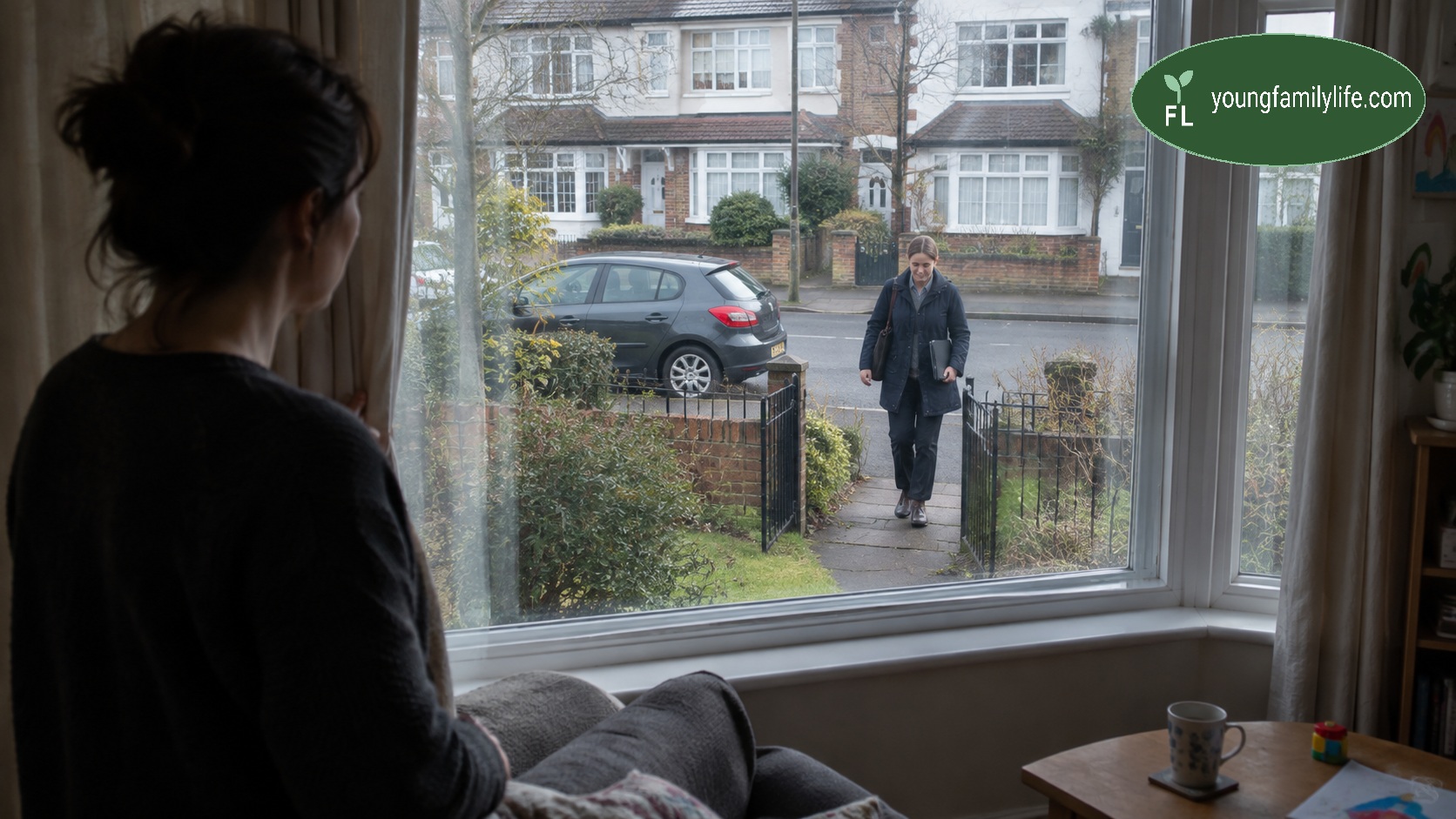
A referral about a child — from a school, a health visitor, a neighbour, a family member, anyone — arrives at what most areas call the front door, usually a multi-agency safeguarding hub where police, health, and children's services information sit together. From there, a triage decision sorts the referral into one of several tracks.
If there is reasonable cause to suspect a child is suffering, or is likely to suffer, significant harm, it becomes a Section 47 child protection enquiry, led by an experienced, qualified social worker — this is the one part of the system where the 2023 change did not remove the qualification requirement. If the concern falls short of that threshold but the family clearly needs support, it now typically becomes a Family Help case: since the 2023 reforms, most councils have merged what used to be two separate tracks — "child in need" (Section 17) and "targeted early help" — into this single service, coordinated by a Family Help Lead Practitioner who may or may not be a qualified social worker, with a social-work-qualified supervisor required to oversee and approve the key decisions. Lower-level concerns may be referred sideways to universal services — a school, a GP, a children's centre — without opening a case at all, and a referral that doesn't meet any threshold is closed with no further action.
The single biggest hinge in the whole system, then, is the triage judgement at the front door itself: whether a case is serious enough to sit with a qualified expert practitioner, or is judged to belong in the wider Family Help tier — a judgement that is, itself, now often made without a social work qualification in the room.
Even the protected part of that picture is less exclusively social-work-led than it first appears. Section 47 enquiries are now typically carried out through multi-agency child protection teams (MACPTs), bringing police, health, and education practitioners into the investigation and assessment work alongside a Lead Child Protection Practitioner, who is meant to be an expert, qualified social worker. The qualification requirement has been preserved at the top of that structure — the lead role — but a good deal of the actual information-gathering and day-to-day contact that an investigation depends on is now carried out by professionals from across that wider network, most of whom have no social work training at all. The "protected" track and the "reformed" track, in other words, are converging on the same underlying pattern: qualification is increasingly concentrated in a single sign-off role, sitting above a much wider layer of practitioners doing the actual watching, listening, and reporting.
This essay is not built on the assumption that a higher salary or a longer qualification automatically produces better protection for a child, or that a degree-holding social worker will always make a sounder judgement than an experienced family support worker who knows a household well. Pay and training are not a straightforward proxy for good outcomes, and treating them as one would be its own kind of oversimplification. The subject here is narrower and more procedural: not who is best placed to help a family, but who now legally and formally holds the responsibility when a judgement about a child's safety turns out to be wrong — and how far that responsibility has moved away from the training, supervision structure, and professional accountability that used to sit underneath it as a matter of course.
This shift happened neither quietly nor by accident. It has a documented history, running through named reviews, named organisations, and named objections — a history more interesting, and more useful, than either "nobody noticed" or "someone did this to save money and hoped nobody would ask."
The 2011 Munro Review of Child Protection is the modern starting point. Professor Eileen Munro's report pushed hard for expanding "early help" — support offered before a family's difficulties escalate into statutory child protection territory — but it did not propose moving core child-in-need or child-protection judgement away from qualified social workers (Munro, 2011). The shift that eventually happened is not what Munro originally recommended; it is what later reforms built, in her framework's name, once funding and workforce pressure entered the picture.
The 2021–22 Independent Review of Children's Social Care, led by Josh MacAlister, is where the current architecture actually originates. It recommended merging targeted early help and child-in-need work into a single "Family Help" service, with multidisciplinary teams — family support workers, domestic abuse workers, mental health practitioners — working alongside social workers, backed by roughly £2 billion of proposed investment (House of Lords Library, 2022). Notably, the review's original design still tried to protect the specialist tier for the highest-risk cases: it proposed a new "expert child protection practitioner" role, reserved for experienced, qualified social workers, to lead any case where a child might be at risk of significant harm (Community Care, 2022).
The actual deskilling step came in 2023. The Department for Education's draft strategy, Stable Homes, Built on Love, proposed removing the requirement for a qualified social worker to carry out child-in-need assessments under Section 17 of the Children Act 1989 — opening this work to "alternatively qualified" staff, potentially including family support, drug and alcohol, domestic abuse, or mental health workers (Community Care, 2023a). Ofsted and the British Association of Social Workers (BASW) both formally objected, warning this could undermine the quality of practice and increase risk to children. The Association of Directors of Children's Services — the body representing the people who actually have to staff and fund these services — backed the change (Community Care, 2023a).
The compromise that emerged required all such cases to be overseen by a social-work-qualified supervisor who approves the key decisions; critics have continued to regard this as a partial safeguard rather than a full one.
By 2025, this had become the Families First Partnership programme, rolling out nationally. Non-social-work-qualified Family Help Lead Practitioners now coordinate cases across the system, and — more controversially — are being positioned to chair child protection conferences, a role that had been independently held by experienced practitioners, separate from a case's own management line, for around twenty-five years (BASW, 2025a). BASW called the proposed change to conference chairing a "massive concern" (Community Care, 2022).
Munro herself, whose original review is the intellectual ancestor of this whole direction, has since said the 2025 reforms are "very likely to fail," citing the scale of change and, specifically, doubt over whether non-qualified lead practitioners can reliably identify escalating risk (Community Care, 2025). An early 2026 evaluation of pilot areas found exactly the concern BASW and Ofsted raised in 2023 already showing up in practice: non-social-work staff reporting a lack of confidence in managing risk in child-in-need cases (BASW, 2026).
This has been chronicled in close to real time, mostly in the sector's own trade press, and mostly by the people with the clearest professional stake in getting it right.
The Case for the Workforce
This shift was not pointless, and it was not purely a cost-cutting exercise dressed up in policy language. There is a real, positive case for widening who does this work, as serious as the risk.
Capacity is the most straightforward part of it. Qualified social workers cannot be trained fast enough, or retained long enough, to meet demand through the statutory tier alone — a workforce shortage and turnover problem that has been chronic and well documented for well over a decade, running in parallel with, and partly driving, the reforms described above. A wider tier of practitioners means more relationship-hours available to families than a purely social-work-staffed system could ever fund.
Rapport is a second, less obvious factor, and it doesn't sit only on one side of the qualification line. A family support worker's caseload and allocation period tend to closely mirror a social worker's — assigned for the life of a Child in Need plan, stepped down when the case closes, much like a qualified social worker's own involvement. Neither role has any structural claim to knowing a family longer or better than the other. What both roles actually depend on for a good outcome is the same thing: building real rapport with a family, so that family can be properly supported to address the concerns that brought services in. A teaching assistant is a partial exception here, since a school-based relationship can genuinely run for years in a way a case-allocated role cannot — but that continuity belongs to the school relationship specifically, not to the family support or Family Help worker role more broadly.
There is also a workforce-development case: these roles offer a route into caring, family-facing professions without a university degree as an entry barrier, drawing in people — often from the same communities they serve — who might never otherwise have entered this kind of work, and for whom this can be a first step toward further qualification rather than a permanent ceiling.
The underlying design logic has a close parallel in primary care: most appointments at a health centre are handled well by a nurse rather than a doctor, not because the case has been downgraded, but because the system is built to escalate to more specialist attention if and when the situation actually calls for it. A tiered safeguarding workforce is meant to work the same way — a Family Help worker handling what the situation currently requires, with the system expected to step a case up to a qualified social worker if the picture changes. Whether that escalation step works as reliably in practice as it does in the primary-care analogy is precisely the question the training and accountability gaps below raise.
The Training Gap
The training gap, set against this, is stark, and its shape is precise rather than merely asserted.
A qualified social worker typically spends three or more years in formal education building a specific kind of framework — not just procedural knowledge of "what to do if," but an epistemological one: how to hold uncertainty about a family's situation, how to weigh one account against another, how to recognise the limits of a single home visit's worth of observation, how to notice when their own assumptions are doing the interpreting rather than the evidence in front of them. This is not a decorative add-on to the job; it is the part of the job that makes the judgement calls defensible.
Most para-professional safeguarding training, by contrast, is measured in days, not years, and is weighted almost entirely toward procedure — what counts as a concern, who to tell, what form to complete — rather than toward the underlying epistemic skill of reading an ambiguous situation without over-trusting a first impression. A person can be diligent, caring, and procedurally correct, and still lack the specific, hard-won capacity to recognise when their own background, class assumptions, or prior experience of parenting is shaping what they think they're seeing in someone else's home. That capacity is not innate. It is trained, deliberately, over years — and a workforce carrying more of this judgement now has, on average, had far less of that specific training than the workforce that used to carry it.
A Half-Century of Who Counts as "Qualified"
"Qualified social worker" has not always meant what it means today, and the history complicates any simple story of standards only ever rising. Before 1971, there was no single, unified professional qualification for social work in Britain at all — children's officers, mental welfare officers, and almoners trained through entirely separate, patchwork routes, some going back to the 1940s, none co-ordinated with the others.
The 1968 Seebohm Report recommended unifying these fragmented services into single local authority Social Services Departments, implemented by the Local Authority Social Services Act 1970 (Seebohm, 1968).
The following year, the Central Council for Education and Training in Social Work (CCETSW) was established to unify training standards, and introduced the Certificate of Qualification in Social Work (CQSW) — the first genuinely national academic qualification (CCETSW, 1971–2001). But CCETSW also introduced a second, lower-bar route at the same time: the Certificate in Social Services (CSS), an in-service, practice-based qualification aimed specifically at people already doing the job without formal training. Existing staff were not required to stop, retrain, and requalify from scratch; they were given a recognised route to catch up alongside the work they were already doing.
Even more strikingly, "social worker" itself was not a legally protected job title in England until 1 April 2005, under the Care Standards Act 2000. Before that date, anyone — with or without any qualification whatsoever — could legally call themselves a social worker.
The full academic, degree-level entry standard now taken for granted did not arrive until 2003, and the qualification itself has changed shape twice more since — DipSW replacing CQSW in 1989–90, today's Social Work England degree-level standard replacing DipSW from 2003 (Portman Recruitment, 2024).
The nearest everyday parallel is the introduction of the UK driving test. Driving licences had existed in Britain since 1903, obtainable simply by applying — no competency of any kind was tested. When the driving test became compulsory in 1935 under the Road Traffic Act 1934, it applied only to people learning to drive from that point on; anyone who already held one of the old, untested licences was never required to go back and sit it (Motor Car Act 1903; Road Traffic Act 1934). They kept driving, indefinitely, under what's informally called a grandfather right.
The social work profession's own history follows a similar shape: a formal competency standard was introduced for those entering afresh, while people already doing the job were carried across on a lower bar, trusted to have already proven themselves through practice. The current shift toward para-professional safeguarding roles is not, in that sense, an entirely new kind of event for this profession — but the earlier examples all involved raising a bar for new entrants while grandparenting the old guard in. The present shift is closer to the reverse: work that had settled at a raised bar is now, in part, being reopened to a wider, less-qualified entry point.
The Risk Gap
There is a second, less discussed gap sitting directly alongside the training one: physical and psychological risk.
If the UK cannot currently produce a single reliable, official dataset on the risk qualified safeguarding staff face on home visits — no isolated Health and Safety Executive figures, no RIDDOR capture of near-misses, a patchwork of council policies built on evidence last properly reviewed before the pandemic changed how home visits work — then the position of a lower-paid, less-trained tier doing an increasing share of the same doorstep and home-visit work is even less visible in any dataset than the specialists' own already-unmeasured risk. This is a second "unlit" risk sitting inside the first: not necessarily a larger one, but one with even less light shone on it, carried by people with even less institutional infrastructure — occupational health support, structured debriefing, formal risk assessment — built around them.
The psychological weight compounds this. Making a safeguarding judgement — deciding whether what you've just seen or heard is concerning enough to escalate — carries a particular kind of load: the knowledge that missing something has consequences for a child, and that raising a false alarm has consequences for a family. Qualified social workers are trained, supervised, and structurally supported to carry that load, however imperfectly. A workforce carrying an increasing share of the same weight, without the equivalent years of training, supervision structure, or professional status that traditionally came with holding it, is carrying something heavier than their formal job description suggests — and is doing so with less institutional scaffolding underneath them than the person the job used to belong to.
The Accountability Gap
A third gap sits alongside the training and risk gaps, and it runs in a direction that isn't obvious until it's spelled out.
Civil liability — being sued, a family seeking compensation for a failure — works the same way regardless of who was involved. A council employee acting in the course of their job is covered by their employer's vicarious liability, whether they hold a social work qualification or not; an independent, self-employed social worker, by contrast, must arrange their own professional indemnity cover precisely because they have no employer to carry it for them (Simply Social Work, n.d.).
This part of the picture doesn't shift with the reforms described above; the local authority remains the party actually on the hook, and its insurance covers qualified and unqualified employed staff alike.
Personal professional accountability is a different matter entirely, and here the asymmetry runs the opposite way to what the rest of this essay might suggest. A registered social worker answers to Social Work England, the profession's regulator, independent of whatever their employer decides. If a case goes badly wrong, that social worker can face fitness-to-practise proceedings — an investigation that can end in suspension, conditions on their registration, or being struck off the register altogether, closing off their ability to work as a social worker anywhere in the country, not just at that employer (Social Work England, 2019; Social Work England, n.d.). This sits on top of, and separate from, whatever the employer itself does.
A family support worker or Family Help Lead Practitioner without a social work qualification has no equivalent standing to lose. There is no regulator, no register, no fitness-to-practise process, because these roles are not protected, regulated titles the way "social worker" is. If something goes wrong, the only mechanism available is the ordinary internal employer disciplinary process, up to dismissal — but there is no independent professional body that can strike them off anything, because there is nothing for them to be struck off from.
The result is a genuine inversion. The person carrying more years of training also carries more personal, career-defining risk if a judgement turns out wrong. The person now doing an increasing share of the same frontline judgement, with less training underneath them, is also the one with the least formal, independent accountability for getting it wrong. Responsibility has moved down the ladder; personal accountability for that responsibility, if anything, has moved the other way.
More Than One Kind of Objection
This is not a single, unified professional community objecting to a single, unified policy establishment. The actual picture has several genuinely different, non-aligned positions in it — people looking at the same shift and seeing different things as the most important feature of it.
BASW and Ofsted's objection has been about competence and risk: that staff without social work qualification may be less able to reliably identify escalating risk to a child, particularly in ambiguous or slow-building cases where the danger isn't visible in any single encounter.
Family Rights Group — the longest-established organisation representing parents and kinship carers in this space — raised a different concern entirely in their formal response to the 2023 reform consultation. Their worry was not primarily that less-qualified staff are dangerous; it was that creating a distinct "expert" child protection tier risks professional differentiation — more status attached to the qualified role — which could damage the trust and continuity a family has built with a Family Help worker, and could leave families facing more bureaucratic handoffs at the exact point they most need consistent support (Family Rights Group, 2023). They also observed, more broadly, that the whole "family-first" framing still gets seen "predominantly through a lens of child protection and managing risk" rather than genuine, non-stigmatising support — a critique of the system's posture toward families generally, not a call for more specialist gatekeeping.
Parents, Families and Allies Network — a parent-led advocacy network, rather than an organisation speaking on parents' behalf — ran its own formal, co-produced consultation directly in response to the 2021–22 review, published as peer-reviewed research (Rasmussen, Krumer-Nevo, & Bar-Chama, 2022). This is a rarer and different kind of voice in the debate: parents and care-experienced people setting the terms of their own submission, rather than being consulted about it afterward.
And the Association of Directors of Children's Services — the employers who actually have to staff and fund these services within a fixed budget — backed the 2023 change that BASW and Ofsted opposed, for reasons that are structural rather than dismissive of the risk: someone has to do this work, and the qualified workforce to do all of it simply does not exist in sufficient numbers.
Four positions, four genuinely different maps of the same territory — competence, trust and continuity, family voice, and workforce capacity — and none of them wrong on its own terms.
A Fifth Map, Still Being Drawn
A further layer has entered this picture more recently, and it is still forming rather than settled. Local political control of children's services is shifting in some areas, including newly-elected administrations whose stated instincts run toward less state involvement in family life and scepticism about how a council's money is spent generally, of which safeguarding and children's services are one part among many rather than a specific target. What the evidence actually shows so far, in the small number of cases where this has happened, is not a consistent story in either direction — one new administration has pushed for more priority and resource toward children's social care rather than less, while another has so far made no significant change to an existing, highly-rated service.
The more useful observation is probably not about any one party's stated position, which is still new enough in local government to be more rhetoric than record. It's that the deeper constraint — a fixed, tight funding envelope and a real shortage of qualified social workers to hire even where money exists — predates and outlasts whichever administration is nominally in charge locally. A newly-elected council learning the actual statutory mechanics of a children's services department, inside a budget inherited entirely from before it took office, has far less real room to change course than any campaign rhetoric might suggest, regardless of which direction that rhetoric points. Political control adds another map to the pile — but the territory underneath it, for now, is being shaped far more by the money and the workforce than by whoever is holding the pen.
What Would Make the Trade Legible
This essay does not argue for reversing the shift, and prescribing a fix sits outside its purpose. What follows describes, in general terms, what would make an already-happening trade visible rather than invisible — a more modest ambition than "solving" it.
Workforce-tier-specific data on outcomes and near-misses would let the sector see, rather than guess at, whether the trade is working as intended. Training investment genuinely proportionate to the responsibility a role actually carries — not to its job title or pay grade — would close some of the gap described above without requiring every family-facing worker to become a qualified social worker. And clearer, shared understanding of what a para-professional safeguarding role is and isn't expected to judge alone would help everyone in the five-map picture above see the same territory a little more clearly, even where they continue to disagree about which feature of it matters most.
Unlit, Not Unfixable
This essay's companion piece on safeguarding workers' own physical risk ended on the idea that a risk nobody has properly measured is unlit rather than unfixable. The same describes this: responsibility has moved down the ladder in full view, documented at every stage, objected to by name, and the objections were substantively right about the specific risks they named — and it kept moving anyway, mostly for reasons that are financial and structural rather than anyone deciding, in so many words, that less training and less accountability was an acceptable price to pay. Naming that clearly is not a criticism of any one decision-maker. It's a description of what happens when a genuine capacity problem meets a training gap, a risk gap, and an accountability gap all at once, and the country doesn't yet have the data to see the trade it has already made.
References
BASW. (2025a). Four challenges facing England's children's social care reforms.
BASW. (2026). Non-social work staff lack confidence in managing risk in child in need cases, finds evaluation (as reported via BASW media coverage).
Community Care. (2022). Review proposals to 'axe' child protection conference chairs a 'massive concern', warns BASW.
Community Care. (2023a). Ofsted and BASW raise safeguarding concerns over allowing non-social workers to hold child in need cases.
Central Council for Education and Training in Social Work. (1971–2001). Historical role and qualifications record (as documented by Social Work England's historical courses and eligibility registers, and the Social Work Centenary project, University of Edinburgh).
Community Care. (2025). Munro: children's social care reforms 'very likely to fail' due to scale of change and lack of testing.
Community Care. (2025). Families more supported and listened to in social care reform early adopter areas, report finds (evaluation coverage referencing MACPT — multi-agency child protection team — structure and roll-out).
Family Rights Group. (2023). Family Rights Group's response to Government's plans for reform (submission on 'Stable Homes, Built on Love', May 2023).
House of Lords Library. (2022). Independent review of children's social care.
Munro, E. (2011). The Munro Review of Child Protection: Final Report — A Child-Centred System. Department for Education.
Rasmussen, K., Krumer-Nevo, M., & Bar-Chama, N. (2022). Parental partnership, advocacy and engagement: The way forward. Societies, 12(8), 353.
Motor Car Act 1903 and Road Traffic Act 1934 (as summarised by the DVLA's own published history of driver licensing, and Graces Guide's history of the driving licence).
Portman Recruitment. (2024). The history of social work (secondary summary consulted for the CQSW-to-DipSW-to-degree qualification timeline).
Seebohm, F. (1968). Report of the Committee on Local Authority and Allied Personal Social Services (the Seebohm Report). HMSO.
Simply Social Work. (n.d.). How to become an Independent Social Worker? (consulted for the employer-indemnity vs. self-employed indemnity distinction).
Social Work England. (2019). Social Workers Regulations 2018 and Social Work England registration rules 2019 (fitness to practise framework).
Social Work England. (n.d.). Safe and effective practice; Renewal (registration and fitness-to-practise guidance).
Note: per standing YFL convention, external hotlinks have been stripped from this list. Each entry gives sufficient detail for independent verification. Several sources are trade-press reporting (principally Community Care and BASW's own media/PSW output) rather than peer-reviewed literature, reflecting that this is a fast-moving, ongoing policy story still being chronicled in close to real time; these should be treated and, where used publicly, framed as such.
Topics: #Safeguarding #SocialWork #ChildProtection #FamilyHelp #WorkforcePolicy #FamilySafeguarding #Deskilling