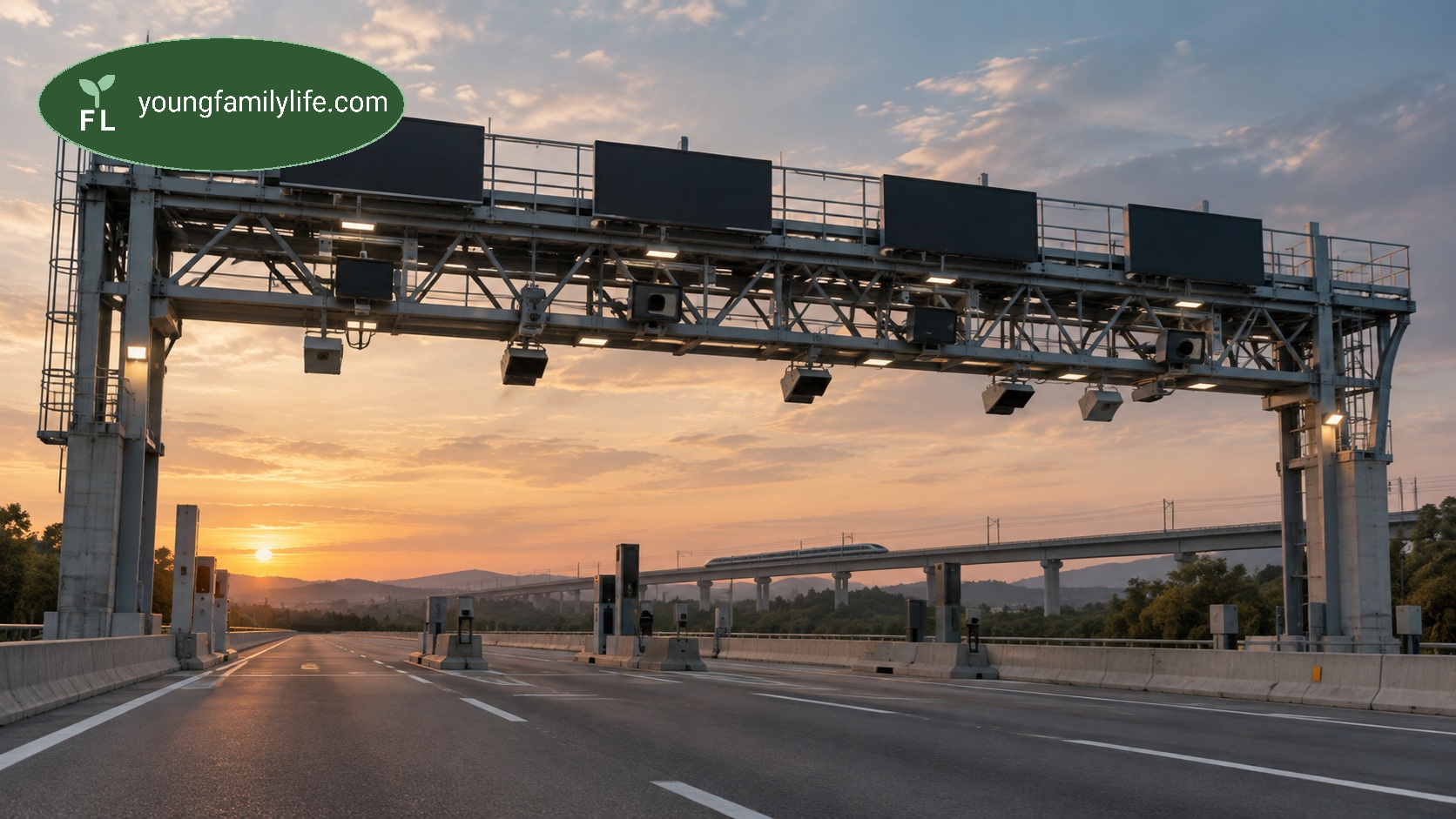
Four ways of paying for something the country can't fund from a single budget line
Between 2010 and 2025, four UK infrastructure programmes were paid for in four genuinely different ways:
- Direct public funding, overrun absorbed — the Elizabeth Line, where the sponsor paid the extra cost and the project reached completion.
- Direct public funding, overrun not absorbed — HS2, where a comparable escalation led to part of the project being cancelled outright.
- Private finance, recovered from government per use — the DBFO “shadow-toll” roads, where a private operator is paid a fee by the state for every vehicle that uses the road.
- Private finance, recovered from the driver directly — the M6 Toll, Britain's only major motorway where the person using the road pays the charge themselves.
Each tells a different story about what a financing structure does to the incentive to control cost, and about who ends up bearing the consequence when an estimate turns out to be wrong.
The Elizabeth Line: an overrun absorbed, a benefit realised
Crossrail, renamed the Elizabeth Line on opening, was forecast in 2010 to cost £14.8 billion. Its final cost came to £18.8 billion — a 28 per cent increase — and it opened three and a half years later than planned, in stages between 2022 and 2023. Transport for London's own figures put the line's economic contribution at an estimated £42 billion, a project sponsor's projection rather than an independently audited outcome, but one worth setting against the final cost regardless: on TfL's own account, the benefit has already outstripped what the project cost to build. Separately confirmed, more measurable outcomes include around 700,000 average weekday passenger journeys, a role in the development of 55,000 new homes along the route, and a 40 per cent increase in demand for the line between June 2022 and October 2023 alone.
The funding model behind this was entirely direct: the Greater London Authority's own Community Infrastructure Levy and a dedicated Crossrail Business Rate Supplement, alongside central government contributions, rather than any private finance or concession structure. When the cost rose, the public sponsor absorbed the increase and the project continued to completion.
HS2: the same model, a different outcome
HS2 was funded on the same basic principle — direct public spending, no private concession — and its cost also rose substantially: from an estimated £56 billion in 2015 to reported estimates exceeding £100 billion by 2020. The response was different from Crossrail's. The eastern leg to Leeds had already been cancelled under Boris Johnson's government, and on 4 October 2023, at the Conservative Party conference in Manchester, Prime Minister Rishi Sunak cancelled the remaining Birmingham–Manchester leg outright, citing costs that had “more than doubled” and redirecting the £36 billion in projected savings into a programme of smaller regional transport schemes branded “Network North.”
The financing model did not differ between the two projects. What differed was scale, and the point at which political appetite for absorbing further cost ran out. Crossrail's overrun, in cash terms, was a fraction of HS2's; whether that difference in scale alone explains the difference in outcome, or whether it was compounded by other factors specific to each scheme, is not something either project's public record settles definitively.
The shadow-toll roads: private finance, recovered per vehicle
A third model emerged from the mid-1990s onward, under the Highways Agency's Design, Build, Finance and Operate (DBFO) programme, part of the wider Private Finance Initiative. Under a DBFO contract, a private consortium designs, builds, finances and then operates a road for a fixed period, typically 30 years, in exchange for a fee paid by government rather than by the driver — a “shadow toll,” calculated from the number of vehicles using the road as recorded by roadside sensors. No toll booth exists on any of these roads; the payment happens entirely between the operator and the state.
The A1(M) Alconbury to Peterborough scheme, on which much A14 traffic runs via a short connecting stretch, is one example: contract awarded in February 1996, an estimated construction cost of £128 million, opened in October 1998, operated by Road Management Services (Peterborough) Ltd under a contract running to 2026. It is worth being precise here, since it is easy to conflate: the A14 itself, the Cambridge–Huntingdon stretch, was never tolled in any form — a 2013 proposal to toll that separate section was dropped after local opposition, and it was built with full public funding. The genuine shadow-toll case sits on the connected A1(M) section, not on the A14 proper.
Around a dozen such DBFO roads were built across Great Britain from 1996 onward, spanning the end of John Major's government and the start of Tony Blair's. An academic financial analysis of the first eight of these schemes, published in 2006, found that within three years of the contracts starting, the Highways Agency had already paid the private operators more than it had cost to build the roads in the first place; the operators' parent companies, meanwhile, reported a post-tax return on capital of 29 per cent and an effective cost of capital roughly twice that of ordinary public borrowing (Shaoul, Stafford and Stapleton, 2006). The declared purpose of transferring construction and operating risk to the private sector does not, on this evidence, appear to have come at a lower total cost to government than direct public funding would have.
The M6 Toll: the one road where the driver pays
A fourth model offers the sharpest possible contrast: Britain's only major toll motorway, where the charge is paid directly by the driver rather than recovered from government. The M6 Toll passed through four Prime Ministers before a single vehicle used it:
- 1980 — first proposed as a publicly funded “Birmingham Northern Relief Road”, then shelved amid spending cuts.
- 1989 — revived under Margaret Thatcher's government as a privately financed scheme.
- 1991 — Midland Expressway Ltd won the 50-year concession, under John Major.
- 2003 — the road opened in December, under Tony Blair.
Its origin, its funding decision, and its completion each fell under a different governing period.
It was built by a construction consortium known as CAMBBA: Carillion, Alfred McAlpine, Balfour Beatty and Amec. That detail carries an afterlife worth noting. Fifteen years after helping build one of Britain's most visible pieces of privately financed infrastructure, Carillion collapsed into liquidation, in January 2018, as the clearest case yet of a strategic government supplier undone by low-margin, high-risk bidding. The same company sits on both sides of this essay's material — as a builder profiting from private infrastructure finance in 2003, and as a supplier whose collapse became the defining case study in what happens when a similar model is pushed too far.
Traffic on the M6 Toll has consistently run below the levels originally forecast. Several contemporary sources attribute this directly to the toll charge itself: in the months after opening, freight operators in particular indicated they would rather absorb the delays of the free, congested M6 through Birmingham than pay the toll, a straightforwardly rational response to a direct price signal that none of the other three models in this essay actually presents to the people using the road.
Who checks the estimate, and who checked whose
All three financing models above share an earlier problem: the original cost estimate. A National Audit Office report published in February 2024, examined by the Public Accounts Committee (PAC) and reported on in May 2024, put it plainly — “there is optimism bias in nearly every project we look at” — and identified a related tendency in government “to approve projects before they have been developed sufficiently for there to be confidence in the accuracy of the cost estimate.” The Government Major Projects Portfolio, the register of departments' costliest and riskiest schemes, held 244 projects worth an estimated £805 billion in whole-life cost at the time of that report; more recent figures put the portfolio at 213 projects worth £996 billion. The finding is still being actively followed up: the National Infrastructure and Service Transformation Authority (NISTA), the successor body responsible for improving these estimates, wrote to the Committee in August 2025 responding specifically to its recommendations, more than a year after the original report.
It is worth being precise about which body is checking which. The NAO is constitutionally independent of government, and PAC is composed of MPs rather than officials, so this pairing is external scrutiny by design, not self-assessment. The body that actually produces the original cost estimates and business cases sits in a different position: NISTA, like the Infrastructure and Projects Authority before it, is a Cabinet Office body, inside government, assessing projects government itself has proposed. A recent case illustrates the concern directly: a major cross-government shared-services programme brought in outside consultants specifically to help “reduce bias and support the development of a realistic business case” for its own proposal — an implicit acknowledgement that an in-house assessment was not trusted to be sufficiently impartial on its own.
PAC's own composition carries a further complication. Like every select committee, its membership reflects the Commons' party balance, so whichever party holds a government majority normally holds a majority of the committee's seats too; the one deliberate counterweight is the long-standing convention, not a rule, that PAC is chaired by an opposition MP. Since the 2024 general election, that has meant a Conservative chair, Sir Geoffrey Clifton-Brown, scrutinising a portfolio of decisions — HS2's original approval in 2012, its repeated cost re-estimates, and its own 2023 cancellation — made almost entirely under the governments of his own party. That is a more tangled incentive than a simple government-versus-opposition frame suggests: a chair in that position may have reason to distance current opposition politics from a previous leadership's record, or reason to go easier on a period his own party governed through, depending on which serves better at a given moment.
Academic research on select committees gives this some empirical shape rather than leaving it as speculation. A study of departmental select committees between 2010 and 2019 found that most reports are agreed by consensus, but formal party-line divisions occurred on 9 per cent of reports, and were significantly more likely when a committee was chaired by an opposition MP (Lynch and Whitaker, 2021). The consensus norm itself cuts both ways: committees work toward unanimous reports partly so that findings cannot be dismissed as partisan, which guards against a report becoming a rubber stamp for whichever party is in office, but also creates its own pressure toward softened, negotiated language regardless of which party holds sway. Separate research examining the charge that select committees amount to “political theatre” and “grandstanding” rather than evidence-based scrutiny found the concern widely enough held to be worth systematic study, based on a survey of 919 people who had themselves given evidence to committees (Journal of Legislative Studies, 2020).
None of this shows that PAC's specific findings on major-projects cost estimation are wrong, or that the optimism-bias conclusion should be discounted. The 9 per cent divisions rate, in the most detailed study available, means the great majority of reports are not obviously shaped by party advantage. What it shows is that the structure checking government's cost estimates has a genuine self-review problem at the level that actually produces those estimates (NISTA), a genuine but partial and empirically modest partisan-composition problem at the level that scrutinises them (PAC), and a separately documented tendency toward theatre in how select committees are sometimes conducted — three distinct concerns, each with its own evidence, that should not be collapsed into one.
What the comparison shows
None of these four cases proves that one financing model is simply better than the others; each involves a different road, a different era, and a different scale of ambition. What the comparison does show is that the financing structure changes who absorbs a wrong estimate, and how visibly:
- Direct public funding, overrun absorbed (Elizabeth Line) — the cost rise was fully visible, and completion turned on political tolerance for the number rather than on the financing mechanism itself.
- Direct public funding, overrun not absorbed (HS2) — the same basic mechanism, but political tolerance for further cost ran out, and part of the project was cancelled instead.
- Private finance, recovered from government per use (the shadow-toll roads) — promised risk transfer to the private sector, but produced, on the only detailed academic analysis available, a total cost to government higher than construction cost within three years, a result no single bill ever states plainly.
- Private finance, recovered from the driver directly (the M6 Toll) — the only model to generate a visible, immediate behavioural response to price: lower use than planned, concentrated exactly where the price was highest to bear.
Behind all four sits the same earlier weakness: a cost-estimation process that a Parliamentary committee has found riddled with optimism bias, checked by a structure that is only partly independent of the government whose projects it reviews.
References
House of Commons Library (2026) Future Transport Infrastructure Projects and the Elizabeth Line. London: House of Commons Library.
Lynch, P. and Whitaker, R. (2021) ‘Unity and Divisions on Departmental Select Committees: A Brexit Effect?’ [journal title and volume/issue not yet formally verified against the primary publication].
National Audit Office (2024) Lessons Learned: Delivering Value from Government Investment in Major Projects, HC 554. London: NAO.
Public Accounts Committee (2024) Delivering Value from Government Investment in Major Projects, Thirty-Second Report of Session 2023–24, HC 456. House of Commons.
Shaoul, J., Stafford, A. and Stapleton, P. (2006) ‘Highway Robbery? A Financial Analysis of Design, Build, Finance and Operate (DBFO) in UK Roads’, Transport Reviews, 26(3), pp. 257–274.
Transport for London (2024) Evidencing the Value of the Elizabeth Line: An Update on the Outcomes of London's Transformational Railway, May 2022 to May 2024. London: TfL.
‘UK Parliamentary Select Committees: Crowdsourcing for Evidence-Based Policy or Grandstanding?’ (2020) Journal of Legislative Studies, 26(2) [author names not yet confirmed against the primary publication].
Topics: #Infrastructure #PublicFinance #Crossrail #HS2 #PFI #ShadowTolls #Carillion #M6Toll #PublicProcurement