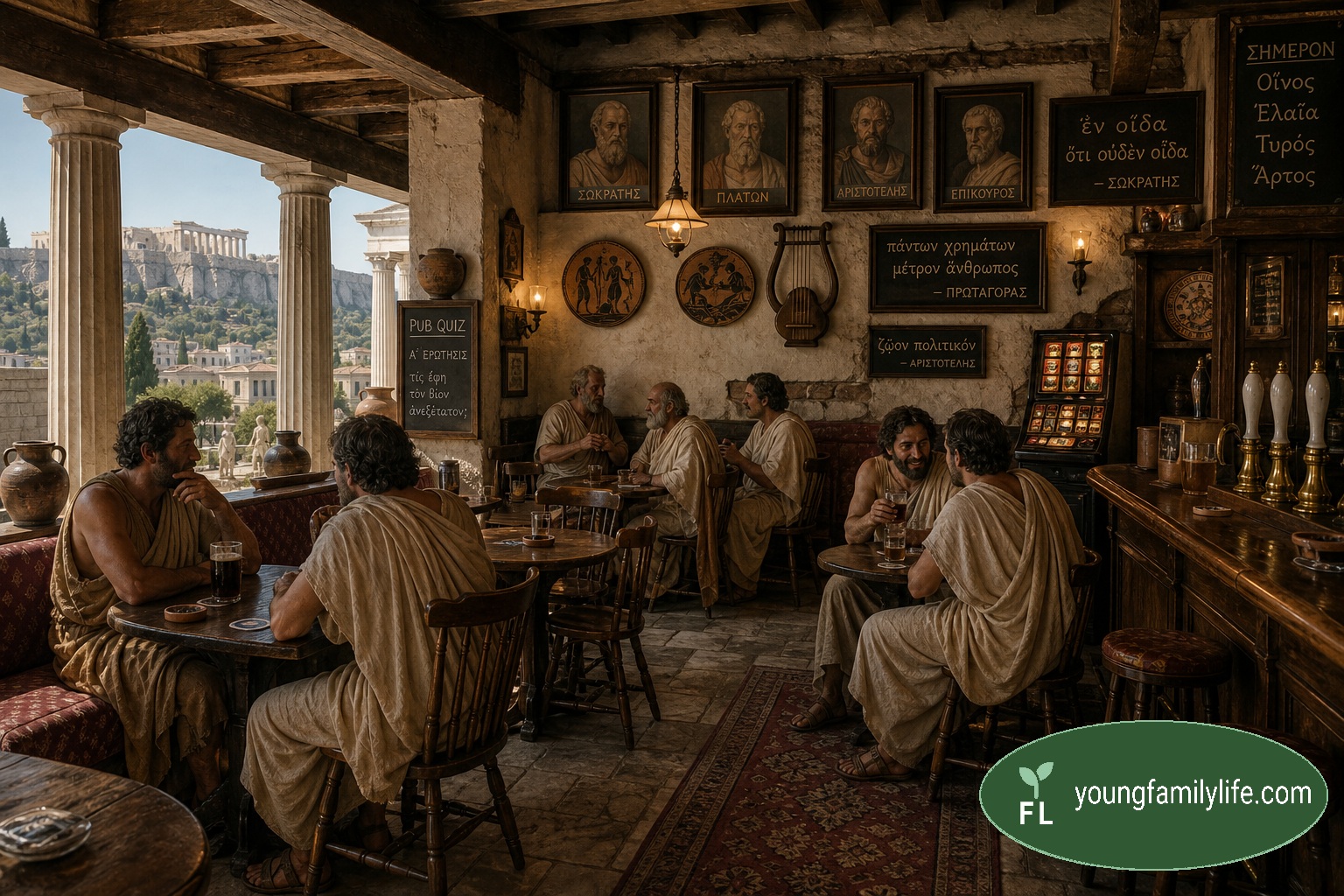
A small cluster of thinkers working in the Greek world between roughly 600 and 200 BC left behind answers to a handful of foundational questions that academic disciplines, for the most part, have never needed to replace. How do you test a belief rather than simply assert it. How do you structure an argument so its conclusion is forced by its premises. How do you find the real cause of a problem rather than blaming forces nobody can observe. What actually is a mind. How do you build certain knowledge from a small set of starting assumptions. How do you turn abstract mathematics into a prediction about a physical object. And how do you tell whether an authoritative answer is actually the correct one. Philosophy, law, medicine, psychology, mathematics, and physics all still carry, in their working methods rather than merely their history books, the fingerprints of people who were trying to answer these questions roughly two and a half thousand years ago.
None of this is a single lucky discovery being retold six different ways. It is a genuine intellectual lineage: Aristotle studied for twenty years under Plato, who had studied under Socrates directly, and Archimedes is known to have engaged seriously with Euclid's geometry a generation after Euclid wrote it. Several of the figures below plausibly read one another's work or crossed paths in a Greek-speaking world that was, intellectually, considerably smaller and more interconnected than its geography might suggest.
Thales Asked "Why" Instead of "Which God"
The earliest figure in this story predates Socrates by close to two centuries. Thales of Miletus, working in the early sixth century BC, is generally credited as the first person in the Greek tradition to propose that natural events have natural explanations, rather than being the direct actions of gods. His own specific claim — that water was the single underlying substance from which everything else was made — did not survive scrutiny. The method behind it did: look for a physical explanation first, and treat divine intervention as a last resort rather than a starting assumption.
Thales also put geometry to demonstrably practical use. He is credited, in later Greek accounts, with calculating the height of the Egyptian pyramids by comparing the length of their shadows to the shadow cast by a stick of known height at the same moment — a straightforward application of similar triangles that remains, in essence, exactly how the topic is introduced in a mathematics classroom today. Physics, at its most basic definition, is the search for the rules nature actually follows rather than the rules a myth assigns to it. Thales is usually credited as the person who decided that search was worth undertaking systematically in the first place.
Pythagoras Thought the Universe Ran on Numbers
Most people meet Pythagoras through a single theorem — that in a right-angled triangle, the square of the longest side equals the sum of the squares of the other two — usually without meeting the considerably larger claim it emerged from. Pythagoras and the school of thinkers associated with him believed that numbers and numerical ratios were not merely useful for measuring things, but constituted the actual underlying structure of reality, including phenomena that do not look numerical at all, such as musical harmony and the movement of the visible planets.
That belief was wrong in several of its specifics, and its more mystical elements — number-worship, a belief in numerological significance — have not survived into modern science. But the underlying instinct, that the universe might be governed by discoverable mathematical relationships rather than simply observed by accident, is close to the working assumption behind most of contemporary physics. Every time a physical law is expressed as an equation rather than a qualitative description, that is a recognisably Pythagorean wager: that beneath the apparent disorder of observation, a numerical pattern is waiting to be found.
What Socrates Actually Did
Socrates himself left behind no writing. Almost everything known about how he actually taught comes second-hand, chiefly from his student Plato, who preserved it in the form of dialogues — conversations, not lectures, which is itself a small clue about what Socrates believed teaching actually was. He was tried and executed by his own city in 399 BC, partly for the charge of corrupting the young through persistent questioning of people who did not welcome being questioned.
The method itself, now generally known by the Greek term elenchus — cross-examination, or refutation — is simple to describe and considerably harder to sit through. Someone states a belief. The questioner does not agree or disagree, but asks what the belief depends on, then asks whether that foundation holds, then asks about the next thing it depends on, continuing until either the belief survives intact or an unnoticed contradiction is exposed. Nothing is lectured, and nothing is simply asserted. Crucially, by several accounts, Socrates treated his own claims as equally open to this scrutiny — the method was not designed as a one-way interrogation of a subordinate, but as a shared examination in which neither party was guaranteed to like what it found.
Where Socrates Still Runs Law and the Humanities
The clearest surviving descendant of this method is the Oxford tutorial. Historians of the university credit Benjamin Jowett, Master of Balliol College in the mid-nineteenth century, with building the tutorial's distinctive one-on-one, question-driven format explicitly on the Socratic model, particularly within the study of Classics. Nearly two centuries later, the tutorial is still described as the signature feature of an Oxbridge education: a tutor who does not supply the answer, but asks the specific question that renders a gap in the student's own argument visible to them.
Law schools arrived at a similar destination by an entirely separate route. In 1870, Christopher Columbus Langdell, the newly appointed dean of Harvard Law School, paired a new pedagogical approach — teaching law through the close study of real court cases rather than textbook summaries of legal rules — with a deliberately Socratic style of in-class questioning. The "cold call" that still features in dramatised accounts of first-year law school (most famously in The Paper Chase) is a direct descendant of Langdell's innovation, though legal historians have been quick to note that the modern classroom version is considerably blunter than what Socrates himself appears to have practised: a genuinely reciprocal examination has, in places, drifted into something closer to a one-way interrogation of an unprepared student. The method has survived across two and a half thousand years; the collaborative spirit behind it has not always travelled with it.
Aristotle Wrote the Sentence Structure of Every Legal Argument
Aristotle's separate contribution to law has nothing to do with the classroom, and everything to do with the shape of an argument itself. He formalised the syllogism: two premises and a conclusion, structured so that if the premises are true, the conclusion is compelled to be true as well. His own textbook example is still taught almost unaltered: all men are mortal; Socrates is a man; therefore Socrates is mortal.
Substitute the content and this is recognisably the shape of a modern legal argument. The major premise is the applicable law; the minor premise is the established facts of the case; the conclusion is the judgment. Legal scholars have traced this structure directly back to Aristotle's Prior Analytics, and it remains, by most accounts, the basic analytical framework taught to first-year law students across both common law and civil law traditions — a pattern roughly two and a third millennia old, built by a philosopher who never practised law in any court.
Hippocrates and the Idea That Diseases Have Causes
Medicine's debt to this period runs deeper than its best-known promise. The Hippocratic Oath — the pledge to "do no harm," still referenced at medical school graduation ceremonies worldwide — is, on most historical accounts, the smaller part of what Hippocrates and the physicians associated with him actually left behind. The larger shift was insisting that illness had natural causes: diet, environment, and the body's own internal processes, rather than divine punishment or supernatural interference, and that those causes could be identified through careful, systematic observation of the patient rather than ritual or guesswork.
That principle sounds obvious now precisely because it succeeded so thoroughly. Every time a modern clinician takes a structured patient history, tracks symptoms over time, and reasons from observed evidence toward a diagnosis, they are using a method the Hippocratic corpus was already documenting in written case records around the fifth century BC — centuries before a microscope, a blood test, or a germ theory existed to justify why systematic observation mattered in the first place.
Where Psychology Got Both Its Name and Its First Textbook
Psychology owes its very name to this same cluster of thinkers. The word derives directly from the Greek psyche (soul, or mind) and logos (study, or reasoned account) — psychology is, quite literally, the study of the soul. Aristotle did not merely supply the word's etymological roots. He wrote what is generally regarded as the first sustained treatise on the subject, On the Soul (better known by its Latin title, De Anima), which classified the mental faculties of plants, animals, and humans in ascending order of complexity, and asked how far the mind could be considered separable from the body at all — a question psychology and philosophy are, in various contemporary forms, still contesting. His three-part model of the soul — vegetative, animal, and rational — shaped how the field conceived of the mind for roughly two thousand years afterward, effectively until the nineteenth century.
Euclid and the Method Every Physics Theory Still Uses
Around 300 BC, the mathematician Euclid compiled a textbook, The Elements, that would go on to become one of the most widely used works in the history of publishing. Its significance lies less in any single theorem than in its structure: begin with a small number of definitions and self-evident starting assumptions (axioms), and build every subsequent result on top of them through strict logical proof, admitting nothing that has not been earned from what precedes it.
That structure — the axiomatic method — did not remain confined to geometry. It is the reason a contemporary mathematics textbook still opens with definitions and axioms before attempting a single proof, and it is the reason theoretical physics is constructed on the same principle: a small set of fundamental assumptions, with predictions derived from them through logical and mathematical necessity rather than trial and error. When a physicist describes a result as following "from first principles," that phrase is performing the same function Euclid's axioms performed for geometry twenty-three centuries earlier.
Archimedes Found Physics in a Bathtub
Archimedes of Syracuse, working a generation or two after Euclid, is the closest the ancient Greek world came to producing a combined physicist and mathematician in the modern sense — and his most famous story is worth telling in full, with its historical uncertainties made explicit rather than smoothed over.
According to the account given by the Roman architect Vitruvius, writing roughly two centuries after the events he describes, King Hiero II of Syracuse had commissioned a votive crown of pure gold for a temple, and grew suspicious that the goldsmith had secretly replaced some of the gold with an equal weight of silver. Because the crown was an irregular, finished shape, its volume could not easily be measured without damaging it — and volume was exactly what Archimedes needed, since a crown adulterated with silver would be bulkier than one of pure gold at the same weight, silver being the less dense metal. According to Vitruvius, the solution came to Archimedes while he was lowering himself into a public bath and noticed that the water level rose in direct proportion to how much of his body was submerged. Realising that this meant he could measure the crown's volume by the volume of water it displaced, he is said to have leapt from the bath and run home through the streets, still undressed, shouting "Eureka" — Greek for "I have found it."
The story does not appear anywhere in Archimedes' own surviving mathematical works, and Vitruvius was writing roughly two hundred years after the fact, which is more than enough time for a story to acquire dramatic embellishment. Galileo himself, writing in the sixteenth century, expressed scepticism about the precise method Vitruvius describes and proposed an alternative technique — comparing the crown's weight to pure gold and pure silver on a balance submerged in water — that he considered more consistent with the rigour of Archimedes' surviving proofs. What is not in dispute is the underlying physics: Archimedes' Principle, that an object submerged in a fluid experiences an upward force equal to the weight of the fluid it displaces, still explains, in identical form, why a steel ship floats and a dropped coin does not.
Archimedes applied the same axiom-and-proof rigour Euclid had used for geometry to the physics of levers and pulleys, establishing the mechanical advantage that allows a small applied force to lift a disproportionately large weight. On the purely mathematical side, he calculated a remarkably accurate approximation of pi using nothing but polygons — sandwiching a circle between shapes with increasing numbers of sides until the estimate narrowed in from both directions, a method that anticipates the core idea of calculus by close to nineteen hundred years. Between the buoyancy principle and the pi calculation, Archimedes represents a point the modern world still organises entire university departments and professions around: where mathematics stops being purely abstract and starts predicting what a physical object will actually do.
Aristarchus Got the Solar System Right, Seventeen Centuries Too Early
Early cosmology's most striking Greek contribution is also a lesson in how being correct is not the same as being believed. Around 250 BC, the astronomer Aristarchus of Samos proposed that the Sun, not the Earth, occupied the centre of the universe, with the Earth rotating on its own axis and orbiting the Sun annually — the heliocentric model, roughly seventeen centuries before Copernicus made the same argument and had it accepted.
Aristarchus's proposal did not survive contact with the authority of its day. Aristotle, and later the astronomer Ptolemy, had already committed the field to an Earth-centred universe, and their combined reputations carried more institutional weight than Aristarchus's geometry did — his model was also unable, at the time, to explain the absence of any observable stellar parallax, which contemporaries treated as a serious empirical objection rather than a mere technicality. It is worth being fair to Aristotle in this specific instance: in the same body of work where he committed to a mistaken geocentric universe, he also argued correctly, from genuine observational evidence, that the Earth itself was spherical, citing the curved shadow the Earth casts on the Moon during a lunar eclipse and the way a ship's hull disappears below the horizon before its mast does. He was not guessing on either question. He simply reached a correct conclusion on one and an incorrect one on the other, using broadly the same evidential method both times.
Aristarchus's own writings on heliocentrism do not survive; the model is known chiefly through references made by Archimedes, who took the idea seriously enough to record it even while working within the older Earth-centred framework himself. Copernicus, some sixteen hundred years later, is known to have read those same Archimedean references before publishing his own heliocentric model. The episode is a useful corrective to the rest of this essay: the ancient Greeks did not get everything right on the first attempt, and even among this particular group of thinkers, an authoritative answer was sometimes preferred over a better one.
None of This Is a Coincidence
Thales, Pythagoras, Socrates, Plato, Aristotle, Hippocrates, Euclid, Archimedes, and Aristarchus were not working in total isolation from one another. Greek intellectual life across the seventh to third centuries BC was sufficiently interconnected that several of these figures plausibly read one another's work or studied under the same teachers, and the direct chain from Socrates through Plato to Aristotle is well documented. What they left behind is not a single discovery retold nine times. It is nine distinct, foundational answers to nine distinct questions, arriving across a few centuries, in the same corner of the ancient world, and proving durable enough that the humanities, law, medicine, psychology, mathematics, and physics have none of them fully needed to replace them.
That durability is worth taking seriously rather than treating as historical trivia. A method, a structure, or a principle that has survived twenty-three centuries of subsequent scrutiny across entirely different cultures, languages, and scientific revolutions has already passed a test that most contemporary ideas will never face. Recognising where a discipline's working method actually came from does not settle whether that method is still the best available one — several of the specific claims examined here, from Thales' water to Pythagoras's numerology to Aristotle's geocentrism, were themselves eventually overturned by exactly the kind of scrutiny their own methods encouraged. But it does mean the question is worth asking directly, rather than assuming that a technique's mere age is either a mark of authority or a reason for dismissal.
References
Aristotle. Prior Analytics.
Barnes, J. (Ed.). (1995). The Cambridge Companion to Aristotle. Cambridge University Press.
Beck, R. (2007). The Pedagogy of the Oxford Tutorial [Conference paper]. Tutorial Education: History, Pedagogy, and Evolution Conference, Lawrence University.
Fox, R. (2008). Tutorials in Greats and History: The Socratic Method. In D. Palfreyman (Ed.), The Oxford Tutorial: "Thanks, You Taught Me How to Think" (2nd ed.). OxCHEPS.
Heath, T. L. (1913). Aristarchus of Samos: The Ancient Copernicus. Oxford University Press.
Kirk, G. S., Raven, J. E., & Schofield, M. (1983). The Presocratic Philosophers (2nd ed.). Cambridge University Press.
Langdell, C. C. (1871). A Selection of Cases on the Law of Contracts. Little, Brown.
Plato. Apology.
Shields, C. (2000). Aristotle's Psychology. In Stanford Encyclopedia of Philosophy.
Vitruvius. De Architectura, Book IX (introduction).
Topics: #Socrates #Aristotle #Hippocrates #Euclid #Archimedes #Aristarchus #Pythagoras #Thales #Philosophy #HigherEducation #CriticalThinking