An ecomap looks, at first glance, like a diagram — a person in the centre, circles around them, lines showing who's close and who's distant. It's tempting to treat the finished drawing as the result: hand it over, file it, move on. But used well, these tools work less like a record and more like a question. What matters is not where the lines end up. What matters is the conversation that happens while they're being drawn — and, just as often, the disagreement between two different maps of the same family that don't quite agree with each other.
What the Tools Are, Briefly
The ecomap was developed by social work academic Ann Hartman in 1975, at the University of Michigan School of Social Work, and published in 1978 in her paper "Diagrammatic Assessment of Family Relationships." It offers a way of visually mapping a person's or family's connections to the wider world beyond the household — services, extended family, work, faith communities, friendships — and the quality of each: close, strained, or absent (Hartman, 1978).
The genogram, by contrast, descends from the family diagrams psychiatrist Murray Bowen developed as part of his family systems theory, drawn during his research at the National Institute of Mental Health between 1954 and 1959 (Butler, 2008). Philip Guerin, who trained under Bowen, coined the term "genogram" itself in the early 1970s (Guerin & Fogarty, 1972). The structured, symbol-based format familiar today — a family tree recording blood and legal relationships across generations, often annotated with significant events such as illness, divorce, or death — was standardised and popularised by Monica McGoldrick, Randy Gerson, and Sueli Petry (McGoldrick, Gerson, & Petry, 2008).
The important structural difference between the two is the spine of everything that follows: a genogram only admits people related by blood or law. An ecomap admits anyone with actual proximity or influence in a person's life, related or not. That single difference in membership rules is what makes the two tools genuinely complementary, rather than two versions of the same picture.
The Map Is a Question, Not a Record
The instinctive assumption is that these tools are measuring instruments — the practitioner extracts accurate information and records it, the way a tape measure records a length. In good practice, this is close to backwards.
In direct practice, a client — often, though not only, a child — will place people according to a naive, literal logic. Physical proximity governs the first attempt: a grandparent living on the next street gets drawn close. A grandparent who moved away, or who died, or who is simply rarely seen, gets drawn distant.
This is not a flaw to correct. It is the mechanism that does the actual work. The gap between where someone is naively placed and what they turn out to mean, once asked about, is often more diagnostically useful than an "accurate" map would ever be. A distant grandparent — geographically far, rarely seen, sometimes even deceased — can turn out, once explored, to hold far more influence over a family's decisions and behaviour than someone drawn much closer on the page. The map's apparent error is the doorway into the conversation that actually matters.
A practitioner who reads the finished diagram as the output — rather than reading the conversation the diagram provoked — has, in a real sense, missed the exercise. The map is a prompt. The value lives in what gets said while it's being drawn, corrected, and argued over.
Why Two Tools Are Better Than One: Mutual Critique
Run a genogram and an ecomap for the same person side by side, and each tool's blind spot becomes visible precisely because the other tool doesn't share it.
Someone can carry real, demonstrable weight on the ecomap — shaping decisions, holding influence over behaviour — while being entirely absent from the genogram, because they're not related at all: a family friend, a neighbour, a former partner, someone the family simply chose. The genogram has no box for that person to exist in.
The reverse also holds. A genogram can show a close blood relative — a sibling, a parent — who barely registers on the ecomap at all, present in the family tree but functionally peripheral in the day-to-day, felt life of the person being assessed.
Neither tool, alone, would surface this mismatch. It only becomes visible by holding both maps up together and asking why they disagree. That disagreement is not an inconsistency to resolve. It is itself the finding.
Influence Doesn't Respect the Boxes
The mismatch uncovered by running both tools together points to something bigger than the tools themselves. Real influence over a family's decisions and behaviour does not sort itself neatly by relationship type, or by the tidy nested "systems" language — family, school, workplace, culture — that structural theories such as Bronfenbrenner's ecological systems model use to organise context (Bronfenbrenner, 1979; Vélez-Agosto et al., 2017). A companion piece on that theory's own history explores this same tension from the theoretical side; what the genogram and ecomap show, side by side, is what that tension actually looks like in a single family's life. Influence travels through story, memory, and emotional weight — not through the category a person happens to sit in.
For a family with a striking generational story — hardship overcome, a first-in-the-family achievement, or conversely an unaddressed thread of harm passed quietly down — this is often exactly where that story surfaces. Not because a form asked for it, but because a naive line on a hand-drawn map didn't match what turned out to be true, and someone was curious enough to ask why.
Why This Can Be Profound for the Person, Too
This isn't only useful for the practitioner's assessment. Clients — again, often children, but plenty of adults too — frequently describe the moment of "seeing" this mismatch on paper as genuinely revealing: recognising, sometimes for the first time in an articulated way, that someone barely present in their day-to-day life has nonetheless been steering a decision, a fear, or a pattern of behaviour.
That reframes what these tools are for. They are not only extraction devices for the practitioner's benefit. Used well, they hand something back to the person whose life is being mapped: an insight about their own world that they didn't walk in with.
How to Actually Use Them: Get Into It
The temptation, especially for anyone new to these tools, is to stay at arm's length — administer the exercise, record the answers, keep a professional distance from the process itself. This is precisely the wrong instinct.
The value of these tools isn't in the diagram; it's in being willing to sit in both chairs — the one drawing, and the one being drawn. A map completed at a distance, treated as a form to fill in rather than a conversation to have, will produce an accurate-looking picture that misses almost everything worth knowing. The discomfort of being asked "why did you put them so far out?" is not a flaw in the exercise. It is the exercise.
In a professional session, only one of those two chairs belongs to the person being assessed. It is the client or family member who draws, or who places the figures, and the practitioner who asks and listens. But a practitioner who has never themselves sat in the other chair — who has never had their own naive placement gently questioned, never felt the small jolt of being asked to account for a line they drew without thinking — is working from a description of that discomfort rather than a memory of it. That gap matters. It is the difference between knowing, intellectually, that the question can feel exposing, and actually knowing what it feels like to be the one exposed.
This is why good training in these tools includes practitioners completing an ecomap or a genogram on themselves, and having it gently probed by a colleague or trainer in the same way they will later probe a client's — ideally through structured roleplay, not a passive demonstration watched from the sidelines. For some practitioners, this experience isn't confined to training at all: they will have been on the client's side of exactly this kind of tool at some earlier point in their own lives, when a professional was supporting their own family. That lived experience, whenever and however it happened, is not a detour from competence. It is part of what makes the eventual delivery genuinely empathic rather than merely technically correct.
The tool rewards whoever is willing to be curious about the answer they didn't expect, not whoever draws the neatest lines — and a practitioner is far better placed to hold that curiosity for someone else once they have felt it, uncomfortably, for themselves. The same principle holds outside any professional context too: two colleagues learning the technique together, or a family trying one informally at a kitchen table out of curiosity about their own network, will get more from it by taking turns in both chairs than by having one person simply direct the other.
Adapting the Tools: Play Instead of Paper
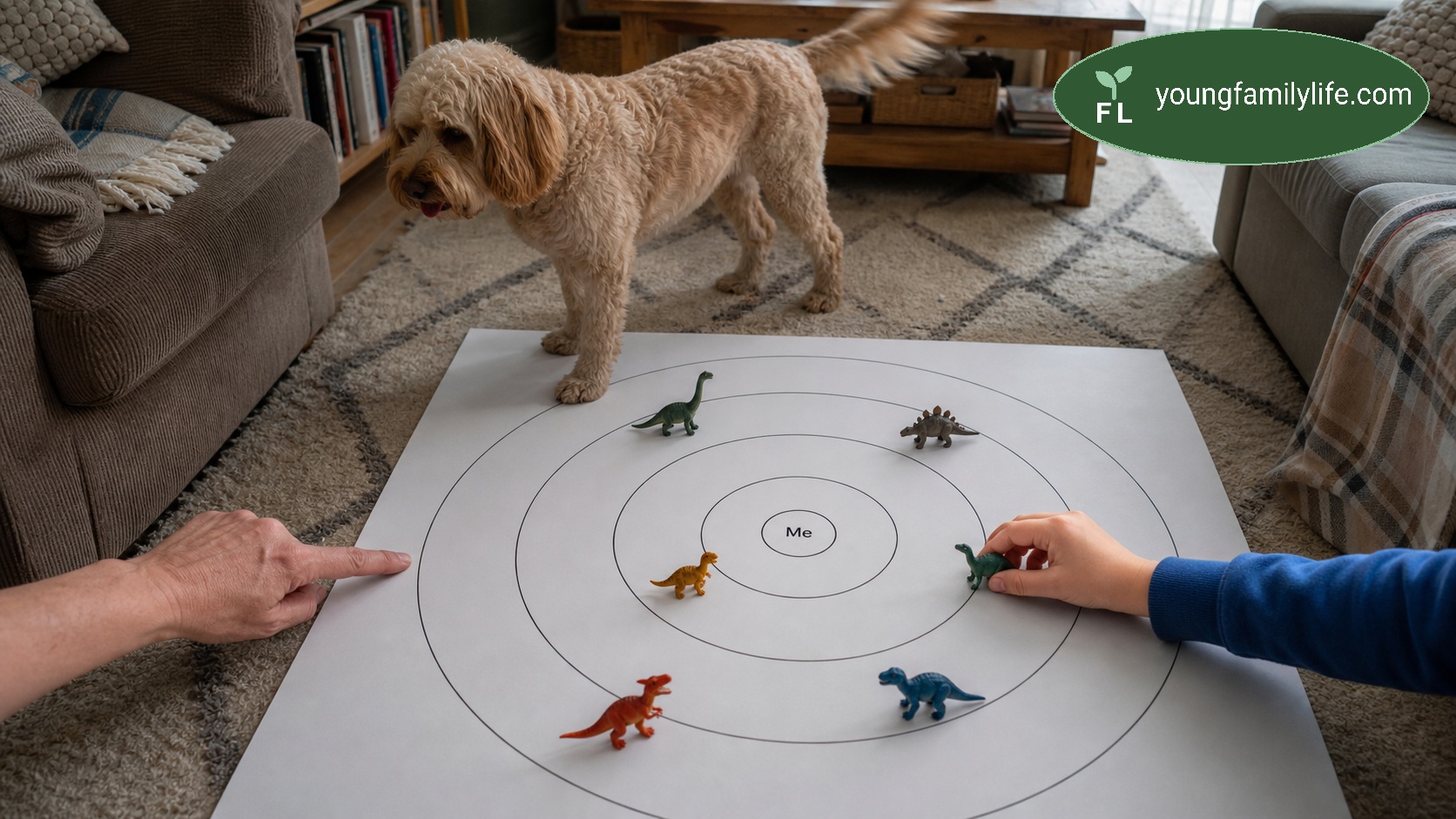
None of this requires a pen, a printed template, or a table between practitioner and client. Ecomaps, genograms, and related tools are routinely adapted by practitioners into something closer to play than paperwork — small figures, toys, or objects placed on a physical surface rather than circles drawn on a page. This adaptation has real clinical roots: it draws on the same tradition as Margaret Lowenfeld's "World Technique," developed in London from the late 1920s, in which children used miniature figures and a sand tray to externalise experience they couldn't put into words (Lowenfeld, 1939). A child can be given a set of toy animals or characters and asked to place them around a simple bullseye pattern — a central circle for themselves, then rings moving outward — choosing which figure represents which person in their life, and where they belong. The clinical structure is unchanged. What changes is the register: a task, not a test.
This matters for exactly the reasons already discussed. A young child, or an anxious adult, will often engage far more openly with objects to move and arrange than with a direct conversation or a form to complete. The physical act of placing a toy dinosaur close to the centre, then hesitating over a second one and pushing it further out, carries the same naive, revealing logic as a hand-drawn line — and often surfaces it faster, because moving a small object feels like play rather than disclosure. The practitioner's job is unchanged too: watch what gets placed where, and then, gently, ask about it.
The same adaptation extends to genograms. Family trees can be built with photographs, drawings, or physical tokens rather than symbols on paper, particularly with children or with family members who find an abstract diagram hard to relate to. What stays constant across every version, clinical or playful, is the principle already set out above: the tool is there to open a conversation, not to close one down with an accurate-looking record. A toy on a tabletop and a pencil line on a template are doing the same work.
Closing
An ecomap or a genogram, done well, isn't a record of a family as it stands. It's an invitation to notice the gap between where influence is assumed to live and where it actually lives — and to stay curious enough, on both sides of the table, to ask why the two don't match.
References
Anna Freud. Resources and research for children, young people, and families. Anna Freud, London. (Charity registration no. 1077106; resource, not a specific publication cited above.)
Bronfenbrenner, U. (1979). The Ecology of Human Development: Experiments by Nature and Design. Harvard University Press.
Butler, J. F. (2008). The Family Diagram and Genogram: Comparisons and Contrasts. The American Journal of Family Therapy, 36(3), 169–180.
Guerin, P. J., & Fogarty, T. F. (1972). The Family Therapist's Own Family. In Georgetown Family Symposium, Vol. 1.
Hartman, A. (1978). Diagrammatic assessment of family relationships. Social Casework, 59(8), 465–476.
Lowenfeld, M. (1939). The world pictures of children: A method of recording and studying them. British Journal of Medical Psychology, 18, 65–101.
McGoldrick, M., Gerson, R., & Petry, S. (2008). Genograms: Assessment and Intervention (3rd ed.). W. W. Norton & Company.
Vélez-Agosto, N. M., Soto-Crespo, J. G., Vizcarrondo-Oppenheimer, M., Vega-Molina, S., & García Coll, C. (2017). Bronfenbrenner's bioecological theory revision: Moving culture from the macro into the micro. Perspectives on Psychological Science, 12(5), 900–910.
Topics: #Ecomap #Genogram #FamilyAssessment #SocialWorkPractice #AntiOppressivePractice #SystemsThinking #ReflectivePractice