What the canteen actually was
The staff canteen meant different things to different people. Some ate there every day and valued the food. Others went for the company and endured whatever was on offer. A few avoided it entirely. But for those who were there, something happened in that room that rarely happens in a performance review, a town hall, or a Teams call.
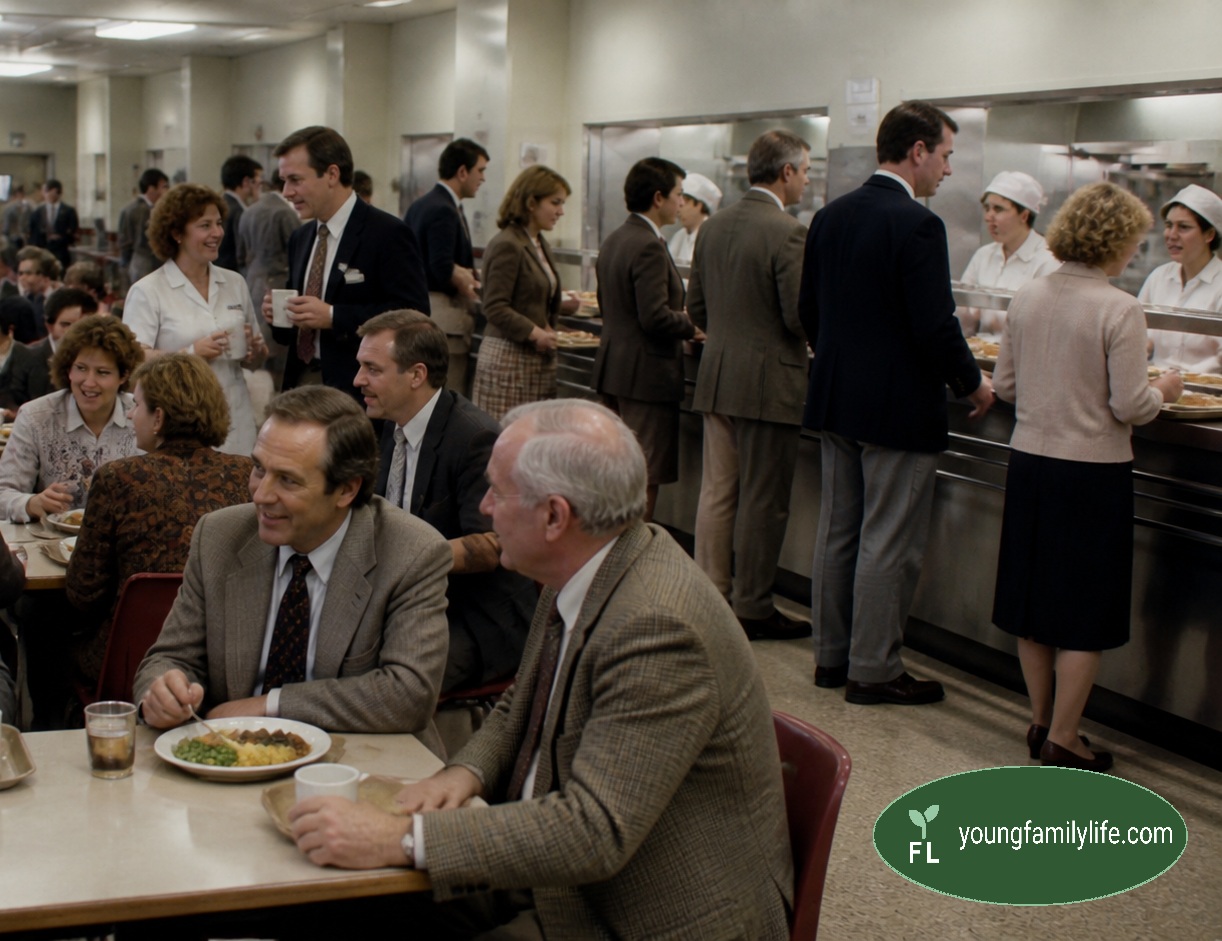
For most of the twentieth century, large British employers — factories, hospitals, councils, government offices — ran a canteen where staff could get a hot meal at lunchtime. It was usually subsidised, meaning the employer picked up some of the cost. It was one room, one queue, the same mug of tea for everyone. And for about an hour a day, it quietly did something that no management training course had yet thought to put a name to: it created the conditions for people at every level of the organisation to encounter each other without an agenda, a hierarchy, or a reason to perform.
That room is almost gone now. In 1995, more than four in five UK workplaces had a staff canteen. By 2015, fewer than half did. The decline has continued since. Where canteens survive, many have been handed over to commercial contractors — the subsidised lunch replaced by the franchise coffee shop or the vending machine.
The full essay behind this piece examines what the research says about that loss in depth. This version covers the same ground in plainer language.
Tools down
The canteen was a tools-down space by default, not by rule. Workers left their machines, their desks, their typewriters, and their telephone switchboards behind because those things could not travel. The break was total. No half-working, no emails checked under the table, no screen glanced at between mouthfuls. The encounter that followed was unencumbered in a way that has become genuinely rare.
This is not straightforwardly a loss in the modern workplace. The employee who takes a laptop to a coffee shop corner table, away from the open-plan floor, can sometimes concentrate on a report more effectively than at their own desk. A change of setting and a caffeine boost serve real purposes. The technology that made work portable has made focus portable too, and that is a real gain for certain kinds of task.
But the two things are not the same. The laptop in the coffee shop is primarily a productivity tool — a deliberate change of environment to help concentrate on a specific piece of work. The person who takes a report there is not looking for connection; they are looking for focus, and the coffee shop delivers it well. That is a different purpose entirely from what the canteen offered. The canteen was not a place to concentrate. It was a place to stop — and in stopping, to encounter other people without any task in view.
The presence of the screen also quietly restores the hierarchy that the canteen suspended. Visible work signals visible commitment; the person with a laptop is demonstrably productive in a way that the person simply eating is not. The markers of status and ambition that the canteen queue briefly made impossible to display come back in through the door of the coffee shop. The canteen, by having nothing to display, allowed people to stop displaying.
Everyone got the same tea
One of the things the canteen did was remove signals of status. Outside the canteen, it was usually obvious who was in charge. Job titles, office locations, who sat in on which meetings — these things marked out the hierarchy clearly enough. But in the canteen queue, the finance director picked up the same tray as the person from the post room. The sugar bowl was the same for both of them, and the teaspoon options were equally limited.
This sounds trivial. It was not. When the visible markers of status are stripped away — not by policy, but by the simple fact that everyone gets the same thing — conversations happen that would not happen otherwise. A junior employee ends up sitting opposite someone three grades above them, with nothing to signal that the difference matters right now. A senior manager is not performing authority. Both of them are just eating.
Glass ceilings in workplaces are real, and the canteen did not remove them. The structural barriers that stopped certain people from being promoted were built into pay scales and panel decisions, not lunchtime seating plans. But the canteen was one of the few places where a worker who would never be invited into a formal meeting with senior leadership might sit opposite that leadership anyway. That encounter did not guarantee anything. It created a possibility that did not exist elsewhere in the working day.
Modern workplaces are, by contrast, very readable. The branded coffee cup from the new coffee bar, the artisan lunch, the well-timed comment on the Director's LinkedIn post — these are signals of aspiration and professional identity, and there is nothing wrong with them. People have always found ways to be noticed by those with the power to advance them. The canteen had its own version: the ambitious worker who made a point of sitting near the gaffer, steering the conversation, being remembered. Brown-nosing, as a practice, is entirely timeless.
What changed is not the game but what the game costs management. The ambitious employee who engineered a canteen conversation with their line manager still told that manager something real — about the mood on the floor, about a problem brewing, about what the team was finding difficult. The information might have been angled, but it was grounded in operational reality. The well-crafted LinkedIn comment tells leadership nothing except that the commenter is paying attention to their feed. The channel changed. The listening opportunity went with it.
The conversations that moved the information
Research from MIT's Human Dynamics Laboratory has been tracking what actually makes organisations work well. The finding that keeps coming up is not about formal meetings, structured feedback, or performance management frameworks. It is about unstructured, face-to-face conversation. The kind that happens without being scheduled.
In one study of a bank call centre, researchers found that simply changing coffee break times so that more staff overlapped with each other — without changing anything else — produced a significant improvement in productivity and team performance. The informal contact did something the formal systems were not doing.
The canteen was a natural generator of exactly this kind of contact. Mixed groups of people from different parts of the organisation sat together regularly, with no agenda and no output required. Information moved. Patterns were named. Difficulties that had not yet reached any official channel surfaced in conversation. The person who knew something useful happened to be sitting next to someone who needed to know it.
Research on firefighter teams at Cornell University found that the platoons who regularly ate meals together performed better as teams than those who did not. The study's author noted that eating together is a more intimate act than reviewing a spreadsheet together — and that the intimacy carries back into the work. When firefighters were embarrassed about not sharing meals in their station, that embarrassment was found to signal something deeper was wrong with how the team was functioning.
Walking the floor
The research on informal contact points consistently in the same direction. The canteen generated it structurally, across different levels of an organisation, every working day. It had a management counterpart that served the same underlying purpose — and disappeared for much the same reasons.
The canteen had a management counterpart. In the 1980s, researchers studying the most successful companies in the United States noticed that the managers in those companies did not typically stay in their offices. They moved around. They had informal conversations. They were visible to their staff not just as a name on a memo but as a real presence in the building.
This was given the name Management by Walking the Floor. The idea was straightforward: a manager who moves through the workplace, talks to people without a set agenda, and listens to what is actually happening on the ground is better informed and more effective than one who relies entirely on reports and meetings. The simple act of being present — and being seen to be present — changes what information reaches leadership, and what leadership knows about how the organisation is actually functioning.
Walking the floor and the staff canteen served different purposes, but they operated as a pair. The canteen gave staff and management a neutral space to encounter each other without it feeling like a visit or an inspection. The floor walk gave management a way to be in the building without requiring a meeting to justify the presence. Between them, they created conditions for organic communication — the kind that happens naturally rather than being engineered.
Walking the floor became a named practice because it had become unusual enough to need a name. When it was simply what managers did, nobody called it a methodology.
There is a further cost that is easy to miss. When managers stop walking the floor and the canteen disappears, organisations lose more than social contact. They lose the informal corrective mechanism that kept leadership's picture of the organisation accurate and current. A manager who only receives information through reports and formal meetings is still experienced — but their experience is no longer being updated by the small daily corrections that informal contact provides. They know what they knew. They may not know what has changed.
The result is a kind of structural blind spot: not arrogance of character, but a gap created by architecture. Problems that once surfaced early in a casual lunchtime conversation reach the formal layer later, and bigger. Solutions that a long-serving colleague might have offered over lunch never get offered at all, because there is no longer a lunch to offer them over. The organisation does not know what it does not know. And that, more than almost anything else the canteen's closure cost, is the hardest thing to recover.
What twelve years in the job actually knows
The canteen was also a place where institutional memory circulated. Large organisations accumulate knowledge over time — knowledge that is not written down anywhere, because it lives in people. The long-serving employee knows why a particular procedure was introduced, not just what the procedure says. They know which problems recur every autumn, which colleagues rise to a crisis and which quietly step back from one, which suppliers are reliable and which always disappoint. This is not information that appears in any document. It is held in a person.
That knowledge moved through the canteen. A newer employee who sat with someone who had been at the organisation for twenty years absorbed things that no induction programme would have covered. Context. Proportion. The kind of pattern recognition that only time in a place can develop. The long-server, in turn, was kept current by knowing who the new people were and what they were finding difficult. The exchange was mutual and informal, and it kept the organisation's collective knowledge distributed rather than locked inside any single individual.
When it worked well, this created a kind of lubricant in the organisation's machinery. A colleague struggling with a process difficulty could be guided around it quietly by someone who had seen the same difficulty before. A situation that looked like a crisis to a newer manager could be placed in context by a peer who had watched the same pattern resolve itself two years earlier. None of this required a meeting. Much of it required a conversation over lunch.
Replacing a member of staff is expensive. Estimates for the average cost of recruitment in the UK run to several thousand pounds a hire, before counting the depletion of informal knowledge that leaves with every departure. The canteen was one of the places where that knowledge was shared widely enough to survive individual departures. When the person who knew something left, others retained it, because it had been passed on across a hundred lunchtimes.
Staying in one organisation for a long time has fallen somewhat from fashion. The dominant idea about career development is that movement signals ambition, and that depth in one place can look like stagnation. But the long-serving employee holds something that cannot be recruited in. The canteen was one of the spaces where that value was visible and practically useful — where what twelve years in the job actually knows was in daily circulation.
Why the canteen closed — and what that cost
In the private sector, the canteen closed mainly because of cost. It was an overhead that could be removed, pushing the expense of lunch onto the employee and the high street. In the public sector, the reasoning was different, and worth understanding.
Large public bodies — councils, NHS trusts, government departments — operate under constant scrutiny. Every pound spent is, in principle, answerable to the public. A subsidised canteen is visible. It is, technically, a benefit: the employer contributing toward an employee's meal. In a political and media environment that frames public sector spending sharply, a subsidised lunch can quickly become a story about civil servants getting a free ride at the taxpayer's expense.
The difficulty is that this framing is not answerable by evidence. Even if a well-managed public body could demonstrate that its canteen generated real value in staff retention, team cohesion, and organisational performance, the moment that evidence was deployed in defence of the canteen, the story became the subsidy rather than the return on it. The critique was a moral one, and moral framings generally win against economic arguments because they do not require the same standard of proof.
So the canteen closed. Not everywhere, and not all at once. But the direction was clear and consistent. And almost nobody counted what left with it.
This is not a claim that the canteen era was a golden age. It was also the era of the 1970s, when industrial action crippled the nationalised industries and workplace relations were deeply adversarial. Eating together in the same room does not resolve a structural dispute about pay or conditions. The canteen was never a substitute for fair employment. It was a mechanism for informal contact that worked when the other elements of a working relationship were also functioning. When they were not, it made no difference.
What the research points toward is something more specific: that informal, face-to-face contact in workplaces has measurable effects on team performance, information flow, and the kind of trust that makes organisations function. The canteen was a structural mechanism for generating that contact, across different levels of the organisation, daily and for free. Its replacement — the individual meal deal, the franchise coffee shop, the hybrid working day — does not generate the same contact. And the formal substitutes that organisations now spend money on — engagement surveys, away days, wellbeing programmes — are attempts to recover, expensively and with mixed results, something that once happened naturally over a subsidised plate of chips.
The canteen was, in its unlovely way, cheap infrastructure. The queue was unglamorous. The tea was often over-brewed. But what circulated in that room — information, familiarity, the occasional career conversation over a plate of chips — kept organisations connected to themselves in ways that no engagement survey has yet managed to replicate. The bill for its absence keeps arriving. It just never gets itemised.
Topics: #InOtherWords #StaffCanteen #WorkplaceWellbeing #OrganisationalCulture #InformalCommunication #ManagementByWalkingTheFloor #SocialInfrastructure #EmployeeEngagement #PublicSector #InstitutionalMemory #WorkplaceProductivity #YoungFamilyLife
Related YFL Content
The Feedback Paradox: When Asking Signals Not Listening — Explores how formal feedback requests often signal that an organisation has stopped listening through informal channels — the same channels the canteen once kept open.
Humility Check-in Card — The framework behind the structural blind spot argument: what happens when experience becomes closed off, and why organisations — like individuals — can be confidently wrong without knowing it.
Living in a Fabricated World — On how professional groups develop shared narratives that can drift from operational reality — a risk that reduces when informal cross-hierarchy contact is strong.
Executive Mobs: The Whirlpool of Professional Groupthink — Examines what happens when professional groups become sealed off from challenge — a dynamic that informal contact across hierarchies can slow or disrupt.
Browse All Essays — The full YoungFamilyLife content library across all four streams.
Copyright Notice
© 2026 Steve Young and YoungFamilyLife Ltd. All rights reserved.
All original content on YoungFamilyLife — including essays, articles, frameworks, and other written material — is the intellectual property of Steve Young and YoungFamilyLife Ltd, unless credited to another source. Content is developed collaboratively using AI assistance to research sources and refine structure, while all intellectual authorship, original insight, and professional expertise remain those of the author.
No part of this website may be reproduced, distributed, or transmitted in any form without prior written permission, except brief quotations for noncommercial use.
For permission requests, contact: info@youngfamilylife.com