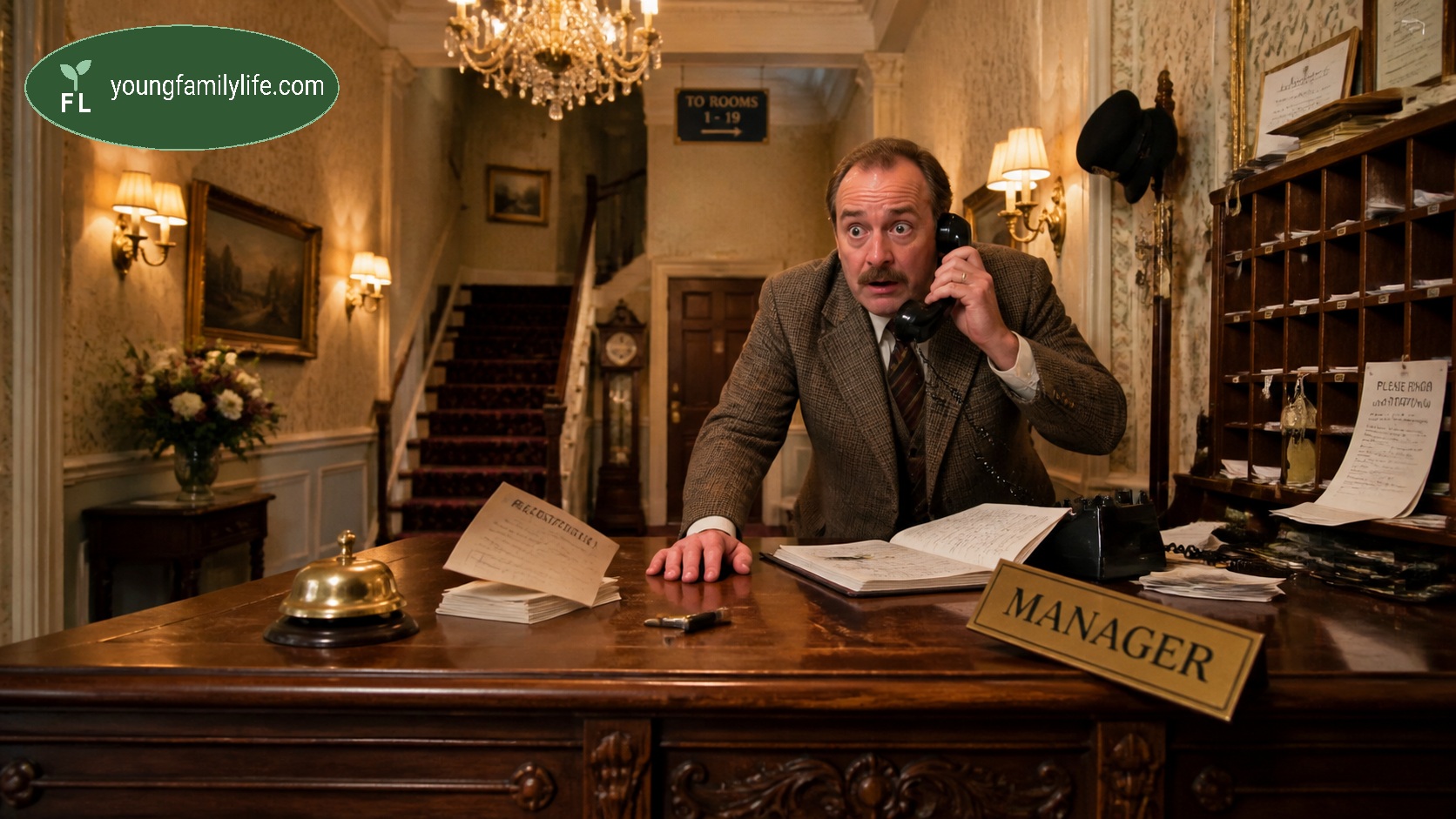
Every century seems to need its own version of this story: someone convinced of how important they are, standing on a roof, or a stage, or a hotel reception desk — just before the gap between what they believe and what's actually true becomes obvious to everyone except them. It's one of the oldest plots there is, and it's never gone out of fashion. Most people meet a gentler version of it first, as children — on a wall, in a desert canyon, or inside a toy who's sure he's a real space ranger. The companion piece on what the phrase actually looks like covers that. This is the same shape, grown up, wearing much more expensive clothes.
The rooftop
In the Book of Daniel, King Nebuchadnezzar walks the roof of his Babylon palace and says out loud, to no one: "Is this not Babylon the Great that I have built?" He isn't wrong about the achievement — he really did build the city. He's wrong about what it means, and the story doesn't let him get away with the mistake. He's struck by a strange kind of madness — losing his mind, living like an animal — until, seven years later, he looks up and it lifts. The Quran's version of the Pharaoh makes almost the same claim, in almost the same pose: "I am your Lord, the Most High." Two very different religious traditions, telling almost the same story about a ruler who mistook what he'd built for what he was.
The same story, told again
Geoffrey Chaucer knew a good example when he saw one. In The Monk's Tale, written in the 1370s, the Monk tells seventeen short tragedies — Lucifer, Alexander, Julius Caesar, Croesus — all falling from the same wheel of fortune. Nebuchadnezzar is one of them, his exact rooftop story told again, nearly two thousand years after Daniel first told it. Chaucer isn't inventing a new story here. He's doing what every century does: picking up the old stories and telling them again, because they still work.
The trap
Shakespeare's Twelfth Night does something crueller with the same idea. Malvolio, the household steward, doesn't just fall into grandiosity — he's pushed into it. Someone forges a letter and leaves it where he'll find it. It convinces him his employer, Olivia, is secretly in love with him, and that he's about to be raised far above his station. He reads it and believes every word: yellow stockings, crossed garters, dreams of running the whole household. The famous line from the play — "some are born great, some achieve greatness, and some have greatness thrust upon 'em" — isn't wisdom. It's Malvolio reading his own trap out loud, completely convinced. The comedy is the gap between what he believes and what the audience can see. The uncomfortable bit, which good productions don't hide, is that the whole household set the trap on purpose, for entertainment, at his expense.
The farce
By the time this idea reaches Basil Fawlty, three and a half centuries later, it's lost its gods and its wheel of fortune, and become almost entirely about class. Basil invents connections he doesn't have. He's rude to guests he thinks are beneath him. He grovels to anyone he suspects is above him. The whole engine of the comedy is the same gap Malvolio had, played purely for laughs, with nothing at stake but a small hotel's reputation and Basil's own dignity — which he loses in every single episode anyway. The audience never doubts what they're watching: a man completely convinced of a status he doesn't have, brought down by that exact belief, episode after episode.
These four stories don't get there the same way. Nebuchadnezzar's belief is entirely his own, coming from nothing but the view from his own roof. Malvolio's is planted by other people, on purpose, for fun — real to him once it takes hold, but planted rather than grown. What doesn't change across any of them is what the audience is watching: someone convinced of more than reality supports, heading somewhere the audience can see coming and the character can't.
What's actually happening in your brain
There's a real, measurable reason behind all four of these stories, and it has a name: schadenfreude — enjoying someone else's misfortune. It isn't just a figure of speech for something vaguely satisfying. Brain scans show it happens in two clear stages, and the order matters.
The first stage is envy, and envy actually feels bad. Watching Nebuchadnezzar on his roof, or Malvolio in his yellow stockings, or Basil inventing himself a title, lights up the same part of the brain that responds to physical pain. Someone else's inflated status — even a made-up one — feels uncomfortable before the story has done anything else to you. The second stage is the payoff. When the fall comes — the madness, the unmasking, the guest who sees straight through him — the brain switches to its main reward centre, the same area that lights up for food, money, or any other win. "Comeuppance" is just the everyday English word for the same thing your brain is doing the science on.
None of this is only something you're born with, either. Nursery rhymes were doing something similar long before cartoons existed. Adults have recited Humpty Dumpty to children for generations — someone who sat somewhere too high, and fell somewhere nobody could fix. Nobody explains the lesson when they say it. Nobody needs to. It rides along inside the rhyme itself, repeated so often it barely needs anyone paying attention for it to sink in. And reciting it isn't only something done to a child. Saying the words back, generation after generation, is also a small, private reminder to the adult doing the reciting — of exactly the same lesson about reaching above your station.
Cartoons picked up the same job. They don't just show a fall — they teach you the correct reaction to one. When Wile E. Coyote's plan blows up in his face, there's a sting of music, a beat of silence, and the whole scene is built to make you laugh, not wince. When Basil Fawlty's lies collapse in front of a guest, the camera holds on the guest's raised eyebrows just as long as it holds on Basil. Children don't just learn to spot a big claim heading for a fall, the way the companion piece on delusions of grandeur describes. They're shown, over and over, exactly how to react to it — that laughing at the pompous once they've fallen isn't unkind, it's just what happens next. By the time anyone needs the actual brain science to explain why watching someone get their comeuppance feels so satisfying, most people have already had years of practice doing precisely that, on a coyote, a steward, and a hotel manager, with the laughing modelled for them the whole time.
This fits an older idea about status itself: a system, built into every social animal, for constantly checking where everyone stands compared to everyone else. Someone claiming status they haven't earned looks to that system like a kind of cheat — a threat to the whole pecking order everyone else relies on. The fall doesn't just end the story. It fixes the mistake. That's very possibly the real reason four completely separate traditions, across two and a half thousand years, all landed on the same shape: a brain built to notice unearned status as uncomfortable, and rewarded, every single time, for watching it get put right.
Topics: #InOtherWords #WhyDelusionsOfGrandeur #Schadenfreude #Grandiosity #Comeuppance #YoungFamilyLife
Related YFL Content
Why Delusions of Grandeur? — of all things? — the full Independent Enquiry essay this piece is drawn from.
In Other Words: What “Delusions of Grandeur” Actually Looks Like — the companion piece on the clinical test that separates confidence, megalomania, and the real thing.
When the Cat Rules the Dog: Psychology of Confidence in Social Groups — the same animal, put to a different use: earned, authentic self-possession rather than a flattering misreading.
Narcissist, Misogynist, Misandrist: Positions, Not Pathologies — a companion account of the same developmental starting point.